Algeria
 Egypt
 Libya
 Morocco
 Sudan
 Tunisia
 Benin
 Burkina Faso
 Cabo Verde
 Côte d'Ivoire
 Ghana
 Guinea
 Guinea-Bissau
 Liberia
 Mali
 Mauritania
 Niger
 Nigeria
 Sierra Leone
 The Gambia
 Togo
 Cameroon
 Central African Republic
 Chad
 DR Congo
 Equatorial Guinea
 Gabon
 Republic of the Congo
 São Tomé and Príncipe
 Burundi
 Comoros
 Djibouti
 Eritrea
 Ethiopia
 Kenya
 Madagascar
 Malawi
 Mauritius
 Mozambique
 Rwanda
 Seychelles
 Somalia
 South Sudan
 Tanzania
 Uganda
 Angola
 Botswana
 Eswatini
 Lesotho
 Namibia
 South Africa
 Zambia
 Zimbabwe
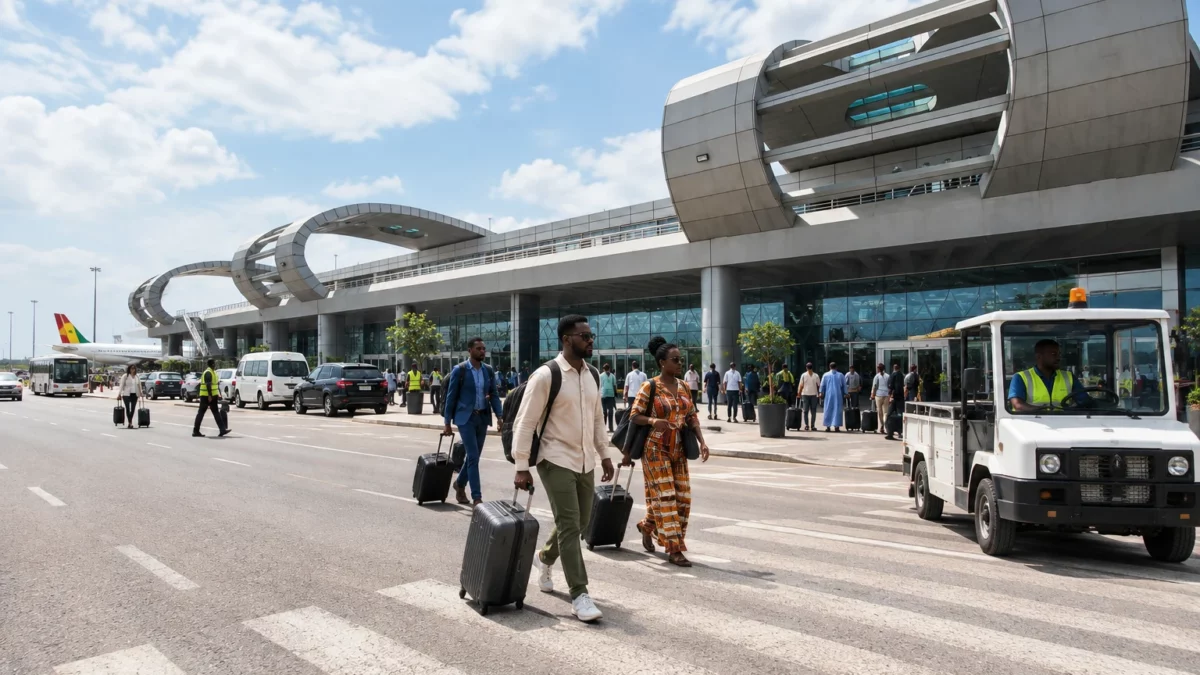
An airport can expand its terminals without serving passengers more efficiently. At Diass, the next challenge is to ensure that the same information reaches teams, airlines and ground services at the right time. That is the aim of a digital programme announced for Blaise Diagne International Airport (AIBD), located about 47 kilometres from Dakar.
A platform expected to handle more traffic
AIBD is Senegal’s main air gateway. It accounts for more than 90% of the country’s air traffic, according to information published by the partners financing its expansion. Its performance therefore matters to passengers, as well as to freight, airlines and the economic activities linked to travel.
The project is part of a regional ambition: to strengthen the Senegalese airport’s position in West African connections. This ambition comes as the continent’s aviation infrastructure seeks to better connect capital cities and capture a larger share of regional travel.
In 2024, AIBD SA, the public company representing the Senegalese state in the airport operator, secured €300 million in financing to develop the platform. The programme notably provides for a 40% increase in annual passenger-handling capacity, with a target of more than five million by 2035, as well as a freight terminal and work at regional airports. These details are reported by the project’s financial partners and the French Treasury. Details of AIBD’s financing and capacity targets have also been published by Mauritius Commercial Bank.
Six tools to coordinate operations
LAS Dakar Aéroport, the company responsible for operating the airport, has selected TAV Technologies to implement six digital systems. The announcement, published on 11 November 2026, describes a suite intended to link flight management, resource allocation and passenger information.
The tools include a Flight Management System (FMS), a Resource Management System (RMS) and a Flight Information Display System (FIDS). The package also includes A-CDM, a collaborative decision-making mechanism that enables stakeholders to exchange operational data, as well as systems designated TDAS and a data integration platform, or IB.
In practical terms, these solutions are intended to help different services share a common view of flights and available resources. Up-to-date information on schedules, boarding gates or ground resources can make it easier to organise work and communicate with passengers. However, the announcement specifies neither the deployment timetable nor the investment amount or the indicators that will be used to assess the results.
AIBD is operated by Limak-AIBD-Summa, known as LAS. AIBD SA owns 34% of the company, alongside Turkish firms Limak and Summa, which each hold 33%, according to the public company’s profile. This governance structure therefore brings the Senegalese state together with private partners in operating the infrastructure. The airport operator’s structure and shareholding are detailed by AIBD SA.
Digital systems cannot replace management reform
The technical modernisation comes at a time when Senegalese authorities are also seeking to turn around and reposition Air Sénégal and AIBD SA. On 18 March 2026, the Council of Ministers reported the government’s intention to support both entities. In April, an ad hoc committee was tasked with continuing their restructuring work, according to reports carried by several Senegalese media outlets.
These initiatives are distinct. IT systems primarily concern the day-to-day coordination of the airport; restructuring concerns the organisation and financial position of the companies. But they meet on one point: expanding an airport does not, by itself, guarantee smoother operations or sustainable financial management.
The benefits will therefore depend on how the tools are integrated into working procedures and adopted by teams. A shared dashboard will not automatically improve punctuality if data are incomplete, services do not update them or responsibilities remain poorly defined. The passenger experience will also need to be monitored: the quality of information, the handling of changes and the management of peak periods.
The impact will not be the same for everyone. Airlines and ground teams may benefit from greater visibility over operations. Passengers, meanwhile, will judge the tangible outcome: consistent information, a clearer journey and less uncertainty in the event of delays. Coordination may also matter to freight operations and businesses that depend on air transport, provided the new systems effectively meet their needs.
A test for the West African hub ambition
Senegal wants to make Diass a major connecting point in West Africa. That ambition will be measured as much by physical capacity as by the quality of connections, operational reliability and links with the country’s other airports. The digital programme is one part of this strategy, not proof that the goal has already been achieved.
At regional level, the stakes go beyond comfort in a terminal. Better-coordinated operations can support connections between West African cities and facilitate freight transport. But the impact of the investment will also depend on factors beyond the software: airline services, ticket prices, land connections and the ability of neighbouring airports to work in compatible networks.
The next step, then, will be less about announcing new tools than publishing their commissioning timetable and verifiable results. For Dakar and the people of Senegal, the test will be simple: digital transformation must translate into day-to-day operations. For West Africa, AIBD’s experience will show how an airport can combine infrastructure expansion, stakeholder coordination and management accountability.