Algeria
 Egypt
 Libya
 Morocco
 Sudan
 Tunisia
 Benin
 Burkina Faso
 Cabo Verde
 Côte d'Ivoire
 Ghana
 Guinea
 Guinea-Bissau
 Liberia
 Mali
 Mauritania
 Niger
 Nigeria
 Sierra Leone
 The Gambia
 Togo
 Cameroon
 Central African Republic
 Chad
 DR Congo
 Equatorial Guinea
 Gabon
 Republic of the Congo
 São Tomé and Príncipe
 Burundi
 Comoros
 Djibouti
 Eritrea
 Ethiopia
 Kenya
 Madagascar
 Malawi
 Mauritius
 Mozambique
 Rwanda
 Seychelles
 Somalia
 South Sudan
 Tanzania
 Uganda
 Angola
 Botswana
 Eswatini
 Lesotho
 Namibia
 South Africa
 Zambia
 Zimbabwe
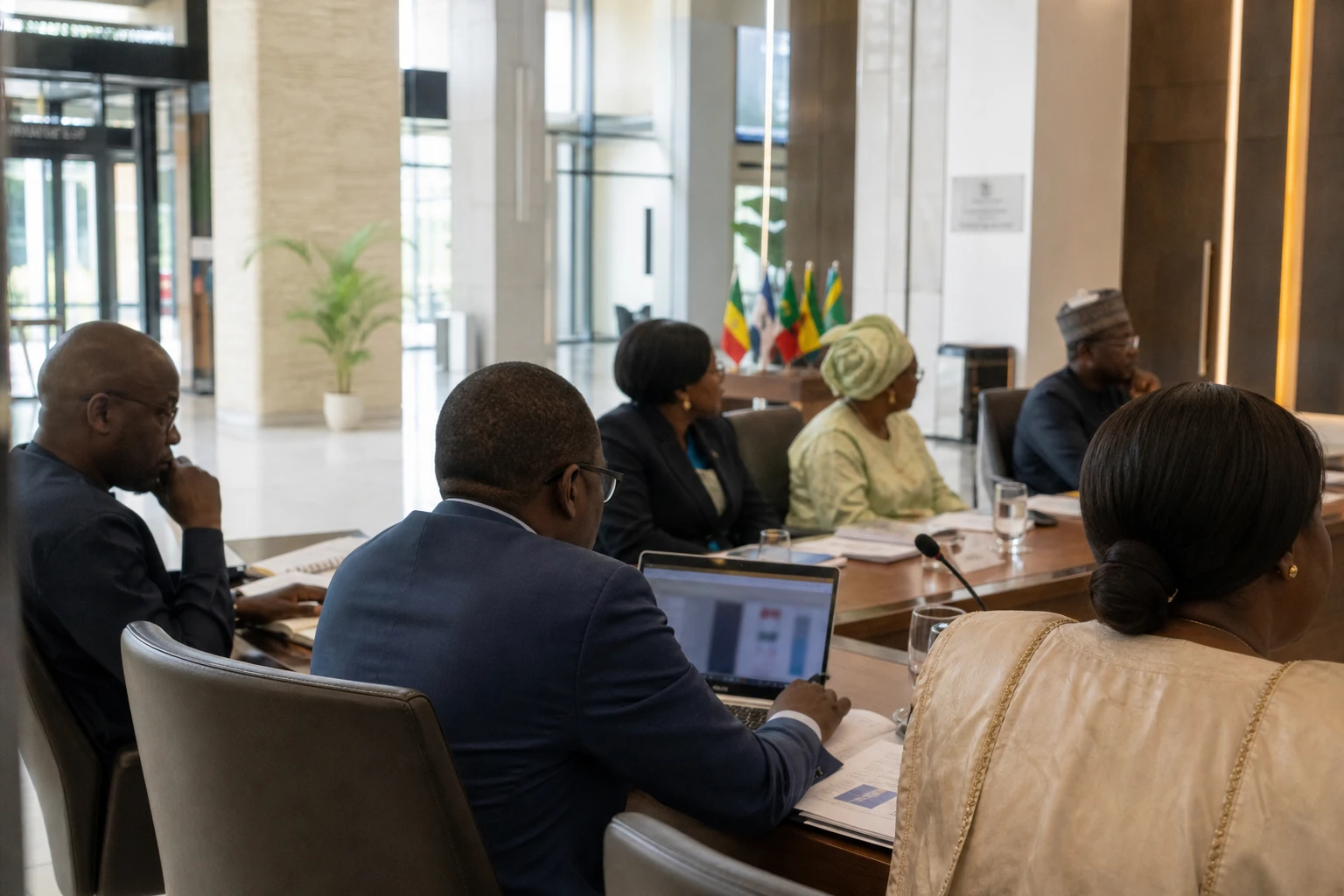
In Dakar, the question is no longer simply how to fund public spending. The challenge is now to reorganise the repayment timetable without undermining Senegal’s economy, social services and regional financing.
First meeting to establish the scope of the debt
On Tuesday 6 October 2026, Senegalese authorities are bringing together their external creditors for a virtual meeting held under the auspices of the International Monetary Fund (IMF). The meeting is due to begin at 12:00 GMT.
The meeting is being presented as an information and dialogue session. No financial agreement is to be concluded at this stage. Nor is it a moratorium, an IMF disbursement or a general suspension of payments.
The Senegalese government is due to set out the country’s economic and financial situation, its reform programme and its debt strategy. The IMF will take part in the discussions, while stressing that final negotiations will be a matter for the Senegalese authorities and their creditors.
The IMF confirms the meeting will take place on 6 October 2026. The institution says its role is primarily to facilitate information-sharing and dialogue between Dakar and its creditors.
This first step should also make it possible to identify the lenders involved precisely. Bilateral creditors are relatively well known. China is among the largest, ahead of France, India, Kuwait, Germany and Japan. However, the exact composition of the debt held by commercial banks and private investors still needs to be clarified.
Senegal is mainly seeking to ease its repayment schedule
The Senegalese government wants to bring its external debt treatment within the G20 Common Framework. This mechanism aims to co-ordinate public creditors and, under certain conditions, involve private creditors in discussions on debt sustainability.
Several options can be considered. These include extending maturities, meaning allowing more time before principal is repaid, lowering interest rates or changing repayment dates. In the most difficult situations, a temporary suspension or a reduction in the debt can also be discussed.
For now, Dakar appears to favour reprofiling. This means spreading repayments over time to reduce immediate pressure on the budget. It would limit cash outflows without, at this stage, seeking direct cancellation of the claims.
There is no guarantee, however, that simply extending repayment dates will be enough. The response will depend on the amount actually owed, the cost of interest, expected growth and the state’s ability to generate sustainable revenue.
Senegal’s Ministry of Economy, Finance and Planning has already announced the launch of a Debt Treatment Plan for Senegal. In its official presentation, it refers to high public debt, a deterioration in the country’s risk profile and more difficult access to international markets.
The same document says the budget deficit fell from 13.4% of gross domestic product in 2024 to 6.4% in 2025. This is a significant improvement, but it does not eliminate financing needs or the burden of accumulated repayments.
A debt issue that goes beyond dealings with lenders
Senegal’s budget trajectory was substantially reassessed following an audit of public finances. The revision changed perceptions of the level of indebtedness and increased pressure on the authorities, who now have to restore lenders’ confidence while protecting economic activity.
For the country’s leaders, there are two objectives. They must secure enough flexibility to fund national priorities, while also showing that the new budget rules will be applied. For households, the risk is an adjustment that would affect subsidies, public investment or social spending.
The effects will not be the same everywhere. In Dakar, where the administration, banks and a large part of the formal economy are concentrated, the impact may first be felt through credit and investment. In the regions, it may be felt more through public transfers, infrastructure, agricultural programmes and spending for local authorities.
The regional private sector is also affected. A poorly co-ordinated restructuring could make financing more expensive for Senegalese companies. It could also affect perceptions of risk in the West African Economic and Monetary Union (WAEMU), the area that shares the CFA franc and a common financial market.
The government is therefore seeking to distinguish the external debt covered by the process from financing raised on the regional market. Senegal’s finance ministry has stressed the importance of this market to funding the state and the WAEMU economy.
Co-ordination will be the next test
The 6 October meeting will not resolve the debt crisis. Its first task is to establish a common basis: which creditors are involved, what amounts should be included and which obligations could fall within the proposed treatment.
The issue of comparability of treatment will be central. This principle means that a creditor should not receive significantly more favourable terms than others when a country is seeking a co-ordinated effort. It will be particularly sensitive if private bondholders or commercial banks take part in the discussions.
Senegal will also have to continue making payments during the negotiation period. In June 2026, the ministry reaffirmed its commitment to meeting its financial obligations and continuing dialogue with investors and technical partners.
In the short term, markets will therefore be watching three things: the composition of the future official creditors’ committee, the content of the reform programme and the timetable for debt treatment. The IMF has said it has not yet set a date for its executive board’s final review of Senegal’s programme.
Across West Africa, the case will be closely watched. Senegal remains one of WAEMU’s largest economies and an important player in the regional financial market. The way Dakar handles this next stage could influence financing conditions for other states in the region, although it will not automatically have the same effects on economies with different debt structures.