Algeria
 Egypt
 Libya
 Morocco
 Sudan
 Tunisia
 Benin
 Burkina Faso
 Cabo Verde
 Côte d'Ivoire
 Ghana
 Guinea
 Guinea-Bissau
 Liberia
 Mali
 Mauritania
 Niger
 Nigeria
 Sierra Leone
 The Gambia
 Togo
 Cameroon
 Central African Republic
 Chad
 DR Congo
 Equatorial Guinea
 Gabon
 Republic of the Congo
 São Tomé and Príncipe
 Burundi
 Comoros
 Djibouti
 Eritrea
 Ethiopia
 Kenya
 Madagascar
 Malawi
 Mauritius
 Mozambique
 Rwanda
 Seychelles
 Somalia
 South Sudan
 Tanzania
 Uganda
 Angola
 Botswana
 Eswatini
 Lesotho
 Namibia
 South Africa
 Zambia
 Zimbabwe
Dakar moves forward, but the real test starts now
In Dakar, the handover of a sports facility is about more than concrete, paint or stands. It is a political and logistical signal, just months before an event that puts Senegal at the heart of African Olympism. The country wants to prove it can host the first Youth Olympic Games on the continent in good conditions. They are scheduled to take place from 31 October to 13 November 2026.
The context gives a sense of what is at stake. Dakar 2026 is taking place in a unique setting: three host cities — Dakar, Diamniadio and Saly — and a programme of 35 sports, including 25 Olympic and 10 exhibition disciplines. Senegal is not just hosting a competition. It also wants to leave a useful legacy for school sport, community sport and urban infrastructure.
Two landmark venues handed over to the head of state
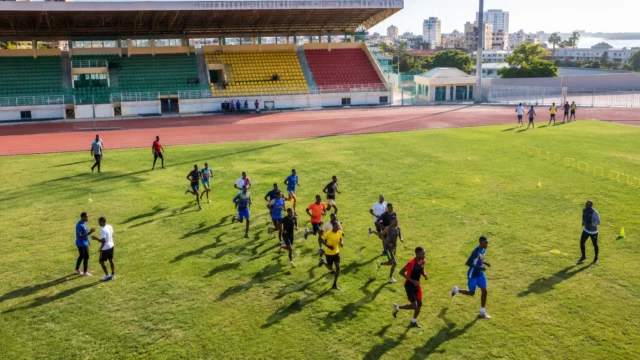
On Saturday 25 July 2026, President Bassirou Diomaye Faye received the renovated Iba Mar Diop Stadium and Dakar Olympic Swimming Pool. According to APS, he expressed his « complete satisfaction » after visiting the two construction sites, completed on schedule for the Dakar 2026 YOG. The head of state praised the teams’ rigour, the commitment of the companies involved and the technical support of partners such as the French Development Agency and the French government.
The handover follows several progress reviews. At the Council of Ministers meeting on 4 March 2026, the presidency had already stressed the progress of YOG-related works. Then, in June, the infrastructure minister said the works would be handed over by 31 July at the latest. Meanwhile, COJOJ general coordinator Ibrahima Wade was still assuring the public this week that competition venues would be delivered on time.
The schedule matters. In the period between the announcement and the handover, pressure on public teams, construction companies and decision-makers has been intense. The Iba Mar Diop Stadium and the Olympic Swimming Pool are not incidental venues. They are in the heart of the Senegalese capital, in busy areas where residents are also expecting tangible benefits in terms of access to sport, traffic and urban development.
A sports project, but also a test of governance
For the average Senegalese person, the stakes go beyond the handover ceremony. The YOG are testing the state’s ability to meet deadlines, coordinate its ministries and bring the public and private sectors together. President Faye himself made this point after the visit: satisfaction is not limited to taking delivery of infrastructure; it will depend on the success of all commitments, from the opening to the closing ceremony. In other words, completed buildings are not enough. The event will need smooth organisation, reliable transport, effective security and a credible experience for athletes and spectators alike.
The project also raises the question of legacy. In a country where participation in sport is often held back by a lack of accessible facilities, renovating major venues could benefit urban young people, federations and sports schools. That is, provided these places do not become mere showcases. The ambition expressed over recent months is clear: to make Senegal a hub for sports events after 2026. COJOJ officials have publicly championed this idea, seeing the YOG as a driver of jobs, training and experience in sports-related professions.
The issue also has a sporting diplomacy dimension. By taking delivery of the projects, Dakar is not speaking only to Senegalese people. The country is addressing the African Union, ECOWAS and the rest of the continent. The 2026 YOG will be the first-ever Olympic event held in Africa. This distinction gives Senegal a role in the spotlight, but also a collective responsibility: to show that major international competitions can be hosted on African soil to high standards, without relying on the usual venues in Europe or Asia.
What Dakar 2026 says about Africa’s current moment
Across the continent, Dakar 2026 comes at a time when several African capitals are seeking to strengthen their position in major sporting, cultural and economic circuits. But Senegal has a rare advantage here: a clear deadline, a powerful Olympic brand and a positive narrative built around youth, training and hospitality. The watchword is not a show of strength. It is the ability to organise, host and leave behind lasting assets.
The message sent on Saturday was therefore twofold. On the one hand, the state wants to show that work is progressing. On the other, it is making clear that handing over a stadium or swimming pool is only one step. The real test will come in October and November 2026. Senegal will then be judged on its logistics, hospitality, institutional coordination and ability to turn a major event into tangible benefits for Dakar, Diamniadio, Saly and, more broadly, Senegalese sport.