Algeria
 Egypt
 Libya
 Morocco
 Sudan
 Tunisia
 Benin
 Burkina Faso
 Cabo Verde
 Côte d'Ivoire
 Ghana
 Guinea
 Guinea-Bissau
 Liberia
 Mali
 Mauritania
 Niger
 Nigeria
 Sierra Leone
 The Gambia
 Togo
 Cameroon
 Central African Republic
 Chad
 DR Congo
 Equatorial Guinea
 Gabon
 Republic of the Congo
 São Tomé and Príncipe
 Burundi
 Comoros
 Djibouti
 Eritrea
 Ethiopia
 Kenya
 Madagascar
 Malawi
 Mauritius
 Mozambique
 Rwanda
 Seychelles
 Somalia
 South Sudan
 Tanzania
 Uganda
 Angola
 Botswana
 Eswatini
 Lesotho
 Namibia
 South Africa
 Zambia
 Zimbabwe
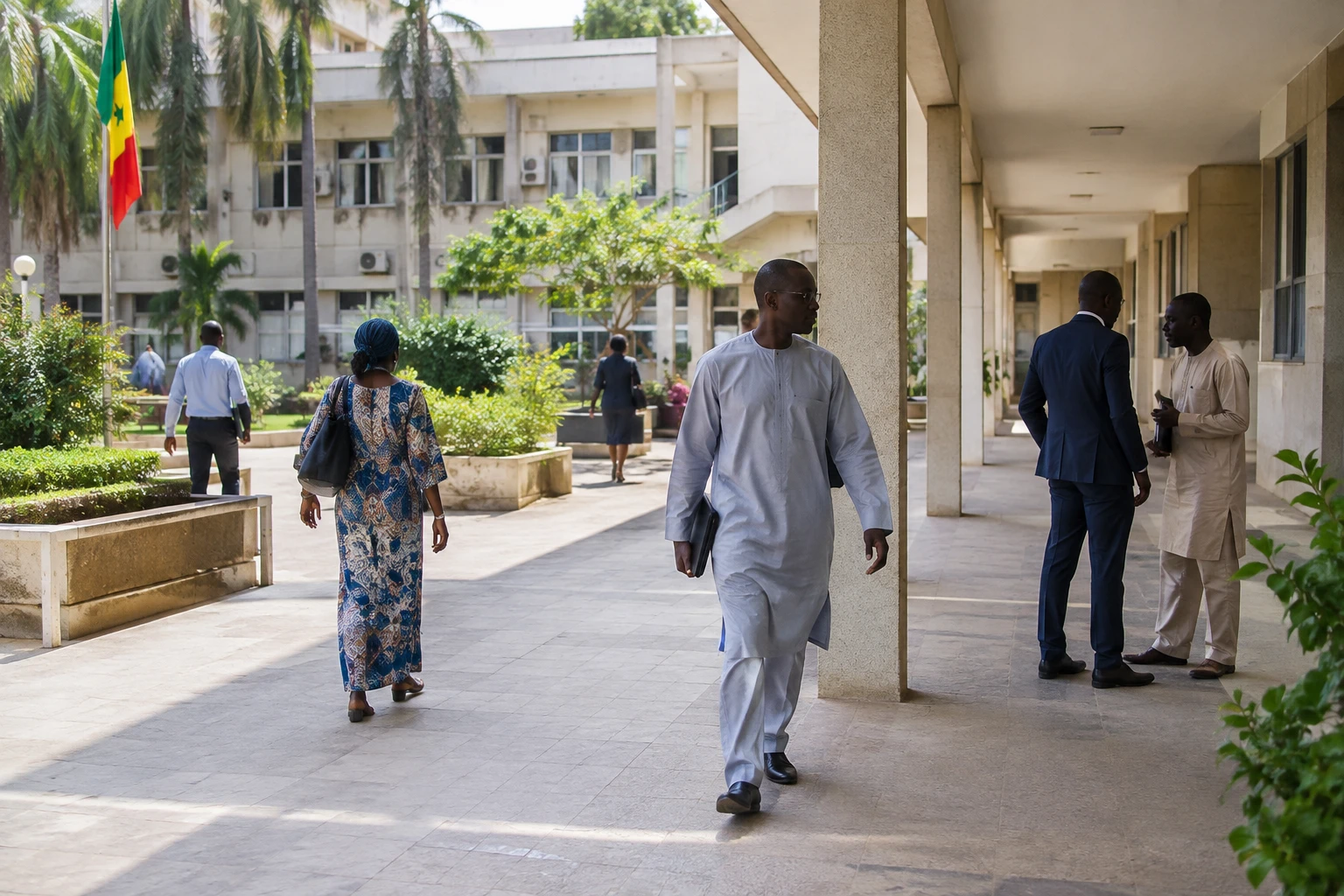
In Dakar and across the regions, a dispute over public accounts can quickly affect essential services: electricity, household support, salaries and payments to businesses. The rejection of Senegal’s revised budget has created fresh uncertainty as the country seeks to restore confidence in its finances and conclude a programme with the International Monetary Fund (IMF).
A revised budget under spending pressure
Senegal is undergoing a major review of its public accounts. After discrepancies were found in debt and deficit figures for previous years, the authorities began work to improve transparency and put the finances back on track. The IMF estimated public and parapublic sector debt at 132% of gross domestic product at the end of 2024. Published in November 2025, this estimate highlights the scale of the financial constraint, though it does not on its own sum up the country’s economic capacity. IMF data on Senegal’s debt and public finances.
The draft supplementary finance bill, or LFR, is used to revise initial revenue and spending forecasts during the year. The text submitted in 2026 took account of lower expected revenues, rising energy costs and higher spending. The parliamentary committee’s report put revenues at CFA francs 5,848.7bn, against an initial CFA francs 6,188.8bn, and spending at CFA francs 7,583.9bn. The projected deficit stood at CFA francs 1,735.2bn, or 7.6% of GDP. The parliamentary report on the draft supplementary budget.
Energy pressures are also weighing on these choices. According to the same report, subsidies planned to support the energy sector were set to reach CFA francs 790.3bn, against CFA francs 250bn in the previous forecast. The funding is intended in particular to cushion the impact of hydrocarbon costs on electricity and domestic gas. But it leaves less room for other priorities, while cuts could affect tariffs or operators’ finances.
Vote rejects the bill before detailed scrutiny
On Tuesday, 3 November 2026, the National Assembly adopted a preliminary motion that led to the bill’s rejection without a general debate. Of 165 MPs, 132 took part in the vote: 109 backed the procedure, 20 opposed it and three abstained. The Senegalese Press Agency had reported that the finance committee had already rejected the bill following a further review on 30 October. The APS report on the parliamentary session.
MPs who backed the rejection challenged the quality of the budget information and the credibility of some assumptions. Amadou Ba, a member of parliament, questioned “budgetary sincerity” in particular and called for data that would make it possible to assess the bill. Cheikh Diba, the minister, defended the text and rejected the criticism. These opposing arguments were not settled through detailed scrutiny in the chamber: the procedure adopted specifically prevented the budget from being examined on its merits. Details of the vote and arguments put forward.
The result therefore reflects an institutional deadlock, but is not in itself enough to establish a rupture between President Bassirou Diomaye Faye and Ousmane Sonko, the prime minister. It shows that the government lacks the support in the Assembly needed to pass this bill. The immediate question is whether the executive will put forward a new version, revise its forecasts or find another way to fund planned spending.
Practical effects beyond the political debate
A rejected budget does not automatically mean public services will stop. It does, however, create uncertainty over the implementation of appropriations and can complicate cash management decisions. Any difficulties would not affect all groups equally: households may feel changes to tariffs or support, while businesses await payment for public contracts and invoices. Smaller organisations, which are often more dependent on regular payments, generally have fewer reserves than large operators.
Urban and rural areas are also exposed in different ways. In Dakar, the continuity of electricity and transport is directly linked to business and service activity. In less well-served localities, investment delays or supply pressures can exacerbate specific existing difficulties in access. The government had also warned that rejection risked jeopardising some payments, including those owed to businesses and back pay for teachers. These consequences remain risks cited by the executive, not disruptions that have already been established.
The IMF dossier adds an external dimension. On 2 September, the prime minister’s office said an agreement in principle at staff level provided for an Extended Credit Facility of CFA francs 1,243bn, or about $2.2bn over three years. A staff-level agreement must still pass through the required institutional stages before funding becomes available. Parliament’s rejection therefore does not, by itself, prove that the programme has been cancelled. It could nevertheless complicate discussions on budget targets, reforms and financing conditions. The prime minister’s office statement on the staff-level agreement with the IMF.
A test of confidence for Dakar and the region
For Senegal’s authorities, the challenge is to reduce the deficit and restore the credibility of the accounts without shifting the entire burden on to households or sacrificing worthwhile investment. The IMF itself has stressed the importance of protecting priority spending and high-impact investment while continuing fiscal consolidation. In the national debate, the demand for parliamentary transparency is thus set against the urgency of funding services and meeting the state’s commitments.
What happens next will depend on the government’s response and the parliamentary timetable, as well as discussions with the IMF. Across West Africa, where economies share markets, infrastructure and a common currency within WAEMU, Senegal’s financial trajectory is being watched beyond its borders. The 3 November vote does not close these dossiers: it makes the central challenge more visible — building a budget compromise credible enough for MPs, citizens, creditors and regional partners.