Algeria
 Egypt
 Libya
 Morocco
 Sudan
 Tunisia
 Benin
 Burkina Faso
 Cabo Verde
 Côte d'Ivoire
 Ghana
 Guinea
 Guinea-Bissau
 Liberia
 Mali
 Mauritania
 Niger
 Nigeria
 Sierra Leone
 The Gambia
 Togo
 Cameroon
 Central African Republic
 Chad
 DR Congo
 Equatorial Guinea
 Gabon
 Republic of the Congo
 São Tomé and Príncipe
 Burundi
 Comoros
 Djibouti
 Eritrea
 Ethiopia
 Kenya
 Madagascar
 Malawi
 Mauritius
 Mozambique
 Rwanda
 Seychelles
 Somalia
 South Sudan
 Tanzania
 Uganda
 Angola
 Botswana
 Eswatini
 Lesotho
 Namibia
 South Africa
 Zambia
 Zimbabwe
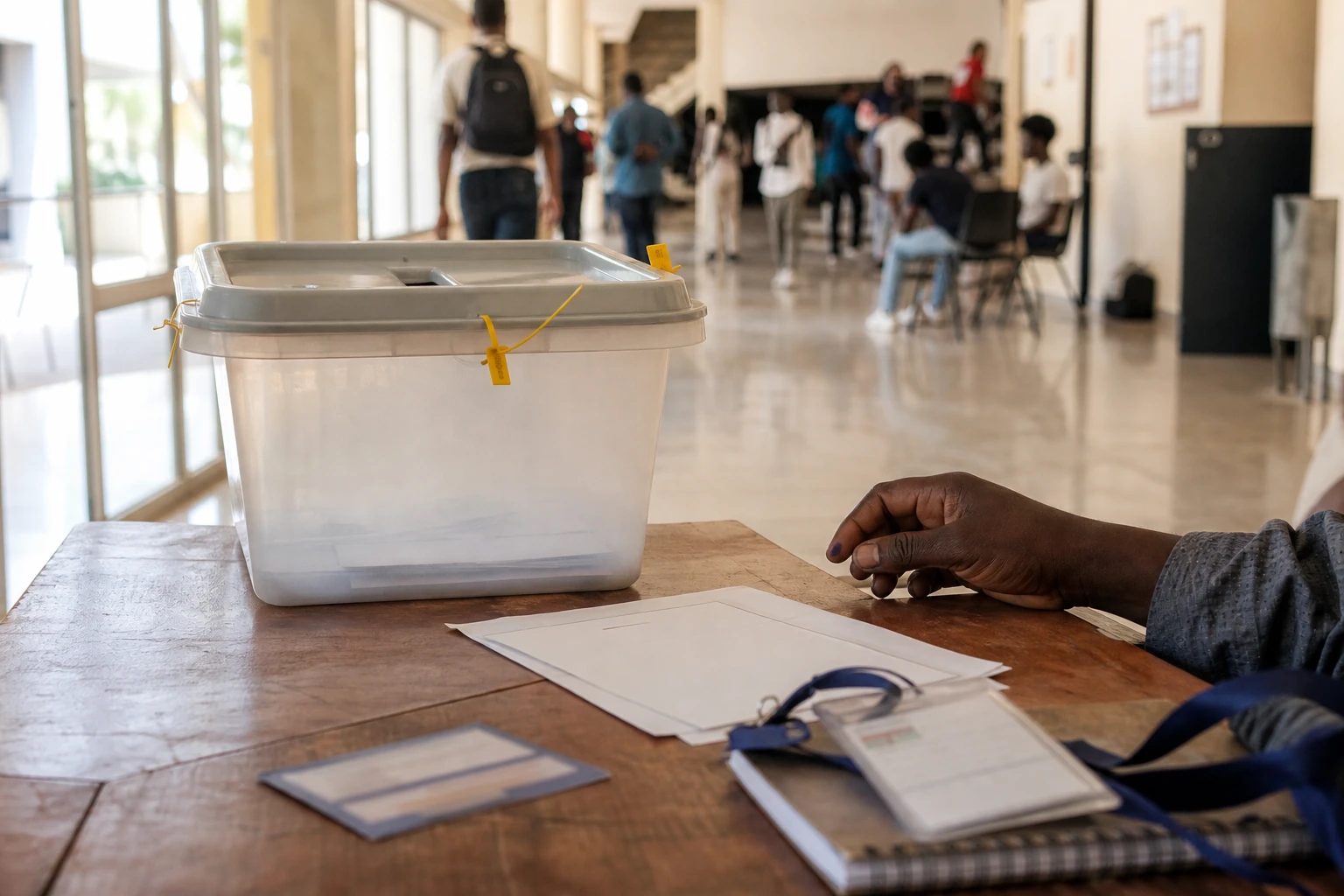
In Saint-Louis, an administrative note is enough to revive a question that reaches beyond the corridors of the campus: how far can a public institution regulate the political and religious expression of its staff without giving the impression that it is monitoring their beliefs? At Gaston Berger University, the debate comes as the leadership of the Regional Centre for University Services in Saint-Louis, CROUS, has just changed hands.
A university term begins amid institutional tensions
Gaston Berger University, based in Saint-Louis, serves a large student community from northern Senegal. Its CROUS manages essential aspects of daily life: accommodation, catering, social support, medical services and campus activities. Established under Senegalese law in 1990, the institution therefore has direct contact with students, as well as staff and trade union organisations.
On 29 September 2026, Mame Thierno Mbaye officially took up his post as director of CROUS. He succeeded Babacar Diop, who had been appointed to lead the institution in 2024. The handover took place in the presence of university officials, staff representatives, social partners and students, at a time when continuity of service remains a central concern.
The new director is no stranger to Saint-Louis. A former UGB student who studied sociology and microfinance, among other subjects, he knows the realities of campus life. His background also has a political dimension. He is described as an official of the Kiiraay party in Darou Mousty, in the Louga region, fuelling questions about the politicisation of administrative appointments.
UGB is not an isolated institution in this landscape. It forms part of Senegal’s national higher education system and of broader debates about the governance of public universities, student representation and the role of political organisations in state services.
What the 2 October note says
A memo dated 2 October reminds CROUS staff of the republican and secular character of the Senegalese state. It also asks them to avoid any “ostentatious display” of political or religious affiliation within the institution’s services.
The text immediately prompted reactions. Some staff and political officials saw it as a possible restriction on religious practice on campus. The CROUS director, for his part, says there is no question of banning religion or individual rites. According to his explanation, the note is instead aimed at public displays of partisan alignment or signs that could disrupt the administration’s work.
Mame Thierno Mbaye says that, on his arrival, he was greeted by staff openly expressing support for Pastef, the party associated with President Bassirou Diomaye Faye and Prime Minister Ousmane Sonko. He believes a political display directed against the new director can create an atmosphere of distrust, and even give rise to suspicions of sabotage.
This justification places administrative neutrality at the heart of a delicate debate. In a public service, neutrality requires staff to perform their duties without favouring a party, faith or group. It does not necessarily mean suppressing personal beliefs. The difficulty, then, lies in distinguishing individual expression, protected by law, from visible political mobilisation in the course of work.
Pastef challenges what it sees as selective neutrality
Pastef officials dispute the force of the argument. Their reasoning is straightforward: an authority appointed despite having a known political commitment cannot, in their view, invoke neutrality to ask others to set aside their affiliations.
The criticism concerns not only the content of the note, but also the process and the general climate surrounding public appointments in Senegal. Since the 2024 change of government, leadership changes at several public bodies have been viewed through the prism of political realignment. Each replacement can therefore be interpreted as a break with the previous team, even when presented as a management decision.
Amath Diallo, secretary-general of the joint trade union body at CROUS and UGB’s rectorate, shifts the debate towards procedure. He believes consultation could have clarified the scope of the text and avoided conflicting interpretations. Above all, he stresses that a public servant must serve the Senegalese administration, not a party in power or an opposition group.
This position reflects a practical concern among staff. An overly broad instruction can be applied inconsistently. It may target an employee because of their actual political commitment, but also because of a simple item of clothing or a religious practice that has been misinterpreted. Conversely, the absence of clear rules can allow partisan power struggles to take root within public services.
A broader question of trust
For students, the issue goes beyond the dispute between the new director and some staff. CROUS is responsible for areas that directly affect their study conditions. A prolonged crisis could complicate the management of accommodation, university restaurants, social assistance or administrative procedures.
The effects may also vary between groups. Trade union officials seek to protect staff rights and autonomy. The management wants to assert its authority from the outset. Students, meanwhile, are primarily looking for reliable services, transparent management and fair access to benefits. On a campus far from Dakar, administrative tensions can quickly have day-to-day consequences.
UGB’s history also weighs on the debate. The university has previously experienced crises linked to campus management, social conditions and relations between students and the authorities. In 2018, a major crisis led to the departure of the rector and the CROUS director. This precedent explains the particular sensitivity surrounding any decision affecting the institution’s governance.
The test will be how the note is applied
What happens next will depend less on statements than on the note’s practical application. The coming days will show whether it is used to regulate partisan behaviour in offices or becomes a tool for policing appearances and beliefs.
CROUS management can still ease tensions by issuing a written clarification, meeting the unions and engaging with student representatives. Such a move would not settle the political debate, but it would make clear which behaviours are covered, what procedures apply and what safeguards staff are offered.
Across Senegal, the case is a reminder of a broader imperative: the administration’s neutrality must be evident in its actions, appointments and day-to-day decisions. Across West Africa, where public universities are often centres of social and political mobilisation, the case of Saint-Louis illustrates the difficult balance between administrative authority, freedom of expression and continuity of public service.
The next indicator will therefore be concrete: will the university term begin without a fresh confrontation over the note, and will CROUS be able to establish its authority without deepening mistrust between management, staff and students?