Algeria
 Egypt
 Libya
 Morocco
 Sudan
 Tunisia
 Benin
 Burkina Faso
 Cabo Verde
 Côte d'Ivoire
 Ghana
 Guinea
 Guinea-Bissau
 Liberia
 Mali
 Mauritania
 Niger
 Nigeria
 Senegal
 Sierra Leone
 The Gambia
 Togo
 Cameroon
 Central African Republic
 Chad
 DR Congo
 Equatorial Guinea
 Gabon
 Republic of the Congo
 São Tomé and Príncipe
 Burundi
 Comoros
 Djibouti
 Eritrea
 Ethiopia
 Kenya
 Madagascar
 Malawi
 Mauritius
 Mozambique
 Seychelles
 Somalia
 South Sudan
 Tanzania
 Uganda
 Angola
 Botswana
 Eswatini
 Lesotho
 Namibia
 South Africa
 Zambia
 Zimbabwe
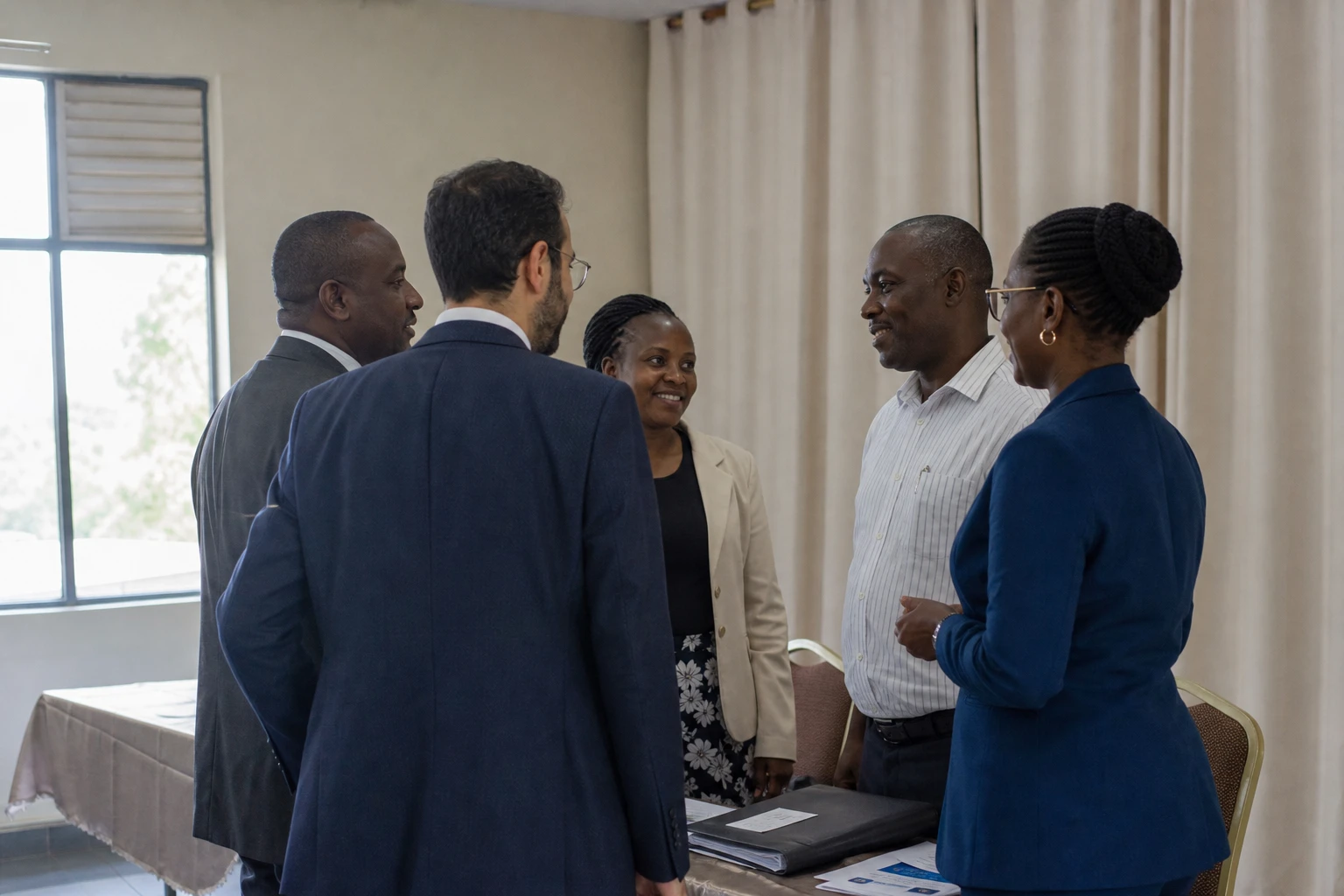
In Kigali, Saddam Alaya’s walk has taken on particular significance. The Jordanian traveller is not simply crossing Rwanda to link two stages of his journey. He is also bringing his message of peace and education to a country where learning, dialogue and memory play a central role in national reconstruction.
A Rwandan stop on an extraordinary route
Saddam Alaya arrived in Rwanda in early October 2026. He is continuing a walk announced as covering more than 23,000 kilometres, between southern Africa and Magadan in Russia’s Far East. The route is set to cross 18 countries and three continents, with arrival expected in 2028.
The project began on 1st January 2026 at Cape Agulhas in South Africa. Before reaching Rwanda, the Jordanian walker had passed through South Africa, Botswana, Zimbabwe, Zambia, Tanzania and Burundi. Jordan’s Petra news agency reported on 19 September that he had already covered more than 4,900 kilometres.
His arrival in Rwanda therefore marks the seventh national stage of the journey. The route links very different places, but also societies that share a regional reality: borders, movement, local exchanges and human ties often extend beyond administrative boundaries.
Rwanda is a member of the East African Community, or EAC, a regional organisation that facilitates cooperation between several countries in the region. This membership gives the Rwandan stage particular significance. It takes place in an area where mobility, cross-border trade and peace initiatives are closely linked.
From sporting feat to dialogue with communities
Saddam Alaya describes his walk as a project with three dimensions: travel, peace and education. The initiative is run by Hike With Me, an organisation founded by the traveller to use walking as a way to meet and engage with communities.
The walker does not restrict his route to major roads. He also seeks to visit schools and talk with pupils. According to figures shared before he entered Rwanda, he had visited 46 institutions and met more than 14,000 pupils and teachers.
These meetings focus on coexistence, dialogue and the importance of education. They give the journey a significance beyond physical endurance. In this context, each stop becomes a space for discussion with young people, teachers, local leaders and residents.
The project also lays claim to a cultural dimension. Saddam Alaya is from Wadi Musa in Jordan, near the site of Petra. He hopes to introduce people along his route to his country and hometown, while connecting his Jordanian identity with an international experience.
The choice of a route between southern Africa, East Africa, Asia and Europe broadens the story. The walk is not solely about reaching a destination. It becomes a way to bring together different places, languages and histories.
Rwanda, a sensitive setting for a message of peace
Passing through Rwanda is no ordinary stop for a project devoted to peace. The country continues to address questions of memory, reconciliation and violence prevention following the 1994 genocide against the Tutsi.
In Rwandan schools and associations, peace education draws in particular on civic responsibility, the prevention of hate and the pursuit of dialogue. Local and international initiatives are developing programmes for young people, aiming to pass on the lessons of history without confining society to its past.
The presence of a foreign walker can therefore create a valuable exchange, provided Rwanda is not reduced to its tragic history. It is also a young society shaped by public policies, economic activity and civic initiatives. The challenge is to listen to local experiences rather than impose an outside message on a complex national reality.
For Rwandans, the visit may offer an opportunity to present their own approaches to peace and social cohesion. It could also foster meetings between schools, civil society groups and a project originating in the Middle East but built largely on the African continent.
A route shaped by realities on the ground
A walk on this scale depends on more than individual determination. It requires permits, accommodation, support at borders and coordination with the authorities of the countries along the route.
Saddam Alaya has described temperatures sometimes exceeding 42 degrees Celsius, as well as difficulties with communications, internet access and the long distances between populated areas. Crossing from one country to another brings further challenges, particularly regarding visas, security and transporting equipment.
The walk nevertheless draws on local support. According to figures released by the organisation, more than 5,300 people have taken part in some sections of the route. The project has also reportedly received more than 95 offers of accommodation and attracted extensive media coverage in the countries crossed.
This support shows that the route depends as much on the communities encountered as on the initial preparations. In urban areas, institutions, schools and media may be involved in welcoming the walker. In rural areas, residents play a more direct role in giving directions, providing accommodation or accompanying him.
After Kigali, a long road north
The stay in Rwanda is expected to last about two weeks, according to reports about the visit. The walker has taken part in community activities in Kigali, including a car-free day, to connect with local people.
The next stages are due to take Saddam Alaya through other East African countries before continuing towards Asia and Europe. The project’s success will depend on his ability to maintain his pace, cross borders and preserve the educational dimension announced at the outset.
At regional level, this stop also highlights the role of citizen mobility in an East Africa shaped by cross-border exchange. A walk cannot replace public policies or institutional peace mechanisms. It can, however, create direct conversations, particularly with young people.
The journey is therefore worth following less as a mere feat of distance than as a succession of encounters. In Rwanda, its message will carry particular resonance: peace is not simply a declaration. It is also built in schools, neighbourhoods, communities and relationships between peoples.
Information on Saddam Alaya’s arrival in Rwanda was cross-checked against the update published before he entered the country.