Algeria
 Egypt
 Libya
 Morocco
 Sudan
 Tunisia
 Benin
 Burkina Faso
 Cabo Verde
 Côte d'Ivoire
 Ghana
 Guinea
 Guinea-Bissau
 Liberia
 Mali
 Mauritania
 Niger
 Nigeria
 Senegal
 Sierra Leone
 The Gambia
 Togo
 Cameroon
 Central African Republic
 Chad
 DR Congo
 Equatorial Guinea
 Gabon
 Republic of the Congo
 São Tomé and Príncipe
 Burundi
 Comoros
 Djibouti
 Eritrea
 Ethiopia
 Kenya
 Madagascar
 Malawi
 Mauritius
 Mozambique
 Seychelles
 Somalia
 South Sudan
 Tanzania
 Uganda
 Angola
 Botswana
 Eswatini
 Lesotho
 Namibia
 South Africa
 Zambia
 Zimbabwe
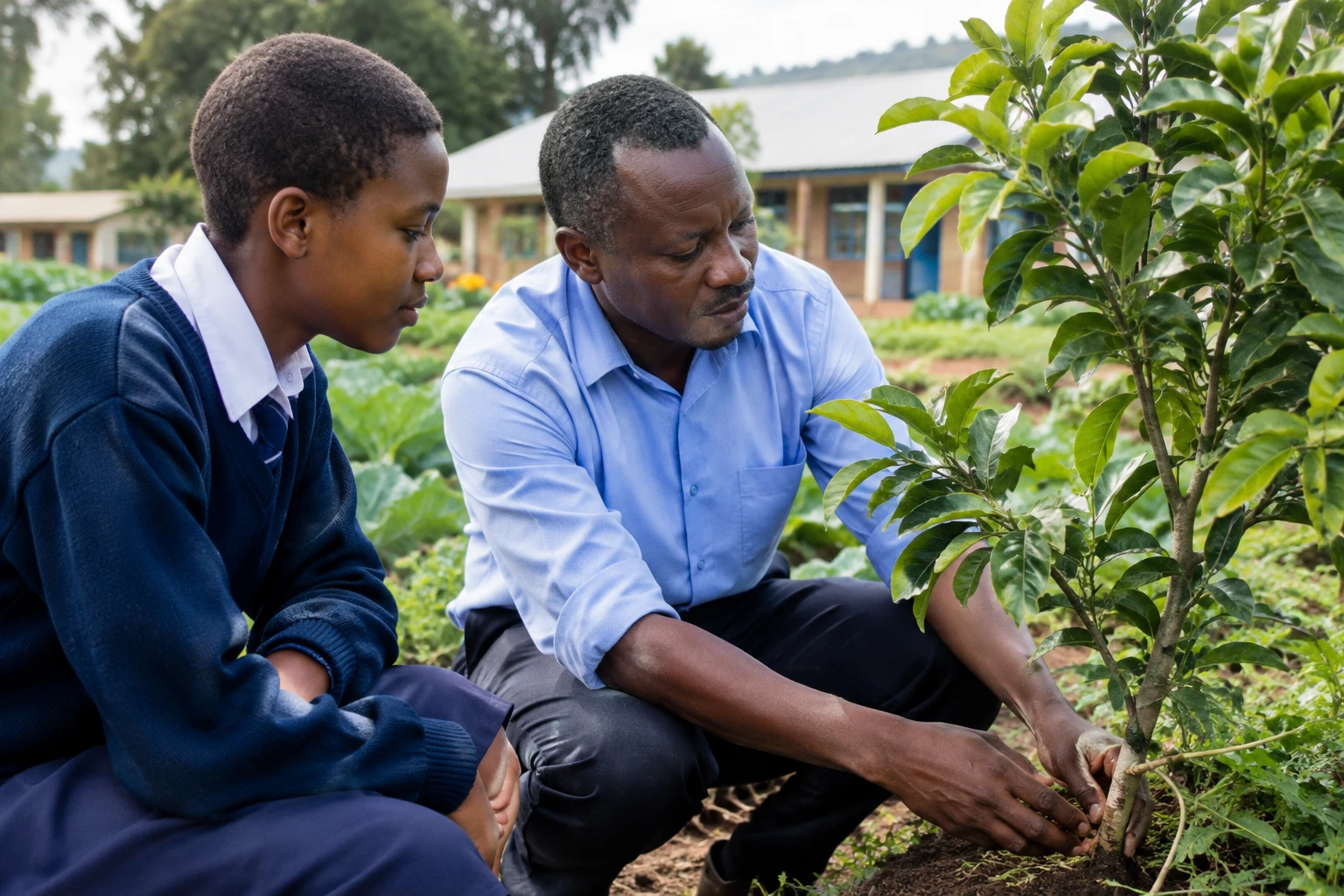
In a schoolyard, learning to protect the soil can begin with a simple act: caring for a tree. In Shyorongi, north of Kigali, pupils put environmental concepts into practice in a garden that also serves as a classroom.
This Rwandan initiative takes on particular significance on 14 November 2026, a day devoted to children, young people, education and skills at COP31, being held in Antalya, Turkey. It is a reminder that climate action does not take place only in international negotiations: it is also built into school curricula and everyday life.
A school plot as a learning ground
In Shyorongi, around 20 kilometres north of Kigali, pupils tend fruit trees and vegetable crops on their school grounds. The garden includes lemon, orange and avocado trees. According to testimony gathered on site, the trees were raised in the school’s nursery.
Tharcisse Hategekimana, who coordinates the activities, explains that the plantings help limit erosion and support biodiversity. For six years, he has offered pupils practical activities and discussions on deforestation, climate change and water harvesting. The young people investigate questions related to biodiversity rather than limiting themselves to theoretical concepts.
Responsibility extends beyond the school walls. Eric Kinyarwanda, an 18-year-old pupil, says that each young person cares for a tree at school and, when possible, at home. He says he looks after an orange tree belonging to his family and shares its fruit with his classmates. These remarks describe an individual experience; on their own, they do not allow participation across all Rwandan schools to be measured.
The school follows the Eco-Schools programme, which turns education for sustainable development into practical, participatory activities. In Rwanda, the local organisation ARCOS describes green learning spaces combining nurseries, gardens, composting and resource management. The programme has expanded with partners from the education and environmental sectors. The Shyorongi school is also described as taking part in activities supported by partners, including UNESCO.
Education policy seeks to take root in everyday life
The project forms part of a broader policy direction. Rwanda’s 2024-2029 education sector strategic plan calls for the environment and climate change to be further integrated into national curricula, for eco-school activities to be expanded, and for the capacities of teachers and pupils to be strengthened. It also provides for teaching resources adapted to different age groups.
This ambition addresses a practical question: how can lessons be connected to the risks and choices facing communities? Planting trees, observing soil conditions or harvesting water can make concepts more accessible. For families, the potential benefits are not only educational: fruit or vegetables can also supplement household resources. But these effects depend on maintenance, access to water, available resources and the continuity of activities.
The initiative’s reach should therefore not be overstated. A school garden cannot replace infrastructure resilient to climate hazards, trained teachers, or land and water management policies. It does, however, give pupils a space to observe their environment and try out responses on a scale they can manage.
The challenge also lies in scaling up. Rwanda’s Ministry of Education has set targets for 2024-2029, but achieving them will depend on resources, pedagogical support and monitoring of schools. Urban and rural schools do not necessarily have access to the same land, equipment or irrigation options. An effective policy must take these differences into account.
From Kigali to Antalya, resources remain central
COP31 takes place from 9 to 20 November 2026. Its official programme sets aside 14 November for children, young people, education and skills. This thematic day highlights climate education, while international negotiations follow their own timetable. The challenge is to link local initiatives with public commitments without presenting a school experience as a sufficient solution in itself.
For Rwanda, the aim is to consolidate educational practices already included in national policy and better connect them with the realities of schools. For pupils, learning takes place through actions and observation. For the authorities, it means funding training, teaching materials and schools able to operate despite climate shocks.
Across East Africa, these questions extend beyond any one country. The states of the East African Community, a regional cooperation organisation, share challenges related to natural resources and climate resilience, while having different education systems. Rwanda’s experience can inform regional exchanges, but should not be transferred mechanically.
The COP31 day devoted to education thus offers a point of comparison: will international announcements be able to support school initiatives over the long term? In Shyorongi, the answer will first be measured in the continuity of learning, the maintenance of the plantings and the pupils’ ability to connect what they study with decisions made at home and in their community.