Algeria
 Egypt
 Libya
 Morocco
 Sudan
 Tunisia
 Benin
 Burkina Faso
 Cabo Verde
 Côte d'Ivoire
 Ghana
 Guinea
 Guinea-Bissau
 Liberia
 Mali
 Mauritania
 Niger
 Nigeria
 Senegal
 Sierra Leone
 The Gambia
 Togo
 Cameroon
 Central African Republic
 Chad
 Equatorial Guinea
 Gabon
 Republic of the Congo
 São Tomé and Príncipe
 Burundi
 Comoros
 Djibouti
 Eritrea
 Ethiopia
 Kenya
 Madagascar
 Malawi
 Mauritius
 Mozambique
 Rwanda
 Seychelles
 Somalia
 South Sudan
 Tanzania
 Uganda
 Angola
 Botswana
 Eswatini
 Lesotho
 Namibia
 South Africa
 Zambia
 Zimbabwe

When families leave their homes, then have to flee again from the place where they thought they would find refuge, the emergency is measured not only by the number of people displaced. It is also visible in occupied schools and health centres, roads made dangerous and aid teams no longer able to reach residents. This is the situation reported in several areas of South Kivu, in the east of the Democratic Republic of the Congo.
Displacement follows the advance of the fighting
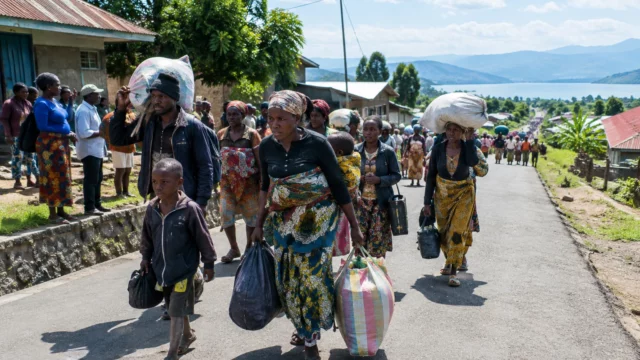
Between 6 and 9 November, more than 323,000 people were reportedly displaced in the territories of Kalehe and Kabare. The preliminary figure was published on 11 November by the United Nations Office for the Coordination of Humanitarian Affairs, OCHA. An estimate reported by Congolese media is consistent with the scale and timing of the displacement. The figure remains provisional, however: clashes and access difficulties are making it harder to count people on the ground.
Population movements took place to the north and north-west of Bukavu, the capital of South Kivu. According to humanitarian reports, some families fled several times as the fighting shifted. Residents who had taken in relatives or neighbours were then forced to leave in turn as the clashes drew closer.
Displaced people sought shelter in schools, places of worship and health facilities. Others took refuge in the forest or near Kahuzi-Biega National Park. The rainy season adds practical difficulties to these movements: sleeping outdoors or moving away from essential services increases health risks and makes it harder to protect children, older people and the sick.
A shifting front line, with information requiring attribution
The fighting is linked to an offensive by the Front for the Refoundation of the Nation (FRN), a politico-military coalition led by former president Joseph Kabila. Press reports describe the movement as backed by Kigali, an accusation disputed in the regional context. It should not be presented as an established fact without attribution to specific sources. Military claims of control over towns should likewise be distinguished from independent verification.
In Bunyakiri, the Congolese army said on 11 November that it had stopped the fighters’ advance. This statement does not mean the area is secure. On the same day, OCHA was still reporting clashes near Chaminunu, in the Kalonge area, and said there were concerns they could spread into Shabunda territory. The situation can therefore change rapidly from one axis to another.
South Kivu is part of a wider crisis affecting the east of the country and spanning the Great Lakes region. Relations between Kinshasa and Kigali remain central to diplomatic efforts, while the Washington and Doha peace processes seek to frame political and security commitments. Their implementation depends in particular on the parties’ ability to reduce violence and allow access to affected areas.
Humanitarian aid caught up in access constraints
Displacement creates more than a need for food or shelter. It also interrupts access to healthcare, water, education and livelihoods. Families hosted in communal buildings often share spaces already used by local communities. In rural areas, those who flee into the forest can find themselves far from markets and services, while humanitarian organisations may struggle to locate them.
OCHA says the movements of several humanitarian teams are restricted and that aid activities have been suspended because of the fighting and access constraints. These interruptions directly affect displaced people, but also residents who remain in their communities and rely on the same services. They also make it harder to assess needs: a provisional figure can quickly become incomplete as families continue to move or remain out of reach.
The Congolese authorities, local actors and aid organisations thus face two linked emergencies: protecting civilians and maintaining safe access routes. Claims of territorial control are not enough to establish that displacement has ended. It is also necessary to check whether residents can return safely, whether services are resuming and whether families who have fled several times have been counted.
Protecting civilians at the heart of regional discussions
On 11 November in Addis Ababa, African Union Commission chairperson Mahmoud Ali Youssouf met James Swan, head of MONUSCO, and the United Nations envoy for the Great Lakes. According to a report published by Actualite.cd, the discussions covered humanitarian access, civilian protection, ceasefire monitoring and the renewal of the mission’s mandate. The meeting places the emergency in South Kivu within a wider institutional debate: what the mission can do, where it can act and how its role fits with African and UN initiatives.
For people in South Kivu, however, the immediate issue remains very practical: being able to flee without being caught up in fresh fighting, finding accessible shelter and receiving regular aid. For the region, what happens next will depend on how the clashes around Kalehe, Kabare and Bunyakiri develop, as well as decisions on humanitarian access and monitoring of ceasefire commitments. The figure of 323,000 gives a measure of the alarm; it does not yet describe all the consequences of a crisis in which displacement is still ongoing.