Algeria
 Egypt
 Libya
 Morocco
 Sudan
 Tunisia
 Benin
 Burkina Faso
 Cabo Verde
 Côte d'Ivoire
 Ghana
 Guinea
 Guinea-Bissau
 Liberia
 Mali
 Mauritania
 Niger
 Nigeria
 Senegal
 Sierra Leone
 The Gambia
 Togo
 Cameroon
 Central African Republic
 Chad
 DR Congo
 Equatorial Guinea
 Gabon
 Republic of the Congo
 São Tomé and Príncipe
 Burundi
 Comoros
 Djibouti
 Eritrea
 Ethiopia
 Kenya
 Malawi
 Mauritius
 Mozambique
 Rwanda
 Seychelles
 Somalia
 South Sudan
 Tanzania
 Uganda
 Angola
 Botswana
 Eswatini
 Lesotho
 Namibia
 South Africa
 Zambia
 Zimbabwe
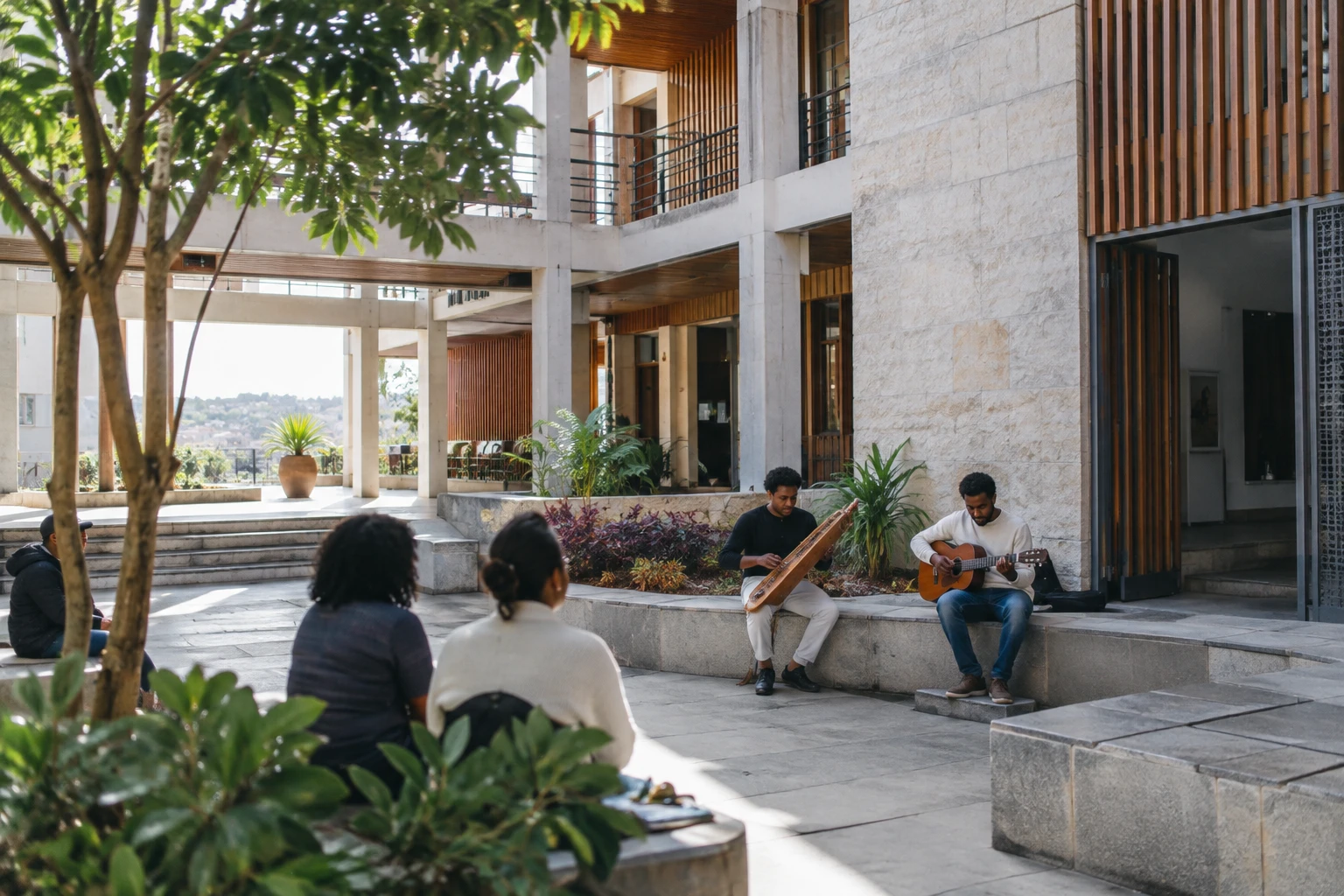
What happens when a Malagasy valiha meets an instrument shaped by the world of flamenco? The answer is not a fusion of styles, but a conversation between two musicians who arrive with their own histories and their own strings.
Two instruments, two trajectories
At the heart of Mandry ve ?, the album by Rajery and Raúl Rodríguez, are the valiha and the flamenco tres. The former is a traditional tubular zither from Madagascar, usually made of bamboo. The latter is a stringed instrument developed by Rodríguez, a Spanish musician and researcher, drawing on several guitar traditions.
The album was released on 2 October 2026. It brings together eleven compositions, with a running time of about 41 minutes, according to its music distribution data. The Malagasy media outlets Newsmada and L’Express de Madagascar also confirm its release in 2026 and the meeting between the two instruments.
This collaboration does not put one instrument at the service of the other. The valiha is not used as local colour for flamenco; nor does the tres overlay Malagasy music. The project takes shape through listening and the search for a shared language, without erasing differences.
A meeting that began in Antananarivo
The two artists’ work together dates back to their meeting in Antananarivo in 2019, Newsmada and L’Express de Madagascar report. They are said to have prepared a joint show in a few days, presented notably at the Institut français de Madagascar and the University of Antananarivo. That first experience laid the foundations for a dialogue that continued afterwards.
A new phase followed several years later, when the musicians met again in the Malagasy capital. Recording “Corazón malagasy” — “Malagasy Heart” — helped revive the project and pave the way for the album. Both Malagasy outlets report these details of its origins and give accounts that are consistent with each other.
For Rajery, this approach is part of a career devoted to the valiha. Known by the stage name Germain Randrianarisoa, he has helped bring the instrument to audiences beyond Madagascar. He has also been part of 3MA, a group bringing together the valiha, Ballaké Sissoko’s Malian kora and Driss El Maloumi’s Moroccan oud. His career is a reminder that musical exchanges in Africa did not begin with a European collaboration.
Tradition as living material
The album’s title, Mandry ve ?, is presented by Spanish public broadcaster RTVE as a question that can be translated as “Is the people still asleep?” This translation is approximate: it is not enough to establish all the nuances of the expression in Malagasy. But the question gives the project a scope that goes beyond the meeting of instruments. It invites listeners to hear music that is rooted, yet moving.
The choice of strings offers common ground. The valiha carries a Malagasy musical history; the flamenco tres reflects Rodríguez’s exploration of the connections between flamenco, Africa and the Caribbean. The album’s compositions, whose titles combine Malagasy and Spanish, point to a desire to build a shared repertoire. In themselves, they do not prove that the traditions are perfectly equal: that is measured in the arrangements, artistic choices and space given to each musician.
This matters in a sector where African music is sometimes presented first and foremost as a source of inspiration for artists from elsewhere. Here, the available sources describe a collaboration between two creators and a jointly credited work. However, they do not provide full details of how the compositions are divided or the production arrangements. It is therefore appropriate to speak of a documented artistic dialogue, without attributing to it guarantees that publicly available information cannot verify.
From the Spanish stage to Malagasy audiences
In autumn 2026, Rajery and Rodríguez presented the album at several venues in Spain. Newsmada announced dates in Madrid, La Bisbal d’Empordà and Barcelona, between 20 and 25 October. A Madrid venue and Spanish media also covered the tour. The project’s circulation thus draws on European stages and cultural networks, while remaining rooted in a meeting that began in Antananarivo.
For Malagasy audiences, the question is also one of access to the work and how it is presented locally. L’Express de Madagascar reports that a presentation in Madagascar is being considered for early 2027. At this stage, this is a prospect reported by the press, not a date confirmed in an official schedule. If it goes ahead, it would allow the project to be heard in the country where Rajery built his relationship with the valiha.
This circulation between Madagascar and Europe is part of a wider regional space. Madagascar is a member of the Southern African Development Community (SADC), which brings together several countries in southern Africa and the Indian Ocean. SADC works, among other things, to promote regional co-operation, but the album is not an institutional programme of the organisation. Its pan-African significance is cultural: it highlights the diversity of the continent’s string traditions and the potential links between distant music scenes.
What happens next will depend on how the two artists bring the album to life over time, how it is received in Madagascar and what place is given to Malagasy creators beyond international tours. Mandry ve ? poses a musical question; the answer will also depend on audiences, venues and the practical opportunities to hear this repertoire again on the Big Island.