Algeria
 Egypt
 Libya
 Morocco
 Sudan
 Tunisia
 Benin
 Burkina Faso
 Cabo Verde
 Côte d'Ivoire
 Ghana
 Guinea
 Guinea-Bissau
 Liberia
 Mali
 Mauritania
 Niger
 Nigeria
 Senegal
 Sierra Leone
 The Gambia
 Togo
 Cameroon
 Central African Republic
 Chad
 DR Congo
 Equatorial Guinea
 Gabon
 Republic of the Congo
 São Tomé and Príncipe
 Burundi
 Comoros
 Djibouti
 Eritrea
 Ethiopia
 Kenya
 Malawi
 Mauritius
 Mozambique
 Rwanda
 Seychelles
 Somalia
 South Sudan
 Tanzania
 Uganda
 Angola
 Botswana
 Eswatini
 Lesotho
 Namibia
 South Africa
 Zambia
 Zimbabwe
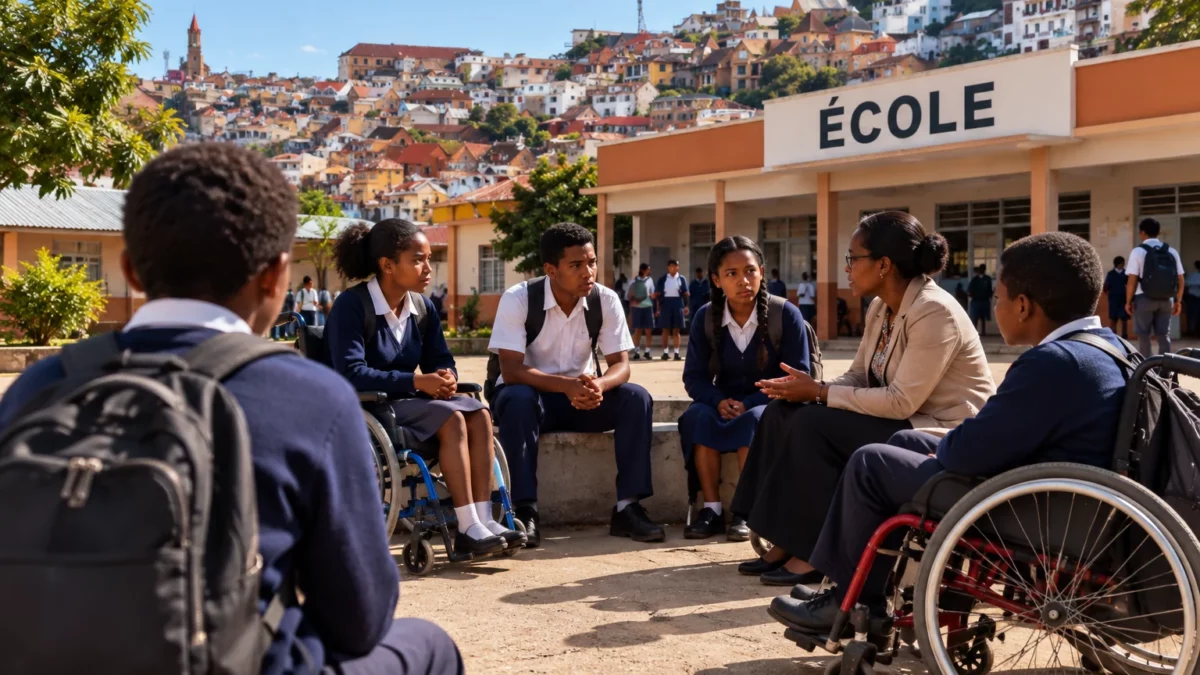
For a disabled child, crossing the school gate does not yet guarantee a place in the classroom. In Antananarivo, an association and families are trying to make a model that brings pupils together work, as resources and facilities remain unevenly distributed across Madagascar.
A national framework, but limited provision
The country has had an official framework for inclusive education since a 2009 decree. The Ministry of National Education says, however, that the first integrated classes date back to 1999, before the scheme was strengthened between 2009 and 2012 with support from partners. An integrated class in a mainstream school caters for pupils with similar needs who require particular support. It is therefore not always the same as a class in which all children follow the same lessons together.
Access difficulties are not confined to schools in the capital. A UNICEF analysis highlights the barriers disabled children face, including infrastructure, a lack of adapted materials, teacher training and social attitudes. The organisation also says that more than one in 10 children in Madagascar has a disability. The often-cited figure that more than half of disabled children are not in school could not be confirmed by a recent independent source: national school-enrolment data remain incomplete or out of date.
The issue is also linked to regional commitments. Madagascar is a member of the Southern African Development Community (SADC), which brings together 16 Southern African states, and ratified the United Nations Convention on the Rights of Persons with Disabilities in 2015. These commitments establish the principle of equal access. Putting them into practice, however, depends on the budgets, equipment and support available at each school.
In Faravohitra, learning at one’s own pace and alongside others
In the Faravohitra neighbourhood of Antananarivo, a classroom caters for about 30 pupils supported by Cœurs Unis pour l’inclusion. Autism, Down’s syndrome and learning difficulties are among the needs encountered. The association, which has been active since 2016, according to its managers, supports children and their families. At break time, pupils from the class mix with those from the mainstream school.
Andidarison, 23, speaks proudly about his sporting activities: running, stretching and shot put. His testimony is a reminder that the lives and abilities of disabled people cannot be reduced to their support needs. For educator Fabrice, inclusion cannot remain a slogan: it is built through daily practice and relationships between pupils.
The learning described by the team sometimes progresses in stages: holding a pencil, colouring, writing one’s name. The work also focuses on socialisation. Regular contact with other pupils can help combat isolation and prejudice. But simply being present in a mainstream school is not enough to ensure an appropriate education. Trained staff, suitable teaching materials and support tailored to each child’s needs are required.
Families play a central role in running this initiative. According to the association’s managers, parents fund activities through their contributions, with no public support or financial partner for this class. This arrangement enables practical action locally, but makes its continuity dependent on household resources. A solidarity fundraiser announced for 28 November illustrates this search for funding, but cannot replace a lasting commitment from institutions.
A measured gap between rights and access in practice
An audit by Madagascar’s Court of Auditors, covering primary education and the 2018-2024 management years, gives a measure of the shortcomings. Of the 27 public primary schools visited, four, or 15%, had integrated classes. Nationwide, the report records 453 schools out of 20,511 with ramps, or 2.2%. These figures describe the schools visited and the facilities recorded; they do not mean that 85% of schools turn away disabled children.
The Court also notes shortcomings in coordination, data and teaching materials. At the public schools visited, the distance between home and school—estimated at an average of three to six kilometres—and the lack of transport can discourage families. These constraints weigh particularly heavily on children who need help getting around. Outside the capital, they can compound a lack of facilities and the distance from specialist services.
The audit therefore describes a system that remains more integrative than inclusive: some children are admitted, but the school and its methods are not always adapted to their full participation. The distinction matters. Integration often requires pupils to adjust to an existing framework; inclusion also requires schools to adapt their spaces, tools and practices.
Progress depends on resources and follow-up
In Antananarivo as in the regions, the issue is therefore not simply creating classes. It is about ensuring they function, training staff, making buildings accessible and supporting families. Associations can create opportunities and change attitudes, but funding through parents’ contributions alone leaves these schemes highly vulnerable.
The Court of Auditors’ report now puts the practical implementation of the national framework centre stage: reliable data on school enrolment, coordination between institutions and investment in schools. For Madagascar and its SADC partners, the challenge is to turn commitments into real access, in the capital and in remote municipalities alike. Progress will have to be measured by pupils’ sustained presence in class, their learning and their participation in school life.