Algeria
 Egypt
 Libya
 Morocco
 Sudan
 Tunisia
 Benin
 Burkina Faso
 Cabo Verde
 Côte d'Ivoire
 Ghana
 Guinea
 Guinea-Bissau
 Liberia
 Mali
 Mauritania
 Niger
 Nigeria
 Senegal
 Sierra Leone
 The Gambia
 Togo
 Cameroon
 Central African Republic
 Chad
 Equatorial Guinea
 Gabon
 Republic of the Congo
 São Tomé and Príncipe
 Burundi
 Comoros
 Djibouti
 Eritrea
 Ethiopia
 Kenya
 Madagascar
 Malawi
 Mauritius
 Mozambique
 Rwanda
 Seychelles
 Somalia
 South Sudan
 Tanzania
 Uganda
 Angola
 Botswana
 Eswatini
 Lesotho
 Namibia
 South Africa
 Zambia
 Zimbabwe
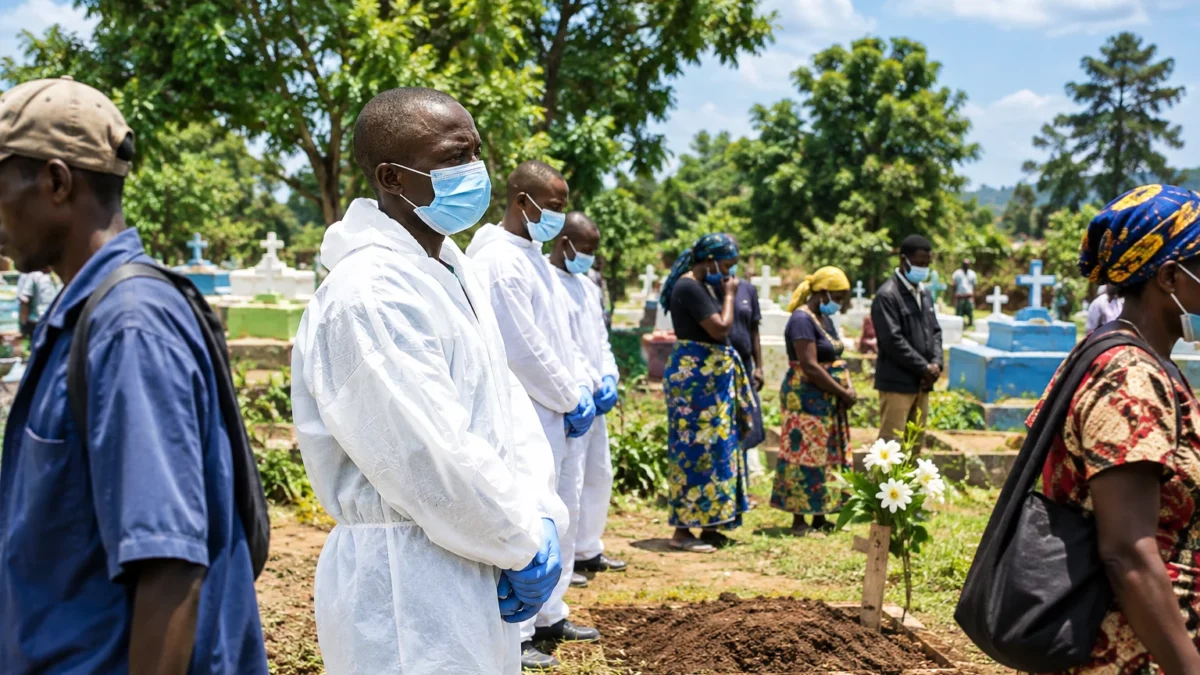
In the east of the Democratic Republic of the Congo, burying someone who has died of Ebola is not simply a public health measure. Teams must sometimes reach hard-to-access villages, persuade families and protect the living without denying relatives a place in funeral rites. In 2019, in Oicha, this balancing act put burial teams under intense pressure.
In Oicha, a public health response against the odds of distance
Oicha is in Beni territory, in North Kivu, a province in the east of the country. Teams responsible for safe and dignified burials also worked in neighbouring villages. According to local team leaders, they were burying three to six people a day. Just two vehicles had to cover a large area that was difficult to access.
The shortage of resources complicated travel and the order in which teams could respond. Cephas Muhongolo, a team member, said demand sometimes exceeded their capacity to respond quickly. In every suspected or confirmed death, time mattered: the body could transmit the virus, particularly when relatives touched it during funeral rites.
Safe burials are not about excluding families. They aim to limit contact with the body while allowing relatives to take part in farewells and rites under controlled conditions. This is crucial in a region where funeral practices carry great significance for families and communities.
An outbreak with national and regional consequences
The outbreak in question was declared on 1st August 2018 in North Kivu, following cases reported in Ituri. It then spread to several health zones, some of them difficult to access. The response took place amid armed conflict and distrust of institutions, while health teams had to carry out surveillance, testing, isolation and contact tracing.
The Democratic Republic of the Congo is a member of the Southern African Development Community (SADC), a regional co-operation organisation. But the proximity of borders and population movements also made health co-ordination with neighbouring countries essential. In July 2019, the World Health Organization declared the outbreak a public health emergency of international concern, after a case was confirmed in Goma, a major city in North Kivu.
One point needs correcting to understand the final toll: the 2018–2020 outbreak in eastern DR Congo was caused by the Ebola Zaire virus, not the Bundibugyo strain, contrary to what the original text stated. The WHO recorded 3 470 cases and 2 287 deaths between August 2018 and June 2020. The final toll was therefore far lower than the more than 11 000 cases cited in the account, a figure that does not match the final data for this outbreak. The WHO’s retrospective report on the 2018–2020 outbreak and the report by the Africa Centres for Disease Control and Prevention confirm these figures.
Trust, a condition for an effective response
The challenges went beyond vehicles. Teams also faced rumours and accusations. Chimène Mwanaki, head of Oicha’s burial team, said some residents suspected them of spreading the disease. In some communities, teams had been attacked or had to work under armed escort.
This distrust cannot be understood without the local context. North Kivu has experienced armed violence for decades, and relations between some residents and the authorities are strained. For local people, the arrival of teams accompanied by security forces can be seen as protection, but also as an imposed presence. An effective public health response therefore depends as much on reaching villages as on the quality of dialogue with families.
The consequences are uneven. In urban centres, teams can sometimes reach healthcare facilities more quickly. In remote villages, roads, insecurity and a shortage of vehicles lengthen response times. Families, meanwhile, must reconcile prevention guidance with the need to see and accompany their loved ones. Local teams find themselves at the intersection of these expectations, with both public health responsibilities and a role as mediators.
Lessons that reach beyond North Kivu
The 2019 account referred to the absence of approved vaccines and treatments for Bundibugyo. This did not accurately describe the outbreak in the east: during the 2018–2020 epidemic, vaccination targeting the Zaire strain was rolled out, alongside experimental treatments and specialised care. The WHO says more than 303 000 people were vaccinated during the response. This distinction matters: medical tools depend on the strain in circulation and do not replace surveillance or access to care.
The final toll also offers a different perspective on the work of burial teams: more than 29 000 alerts about deaths were investigated and more than 26 000 safe and dignified burials carried out, according to the WHO. These figures show the logistical scale of the response, but do not erase the difficulties experienced in Oicha. They are a reminder that national systems also rely on local teams, which must earn trust while working in complex conditions.
The outbreak in eastern DR Congo ended on 25 June 2020, but it left lessons for public health responses across the region: involve communities, adapt funeral rites with families and provide sufficient transport. When an epidemic spreads through areas affected by insecurity, protocols only work if teams can reach residents and be heard.