Algeria
 Egypt
 Libya
 Morocco
 Sudan
 Tunisia
 Benin
 Burkina Faso
 Cabo Verde
 Côte d'Ivoire
 Ghana
 Guinea
 Guinea-Bissau
 Liberia
 Mali
 Mauritania
 Niger
 Nigeria
 Senegal
 Sierra Leone
 The Gambia
 Togo
 Cameroon
 Central African Republic
 Chad
 Equatorial Guinea
 Gabon
 Republic of the Congo
 São Tomé and Príncipe
 Burundi
 Comoros
 Djibouti
 Eritrea
 Ethiopia
 Kenya
 Madagascar
 Malawi
 Mauritius
 Mozambique
 Rwanda
 Seychelles
 Somalia
 South Sudan
 Tanzania
 Uganda
 Angola
 Botswana
 Eswatini
 Lesotho
 Namibia
 South Africa
 Zambia
 Zimbabwe
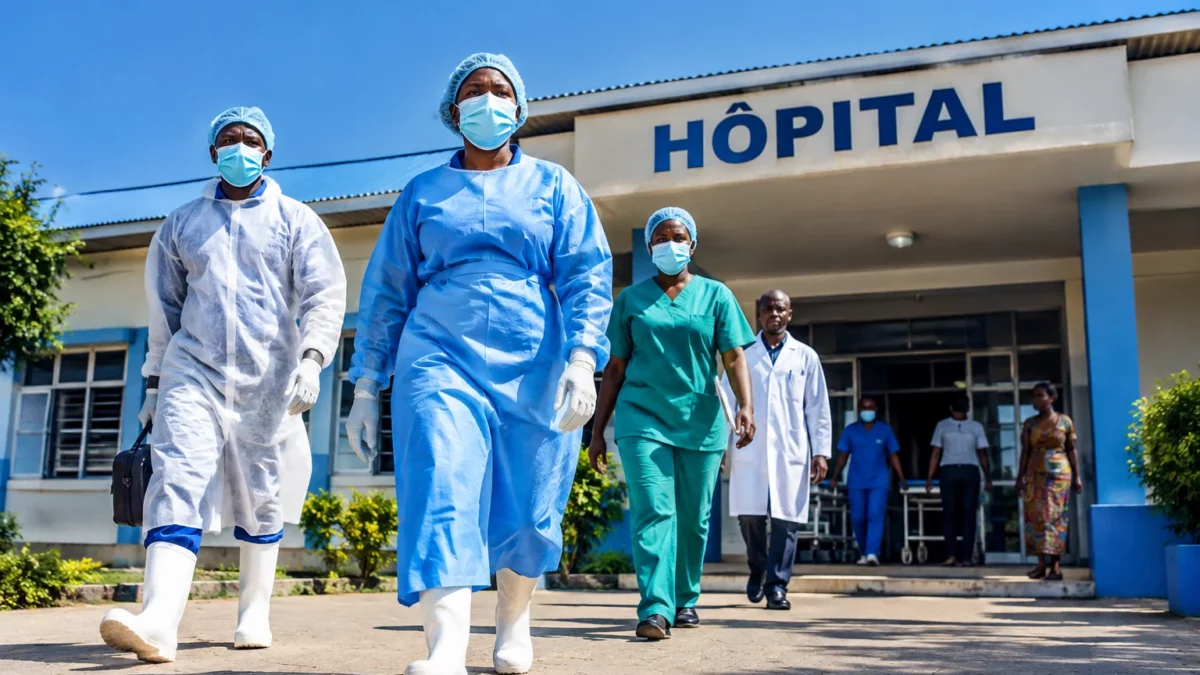
In Ituri, teams working to combat Ebola had to seek shelter in a hospital as fighting drew closer. The episode brings home a reality for local people: when travel becomes dangerous, access to healthcare and epidemic surveillance can be disrupted at the same time.
A hospital caught up in insecurity
On 22 November, the World Health Organization (WHO) Director-General, Tedros Adhanom Ghebreyesus, reported that health workers and partners in the Ebola response had taken refuge in a hospital maternity ward in Ituri. Fighting was taking place nearby. Staff had been there for more than 24 hours, according to his alert, reported by Actualite.cd.
On 24 November, the WHO Director-General announced the safe evacuation of the organisation’s staff, personnel from the Congolese health ministry and their colleagues. The UN Stabilisation Mission in the DRC (MONUSCO), for its part, said its peacekeepers had reached ten health professionals, including a doctor and nurses from Akwe’s referral hospital. These reports place the incident in Akwe, in Djugu territory, and document a period of shelter lasting more than three days.
Teams from the WHO and the Africa Centres for Disease Control and Prevention, Africa CDC, were also evacuated from Mongbwalu to Bunia, according to Congolese outlet Bunia Actualité. These moves protect the teams but temporarily take responders away from some areas where the health response must continue.
An epidemic under pressure in a region affected by fighting
The current Ebola outbreak in the Democratic Republic of the Congo was declared on 15 May 2026. Ituri, in the country’s north-east, is among the provinces affected. On 18 November, the WHO maintained the outbreak’s status as a public health emergency of international concern. This designation signals a risk requiring co-ordination beyond national borders; it does not mean that every territory is affected in the same way.
The security situation is also localised and volatile. In Djugu territory, clashes have resumed between the Armed Forces of the DRC (FARDC) and fighters from the Convention for the Popular Revolution (CRP), according to information published by Bunia Actualité. This context does not sum up all the violence in eastern Congo, where several armed and political dynamics coexist.
Medecins Sans Frontieres (MSF), which has been present in the region for decades, describes a deterioration in security after fighting resumed between the CRP and the FARDC in late 2025. In an assessment published in April 2026, the organisation reported health facilities closed or relocated and residents reluctant to travel for treatment. It also said it was supporting medical activities with local health authorities in Fataki. This picture sheds light on underlying difficulties, without establishing that all facilities in Ituri have faced the same fate.
The Ebola response depends on several interconnected tasks: identifying cases, monitoring people who have been in contact with a patient, referring patients and informing communities. When teams can no longer travel, these operations risk slowing down. However, the information available does not support the conclusion that healthcare in Akwe or response activities across the whole territory have come to a complete halt.
For residents, security determines access to healthcare
The effects of an interruption are not limited to the fight against the virus. Patients need routine care, while families are trying to reach a medical centre without crossing combat zones. Local health workers, too, must be able to work and return home safely. An evacuation protects the staff concerned, but it may temporarily reduce the presence of specialists in the hardest-to-reach areas.
The consequences vary depending on location and transport options. In Bunia, the provincial capital of Ituri, evacuated teams may find a safer setting. In more isolated communities, residents depend more heavily on nearby facilities and road travel. When travelling becomes risky, contact tracing and access to consultations can become more difficult for families and health workers alike.
Trust also matters. Measures to combat Ebola — isolation, medical monitoring and safe burials — require regular engagement with residents. Staff cannot replace these relationships with instructions given remotely. Congolese health authorities, local teams and partner organisations must therefore balance security, continuity of care and communication, without portraying communities as a uniform obstacle to the response.
A Congolese challenge with regional consequences
The DRC is a member of the Southern African Development Community (SADC), a regional organisation bringing together countries in southern and central Africa, and participates in continental public health mechanisms. Africa CDC, the African Union’s public health agency, is involved in the response. These links make information-sharing and co-ordination between countries necessary, particularly when cross-border movement is possible.
At national level, an immediate challenge is to maintain surveillance and healthcare in areas from which teams have had to withdraw, while protecting patients and staff. At regional level, the priority is to support detection capacity and health co-operation without confusing border vigilance with the closure of exchanges. The situation in Akwe shows above all that the epidemic response also depends on very practical conditions: passable roads, protected facilities and teams able to reach residents.
What happens next will depend on how the fighting in Djugu territory develops and whether teams can return to the evacuated areas. MONUSCO described its intervention as a measure to protect civilians in the communities concerned; the WHO, for its part, called for hospitals, patients and staff to be protected. These calls are a reminder that medical facilities must remain accessible, even when fighting draws closer.