Algeria
 Egypt
 Libya
 Morocco
 Sudan
 Tunisia
 Benin
 Burkina Faso
 Cabo Verde
 Côte d'Ivoire
 Ghana
 Guinea
 Guinea-Bissau
 Liberia
 Mali
 Mauritania
 Niger
 Nigeria
 Senegal
 Sierra Leone
 The Gambia
 Togo
 Cameroon
 Central African Republic
 Chad
 Equatorial Guinea
 Gabon
 Republic of the Congo
 São Tomé and Príncipe
 Burundi
 Comoros
 Djibouti
 Eritrea
 Ethiopia
 Kenya
 Madagascar
 Malawi
 Mauritius
 Mozambique
 Rwanda
 Seychelles
 Somalia
 South Sudan
 Tanzania
 Uganda
 Angola
 Botswana
 Eswatini
 Lesotho
 Namibia
 South Africa
 Zambia
 Zimbabwe
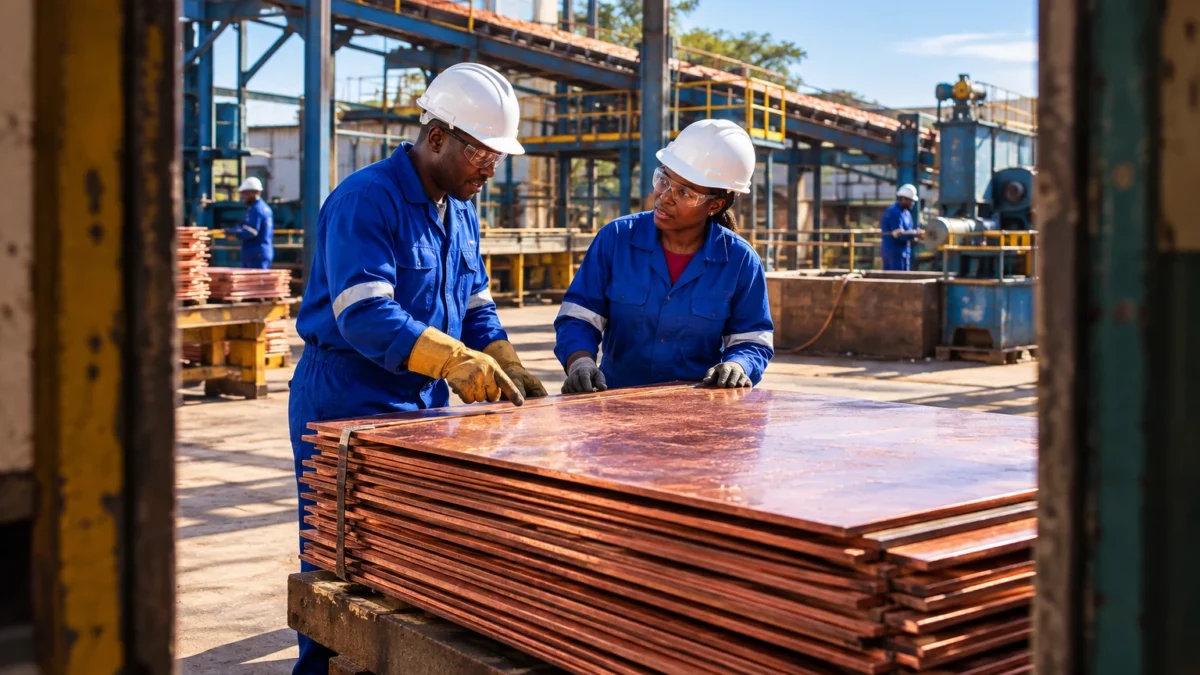
Zambian copper is still largely exported as a raw material. For Lusaka, the challenge is now to capture more value locally without making the rules so unpredictable that they deter mining projects.
This balancing act is becoming particularly important as countries and companies seek to secure the minerals needed for batteries, electricity grids and other technologies. Zambia wants to attract capital while also strengthening local processing and the benefits for its economy.
A national strategy to be translated into rules
In 2024, the Zambian government adopted its first National Critical Minerals Strategy for the 2024–2028 period. It identifies eleven priority resources: copper, cobalt, lithium, graphite, nickel, manganese, tin, uranium, coltan, sugilite and rare earths. The document lists geological mapping, partnerships with the private sector and local value addition among its areas of focus. Zambia’s official critical minerals strategy thus aims to link resource exploitation to national economic development.
The strategy sets the direction, but does not on its own establish the specific conditions for investment. That is the role of the regulatory framework now being prepared. According to information provided by the Ministry of Mines, a meeting held on Tuesday 24 November 2025, chaired by its Permanent Secretary, Hapenga M. Kabeta, reviewed recommendations from stakeholders.
Discussions covered the definitions used in the text, mineral processing, state participation and partnerships with investors. Officials also stressed that the future framework must be aligned with existing mining laws and policies. No publication timetable was announced in the information available.
Benefit-sharing at the centre of discussions
Proposals discussed in 2025 are said to have envisaged a free-carried state interest of at least 15% in certain projects, potentially rising to 40%, as well as a right of first refusal over minerals sold in the country. These provisions prompted questions about how the state could acquire an equity stake in mining companies. As the text is still being prepared, it is not possible to say that these thresholds will appear in its final version.
The distinction matters. Public participation can give the state a share of revenues and a presence in decision-making. But the terms — the projects covered, financing, governance and risk-sharing — also determine how predictable the rules are for investors and what benefits are actually available to Zambians.
The debate is part of a broader reform of the sector. Zambia’s Minerals Regulation Commission Act established a new body responsible for regulatory oversight, while the 2025 Geological and Minerals Development Act governs, among other things, exploration and mining. The Extractive Industries Transparency Initiative describes these laws as the pillars of the current mining framework. The future critical minerals regulations will therefore need to fit alongside these institutions, rather than operate in parallel. The EITI report on Zambia’s extractive sector examines this legal framework.
Copper, local processing and regional benefits
Copper remains the country’s mining mainstay. The national production strategy targets three million tonnes a year by 2031, an objective that will require new investment in exploration, mines and processing capacity. The ministry is also highlighting local processing and the integration of Zambian suppliers. This could create opportunities beyond extraction, particularly in services, metallurgy and industrial maintenance.
The effects would not be uniform, however. Large companies and the state are directly affected by ownership and tax rules. Zambian businesses may benefit from local contracts if they have the necessary skills, financing and equipment. In mining regions, communities are also looking for jobs, services and careful management of environmental impacts. A text focused on investment alone cannot guarantee these benefits.
Zambia is a member of the Southern African Development Community, or SADC, which brings together countries in the region and promotes their economic cooperation. Zambian mining output also depends on cross-border transport corridors to reach ports and markets. Clearer rules could therefore be of interest to regional partners and investors seeking to link extraction, processing and logistics across borders.
Implementation will be the next test
At continental level, the issue raises a question shared by several producer countries: how can they attract financing without limiting their ambitions to exporting raw minerals? Lusaka’s strategy offers a partial answer through processing and local partnerships. But the final balance will depend on the content of the regulations, their consistency with mining laws and the ability of institutions to implement them transparently.
The next step to watch is therefore the publication of the final text and its implementing provisions. Until these are known, proposals for public participation and pre-emption remain ideas under discussion, not settled rules. For Zambians, the decisive measure will be not the stated ambition but the share of mining activities, skills and revenues that is actually anchored in the country.