Algeria
 Egypt
 Libya
 Morocco
 Sudan
 Tunisia
 Benin
 Burkina Faso
 Cabo Verde
 Côte d'Ivoire
 Ghana
 Guinea
 Guinea-Bissau
 Liberia
 Mali
 Mauritania
 Niger
 Nigeria
 Senegal
 Sierra Leone
 The Gambia
 Togo
 Cameroon
 Central African Republic
 Chad
 Equatorial Guinea
 Gabon
 Republic of the Congo
 São Tomé and Príncipe
 Burundi
 Comoros
 Djibouti
 Eritrea
 Ethiopia
 Kenya
 Madagascar
 Malawi
 Mauritius
 Mozambique
 Rwanda
 Seychelles
 Somalia
 South Sudan
 Tanzania
 Uganda
 Angola
 Botswana
 Eswatini
 Lesotho
 Namibia
 South Africa
 Zambia
 Zimbabwe
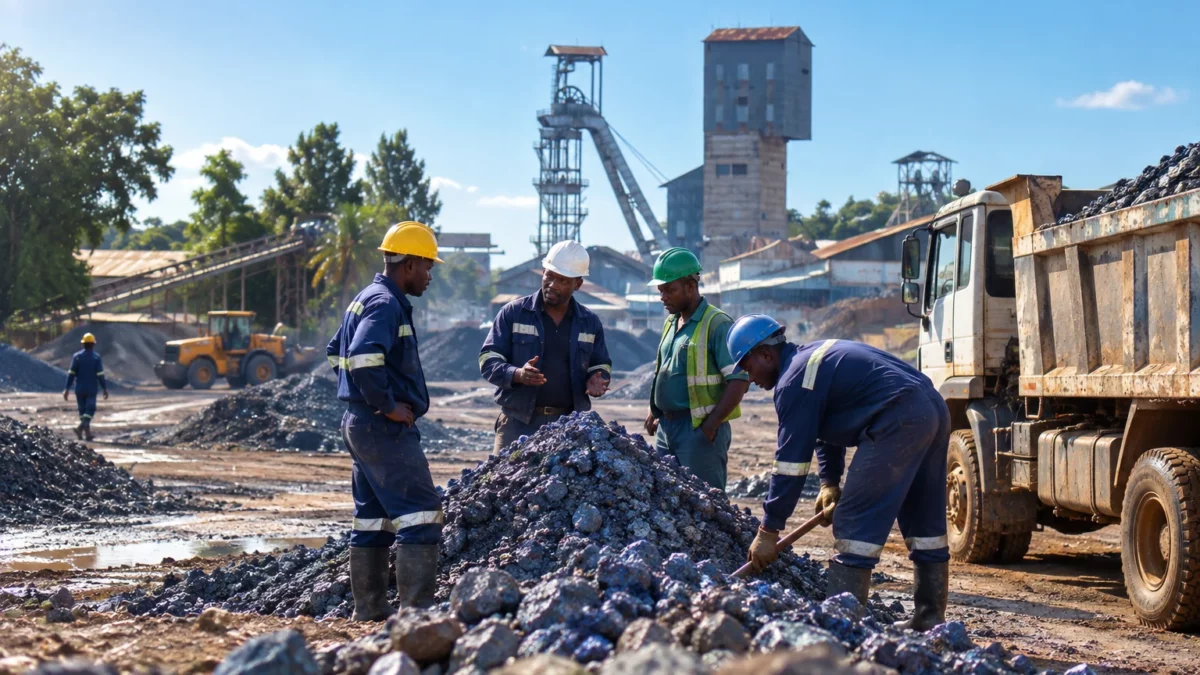
In Kolwezi, in the south-east of the Democratic Republic of the Congo (DRC), decisions taken in Kinshasa on cobalt have repercussions far beyond the mining sites. They affect public revenue, exporting companies and workers whose livelihoods depend on the sector. On 30 November 2026, a new suspension of exports is set to halt these flows as prices fall and stockpiles build up.
A global market under pressure
The DRC is the world’s leading producer of cobalt, a metal used in some rechargeable batteries and industrial applications. Its importance means that the country’s decisions have a direct effect on global supply. But the country also remains dependent on raw-material exports, while the most lucrative stages of processing and manufacturing are often carried out elsewhere.
The decision follows an initial suspension in 2025. At the end of that period, the Regulatory and Control Authority for Strategic Mineral Substances Markets (ARECOMS) introduced a quota system: caps on the quantities companies can export. The scheme provided for 96,600 tonnes in each of 2026 and 2027, including a strategic share managed by the regulator. The International Energy Agency sets out the details of this mechanism in its brief on Congolese export quotas.
The DRC is a member of the Southern African Development Community (SADC), a regional organisation for economic and political co-operation. Its mining strategy is also part of a continental debate: several countries are seeking greater control over their resources and to develop local processing. The reach of these policies, however, depends on their implementation and the availability of markets.
A pause to review quotas
ARECOMS announced on 23 November that all cobalt exports would be suspended from 30 November 2026 until further notice. The measure covers production intended for export, whether from industrial, semi-industrial, small-scale or artisanal mines. Operators have until 29 November to complete shipments authorised for the month, according to information published about the decision.
The regulator cites slowing global consumption, accumulating stockpiles and speculative practices amid an oversupply. It says it intends to use the interruption to review the allocation of quotas and bring exports closer into line with demand. An assessment is planned four months after the measure takes effect. This does not, in itself, mean that shipments will resume: a new decision must set the terms.
Unused quotas will not automatically be carried over, and the authorisations allocated for 2026 and 2027 are not guaranteed to remain in force after the suspension. This uncertainty affects mining groups, traders and transport companies. It also affects public finances, since exports contribute to tax revenue and foreign-currency inflows.
Congolese media have also reported the announcement and its application to all categories of production. The Opinion Info in the DRC and the international news agency Reuters describe its scope and the reasons given by the regulator.
Falling prices, rising volumes
The new restriction comes after prices rebounded sharply following the first suspension, then fell again. According to figures cited in available market information, the price is said to have reached about $58,000 a tonne in the first quarter of 2026, before dropping to $33,525 on 20 November. The Central Bank of the Congo had already documented the decline in its economic review of 6 November, citing a reference price of $33,930 a tonne. The two figures refer to different dates but indicate a similar trend.
At the same time, Congolese exports increased under the quota system. Official statistics cited in published reports show that 61,440 tonnes were shipped between January and the end of September 2026, compared with 44,338 tonnes over the whole of 2025. The cap set for 2026 remains 96,600 tonnes. These figures suggest that more Congolese cobalt returned to the market after the previous ban was lifted.
This succession of measures illustrates the limits of a restriction policy taken in isolation. Cutting exports can reduce available supply and support prices, but the effect also depends on demand from battery manufacturers, stock levels and production in other countries. The resumption of shipments after the first suspension may have contributed to pressure on prices, but it is not, by itself, a complete explanation for their movement.
The effects are not the same for everyone
For major mining companies, including CMOC and Glencore, the quota timetable determines whether they can ship their production and plan their sales. For the Congolese state, higher prices may increase the value of exports, but an interruption can delay revenue from sales. The overall impact will therefore depend on how long the suspension lasts and the volumes authorised when exports resume.
The effects may also be felt by subcontractors, transport companies and workers, including those in artisanal supply chains. A fall in shipments does not automatically translate into higher local incomes: this depends on how value is distributed and on the options for storage or domestic sales. The available information does not yet make it possible to measure these consequences for mining communities.
For Kinshasa, the challenge is to exert greater influence on the market without making exports unpredictable for operators. For international buyers, the suspension adds to supply uncertainty. At regional and continental level, the issue is a reminder that controlling supply alone is not enough to create a local industry: processing capacity, infrastructure, access to energy and stable rules also matter.
The next key step will be ARECOMS’ decision on the volumes and conditions for any possible resumption, following the review announced for four months later. Until then, changes in stockpiles, prices and global demand will show whether the new pause durably alters the market balance or merely shifts the timing of exports.