Algeria
 Egypt
 Libya
 Sudan
 Tunisia
 Benin
 Burkina Faso
 Cabo Verde
 Côte d'Ivoire
 Ghana
 Guinea
 Guinea-Bissau
 Liberia
 Mali
 Mauritania
 Niger
 Nigeria
 Senegal
 Sierra Leone
 The Gambia
 Togo
 Cameroon
 Central African Republic
 Chad
 DR Congo
 Equatorial Guinea
 Gabon
 Republic of the Congo
 São Tomé and Príncipe
 Burundi
 Comoros
 Djibouti
 Eritrea
 Ethiopia
 Kenya
 Madagascar
 Malawi
 Mauritius
 Mozambique
 Rwanda
 Seychelles
 Somalia
 South Sudan
 Tanzania
 Uganda
 Angola
 Botswana
 Eswatini
 Lesotho
 Namibia
 South Africa
 Zambia
 Zimbabwe
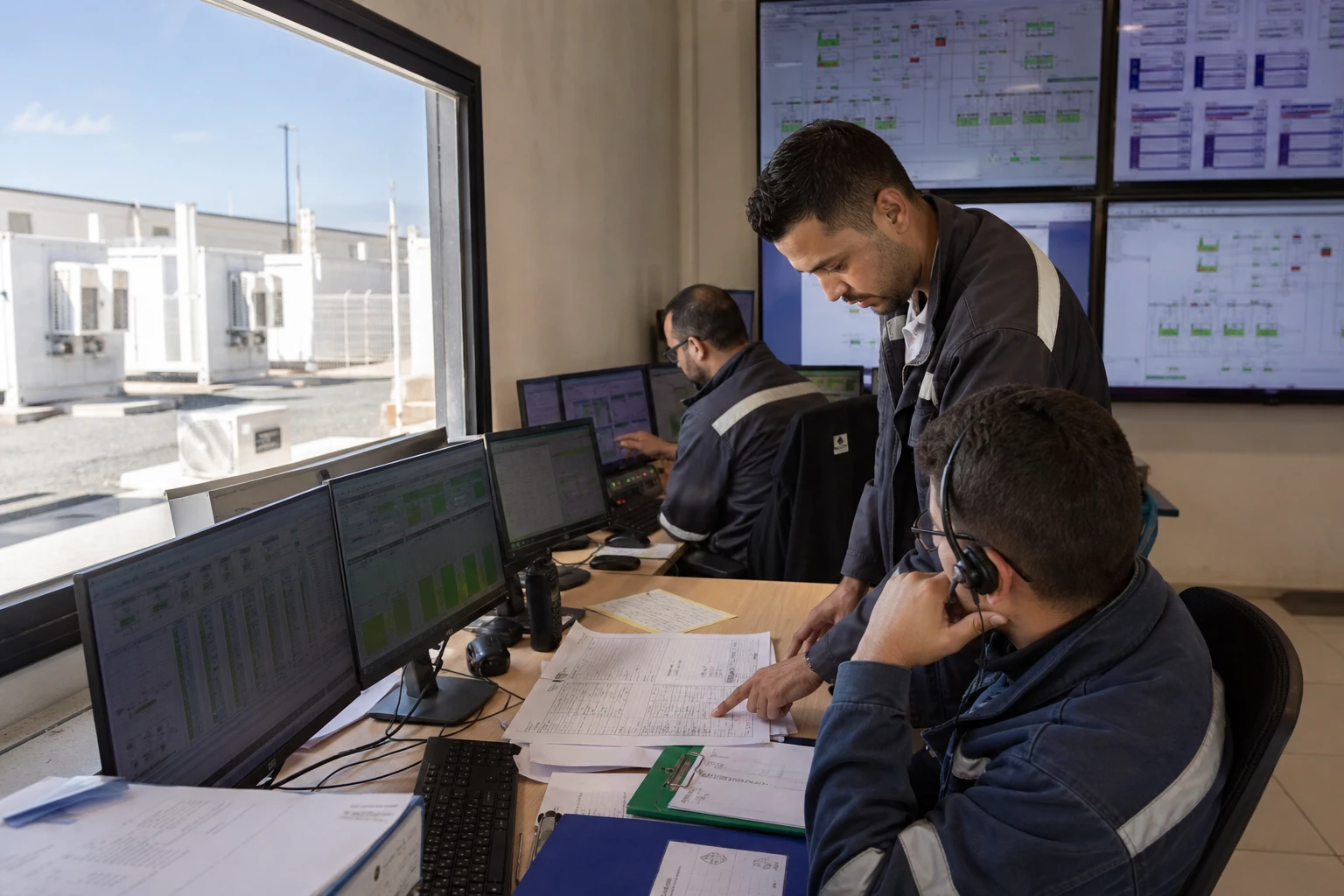
Storage enters Morocco’s energy workshop
In Benguerir, solar power is no longer just producing electricity in step with the sun. It is also beginning to learn how to keep to the schedule of a factory, a mining site and an industrial production line that does not stop when the light fades.
That is the purpose of the new battery storage system commissioned at the Benguerir site in Morocco. With 25 MW of power and 125 MWh of capacity, the installation can supply electricity for five hours. It is connected to a 67 MWp photovoltaic plant already operating within the same mining area.
This type of equipment changes the logic of a solar project. The aim is no longer simply to produce clean energy, but to make it available at the right time. In industrial operations, that difference matters as much as installed capacity.
Another step in Morocco’s energy strategy
For several years, Morocco has followed a clear course: increase the share of renewables in its electricity mix and reduce its dependence on fossil fuels. Official documents from the Ministry of Energy Transition and ANRE set a target of more than 52% of installed electricity capacity coming from renewable sources by 2030. The National Electricity Regulatory Authority, for its part, has published a grid hosting capacity target of 10,429 MW of renewables by that date.
Against this backdrop, OCP Green Energy’s project takes on particular significance. The Moroccan group, a pillar of the phosphate and fertiliser industries, is not simply seeking to green its image. It is securing part of its electricity consumption with resources over which it has greater control, while limiting its exposure to price and supply fluctuations.
Benguerir is no arbitrary choice. The city lies at the heart of a mining and industrial ecosystem where continuity of service is strategic. The stakes extend beyond the production site itself: the project is intended to show that a major industrial player can integrate solar power and storage within a single energy system, without waiting for a solution from outside.
What the battery changes in practice
The battery’s first function is simple: to smooth out the intermittency of solar power. During the day, when photovoltaic generation is strong, electricity is stored. It can then be fed back into the system during periods of peak demand, or when generation falls. For mining and industrial operations, this reduces reliance on the grid during certain hours and improves the stability of the power supply.
Its second function is economic. A storage system makes it possible to use each kilowatt-hour generated on site more effectively. It turns variable energy into a more predictable resource. For a group whose facilities consume electricity on a massive scale, that predictability affects operating costs and, in turn, competitiveness.
The project’s announced cost of nearly 170 million dirhams, or about $18 million, also signals that the technology is maturing. Storage remains a costly component, but becomes more accessible when integrated into a comprehensive industrial strategy. The group is part of a trend seen internationally: according to the International Energy Agency, batteries have become a key tool for supporting the growth of variable renewables, while LFP technology is gaining ground in a large share of new storage systems.
For ordinary Moroccans, the direct effect is less visible than it is for industry. But it is there. The more a major energy consumer secures its own transition, the more it helps develop a local market for equipment, engineering, operations and maintenance. This creates expertise, skilled jobs and supply chains within the country.
An industrial trajectory reaching beyond Benguerir
The commissioning of this first installation remains modest compared with the ambitions set out. OCP Green Energy has already brought an initial 202 MWp tranche of solar capacity into operation, spread across Benguerir, Foum Tizi and Oulad Farès in Khouribga. The group has also said it aims to reach 1.2 GW of renewable capacity in 2027, with the goal of meeting all its industrial electricity needs from renewable sources by then. In the longer term, its roadmap envisages more than 2 GW of renewable capacity and at least 2 GWh of storage.
This progress says something about Morocco’s industrial landscape today. The country is no longer simply installing solar plants. It is seeking to bring together generation, storage, grid regulation and end use. This is a more complex step, but also a more robust one. It avoids reducing the energy transition to an accumulation of megawatts.
The regional context reinforces this perspective. Across North Africa, several countries are accelerating their efforts in solar, wind and grid infrastructure, but storage is now becoming a central issue wherever renewables are gaining ground. IRENA notes that as the share of variable energy sources increases, the need for batteries becomes structural. Morocco, which has long positioned itself as one of the continent’s most advanced countries in the electricity transition, is testing a component that could spread to other African industrial sectors.
That is where the project’s continental significance lies. For governments, the question is no longer just how to produce more renewable electricity. It must also be made reliable, affordable and compatible with heavy industry, mining, desalination and the future growth of electric mobility. In this field, Morocco is seeking to show that a transition model backed by a major national player can go beyond symbolism.
What happens next remains to be seen. The performance testing phase will show how the installation holds up over time, including its losses, maintenance requirements and integration with the rest of the system. That is often where an energy project’s credibility is put to the test. In Benguerir, Morocco is now making progress on this specific challenge: turning sunshine into electricity that is available, not merely generated.