Algeria
 Egypt
 Libya
 Sudan
 Tunisia
 Benin
 Burkina Faso
 Cabo Verde
 Côte d'Ivoire
 Ghana
 Guinea
 Guinea-Bissau
 Liberia
 Mali
 Mauritania
 Niger
 Nigeria
 Senegal
 Sierra Leone
 The Gambia
 Togo
 Cameroon
 Central African Republic
 Chad
 DR Congo
 Equatorial Guinea
 Gabon
 Republic of the Congo
 São Tomé and Príncipe
 Burundi
 Comoros
 Djibouti
 Eritrea
 Ethiopia
 Kenya
 Madagascar
 Malawi
 Mauritius
 Mozambique
 Rwanda
 Seychelles
 Somalia
 South Sudan
 Tanzania
 Uganda
 Angola
 Botswana
 Eswatini
 Lesotho
 Namibia
 South Africa
 Zambia
 Zimbabwe
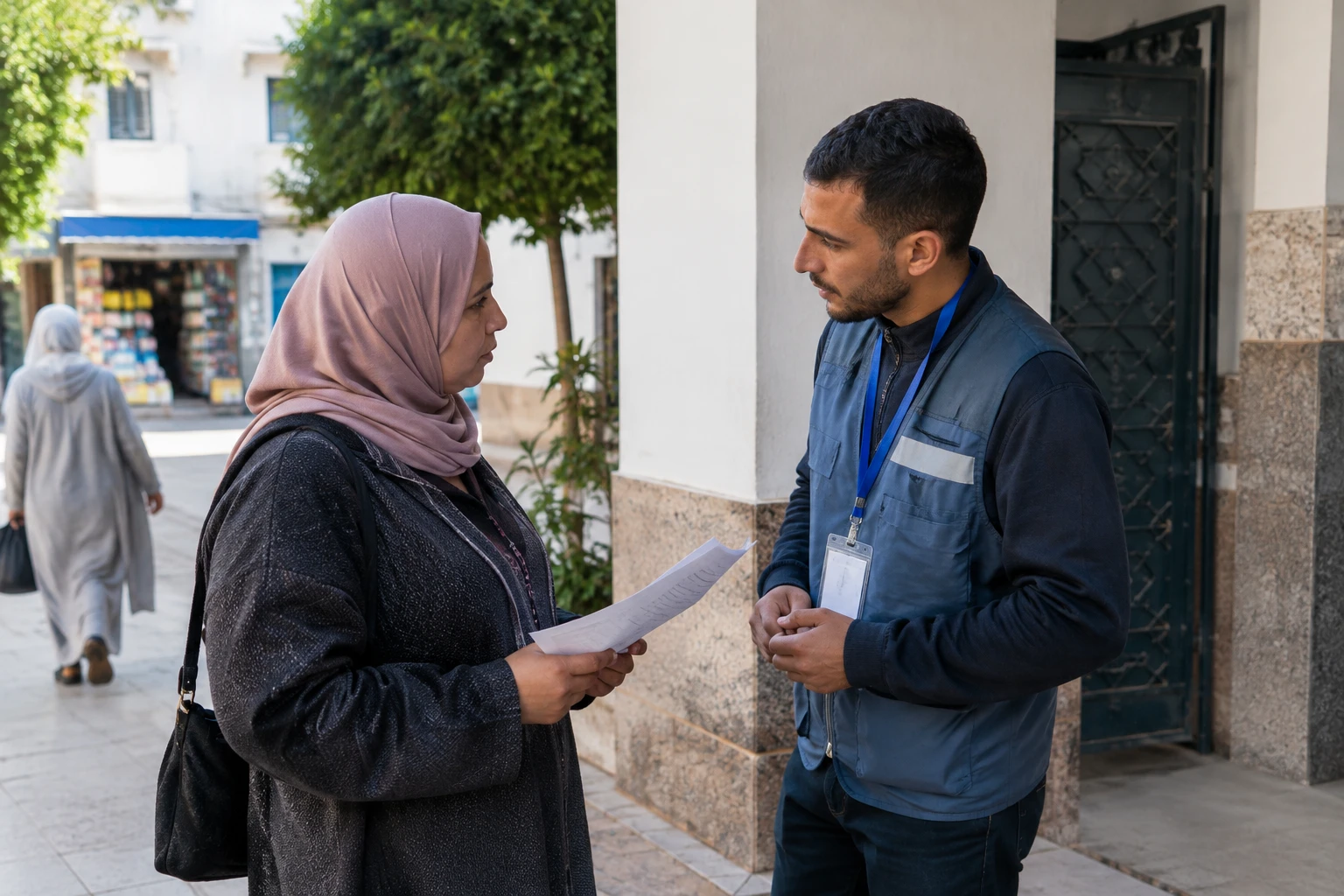
For millions of Moroccan households, direct aid has become a regular supplement to the family budget. From 2027, its monthly minimum is due to increase. The question will be whether the rise keeps pace with actual expenses and reaches the families most in need.
A planned increase in an already extensive scheme
The Government Council, which met in Rabat on 12 November 2026, approved a draft decree raising the minimum fixed assistance payment from 500 to 600 dirhams, with effect from 1 January 2027. The increase is 20%. The text then provides for step-by-step increases to 1,000 dirhams in 2031. This is a draft regulation adopted by the Council, not an increase already being paid to beneficiaries. SNRT News reports the adoption of the draft decree; TelQuel confirms the announced effective date.
The amendment concerns Law No. 58.23 on direct social assistance and its implementing text. Launched in December 2023, the programme is part of Morocco’s social protection reform. The National Social Support Agency (ANSS) oversees the scheme. Eligibility is based in particular on household members’ registration in the National Population Register and the Unified Social Register, which is used to assess households’ socio-economic circumstances. The ANSS sets out the legal framework.
At the end of 2025, nearly 3.9 million households were receiving this assistance. They included 5.5 million children and around 1.7 million older people. Since the programme began, 51 billion dirhams had been paid out, according to ANSS figures reported by Morocco’s official portal. These figures show the scale of the scheme, but do not in themselves indicate whether payments cover each household’s needs. The assessment published by Maroc.ma corroborates the Agency’s 2025 annual report.
Purchasing power: national averages and local realities
The increase comes as prices move in contrasting directions. In September 2026, the national consumer price index was up 0.5% year on year, according to the High Commission for Planning (HCP). Non-food prices rose by 2.8%, including transport prices, while food prices fell by 2.5%. A national average does not necessarily reflect every household’s basket, however: spending on transport, food and housing varies according to place of residence and income. The HCP’s September 2026 figures detail these differences.
Territorial disparities provide another measure of the challenge. For 2024, the HCP puts the national multidimensional poverty rate at 6.8%, taking account of deprivation beyond income alone. It reaches 13.1% in rural areas, compared with 3% in urban areas, according to the map published by the institution. Hardship is therefore not evenly distributed: rural households may face both remoteness from services and low incomes, while urban families contend with other costs, particularly housing and transport. The HCP’s regional data shed light on these differences.
In this context, the minimum fixed payment is only one part of the assistance. The scheme also provides allowances whose levels depend on household composition and criteria related to children. The higher floor may therefore increase the disposable income of some households, but its effect will depend on the rules for implementation, price movements and the regularity of payments. The ANSS portal says assistance varies according to family circumstances and the categories concerned.
From cash transfers to an effective social system
Morocco’s government says the increase is intended to protect purchasing power. The government has also referred to monitoring prices and combating speculative practices. But cash assistance alone cannot address the causes of disparities in living standards. Access to employment, healthcare, education and public services remains crucial to protecting families over the long term.
The expansion also raises questions about funding and oversight. The 51 billion dirhams already paid out represent a significant budgetary effort. The steps planned through to 2031 will need to be backed by sufficient resources and transparent evaluation: who receives the assistance, which households remain outside the scheme, and how do payments change in relation to essential expenses? For beneficiaries, effective identification and simple procedures matter as much as the announced amount.
Regionally, Morocco is placing this reform within a wider North African debate about targeting assistance and social coverage. The Arab Maghreb Union brings together Morocco and its neighbours, but social policies are still decided at national level. The Moroccan scheme nevertheless features in continental discussions on how to link social transfers, population registers and efforts to tackle inequality, without conflating distinct economic contexts.
The next concrete step will be the announced entry into force on 1 January 2027. Until then, publication of the final arrangements and monitoring of the first payments will make it possible to assess whether the increase is actually reaching the targeted households. The 1,000-dirham goal for 2031 sets a course; its impact will depend on its funding and real purchasing power.