Algeria
 Egypt
 Libya
 Morocco
 Sudan
 Tunisia
 Benin
 Burkina Faso
 Cabo Verde
 Côte d'Ivoire
 Ghana
 Guinea
 Guinea-Bissau
 Liberia
 Mali
 Niger
 Nigeria
 Senegal
 Sierra Leone
 The Gambia
 Togo
 Cameroon
 Central African Republic
 Chad
 DR Congo
 Equatorial Guinea
 Gabon
 Republic of the Congo
 São Tomé and Príncipe
 Burundi
 Comoros
 Djibouti
 Eritrea
 Ethiopia
 Kenya
 Madagascar
 Malawi
 Mauritius
 Mozambique
 Rwanda
 Seychelles
 Somalia
 South Sudan
 Tanzania
 Uganda
 Angola
 Botswana
 Eswatini
 Lesotho
 Namibia
 South Africa
 Zambia
 Zimbabwe
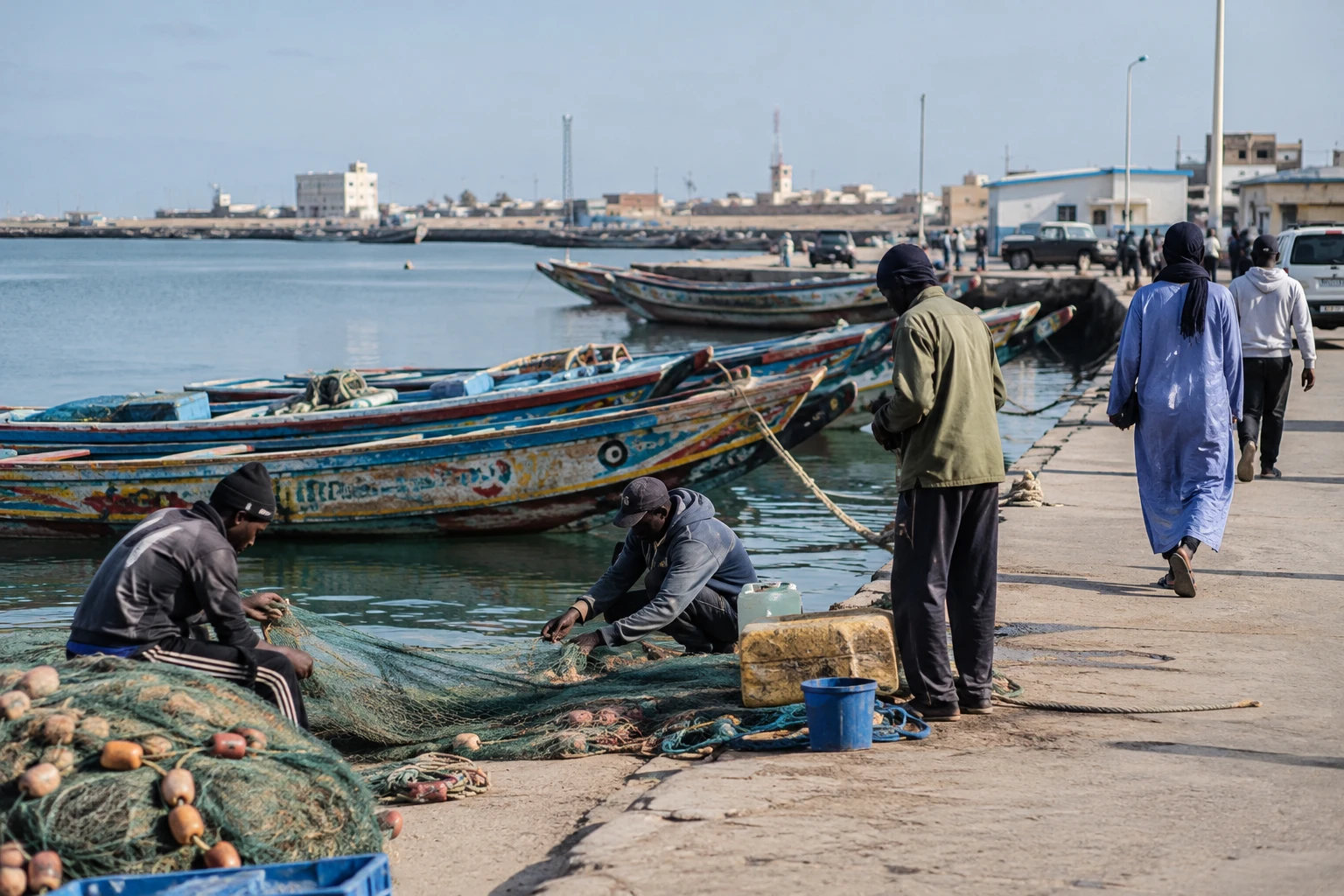
Thousands of pirogues visible in a port do not prove that a crossing to the Canaries is being prepared. In Nouadhibou, Mauritania, old satellite images have been taken out of context to fuel the idea of an imminent mass departure. The boats are really there. The interpretation accompanying the images is not.
A fishing port photographed years apart
Comparing the images with satellite archives provides a decisive piece of evidence: the boats have appeared in the same place for several years. Images taken in 2012, 2017, 2020 and 2025 show similar concentrations in Nouadhibou’s fishing port. On their own, they therefore do not document a recent mobilisation of boats for a crossing to Spain.
Images from 2026 also show fishermen working near pirogues and a fishing boat in the port. This is consistent with the satellite images: the longstanding presence of numerous boats is part of local fishing activity, not evidence of a coordinated departure. Two fact-checks published in November 2026, by RTVE in Spain and TF1 Info in France, reached the same conclusion.
The confusion rests on misleading visual reasoning: boats are visible, so they must be ready to put to sea with migrants. But a satellite image cannot reveal how a boat is used, its condition, its crew or its destination. Without a clearly established date, comparison with archival images and independent evidence, it cannot confirm an imminent operation.
Nouadhibou, a fishing city and migration transit point
Nouadhibou, a major port city in northern Mauritania, is an important fishing centre. The pirogues moored there are part of a real economic environment: fishermen, fish traders, transporters and families depend on the sector. Presenting these boats indiscriminately as migrant vessels therefore risks associating an ordinary local activity with a supposed threat, without evidence.
This clarification does not mean that departures for the Canaries do not take place. The Atlantic route links several West and North African coasts to the Spanish archipelago. Mauritania is both a transit country and, for some people, a destination. Departures by sea and shipwrecks have been reported in the region. But these separate facts do not validate a specific claim based on old images.
The route is regional: journeys may begin in different countries, and routes change according to controls, smuggling networks and conditions at sea. Arrivals in the Canaries do not, on their own, make it possible to infer that boats visible in Nouadhibou are about to depart. The migration context must be documented using on-the-ground data, not inferred from an aerial view.
An issue at the intersection of fishing, borders and human lives
For Mauritanian fishermen, the primary concern is how their port and profession are portrayed. A misleading caption can erase the everyday use of the boats and turn a place of work into a scene of alarm. For people on the move, the concern is different: narratives of an “invasion” can harden public debate and reduce diverse journeys to a collective threat.
Irregular departures carry serious risks. However, discussing them requires distinguishing established facts from viral predictions. The migration partnership signed by Mauritania and the European Union in Nouakchott on 7 March 2024 covers, among other things, migration management, the fight against smuggling networks, refugee protection and the strengthening of search-and-rescue operations. It also provides for regular dialogue between the parties.
This cooperation forms part of a broader regional relationship between countries of origin, transit and destination. It concerns Mauritanian sovereignty, safety at sea and the rights of migrants. It does not, however, turn every moored boat into an indication of a clandestine departure. Mauritania is a member of the African Union and the Arab Maghreb Union, while its relations with its West African neighbours also matter in managing regional migration.
What the images cannot prove
The viral post gives a near-term deadline and assigns a destination to the boats. The available archives prove neither. Instead, they show a recurring port configuration. The accurate formulation is therefore simple: the images are authentic, but they are old or do not prove the migrant use attributed to the boats.
The rumour has already circulated in similar forms since 2020, according to RTVE’s fact-check. Its repetition is not confirmation. It is a reminder of the importance of checking an image’s date, its exact location and how it compares with earlier views, especially when a caption claims to announce an imminent event.
What should be monitored next is not a departure inferred from a photograph, but the documented evolution of crossings and public responses: data from the authorities, observations by organisations on the ground and regional cooperation. In this case, the images make it possible to identify boats in a fishing port. They do not make it possible to announce a flotilla of migrants heading for the Canaries.