Algeria
 Egypt
 Libya
 Morocco
 Sudan
 Tunisia
 Benin
 Burkina Faso
 Cabo Verde
 Côte d'Ivoire
 Ghana
 Guinea
 Guinea-Bissau
 Liberia
 Mali
 Niger
 Nigeria
 Senegal
 Sierra Leone
 The Gambia
 Togo
 Cameroon
 Central African Republic
 Chad
 DR Congo
 Equatorial Guinea
 Gabon
 Republic of the Congo
 São Tomé and Príncipe
 Burundi
 Comoros
 Djibouti
 Eritrea
 Ethiopia
 Kenya
 Madagascar
 Malawi
 Mauritius
 Mozambique
 Rwanda
 Seychelles
 Somalia
 South Sudan
 Tanzania
 Uganda
 Angola
 Botswana
 Eswatini
 Lesotho
 Namibia
 South Africa
 Zambia
 Zimbabwe
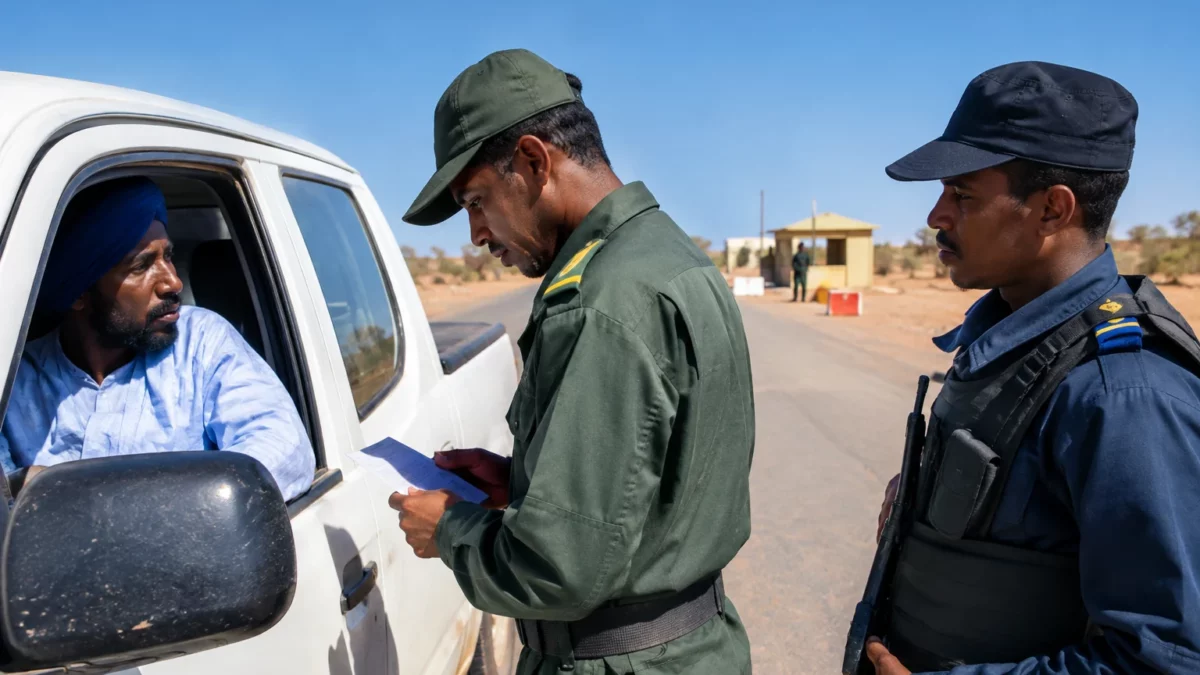
A 1,700-kilogram shipment was intercepted far from the ports, in eastern Mauritania. The case highlights a practical challenge for Nouakchott: preventing cross-border Sahel routes from being used to transport drugs between neighbouring countries.
An inland route at the heart of the investigation
The operation took place in the Daché area, in the Hodh Ech Chargui region, near the border with Mali. According to Mauritanian police, a Toyota Hilux was carrying the cocaine. Two foreign nationals were arrested. Their nationality and the countries of presumed origin and destination have not been made public.
Police say the Central Office for the Fight against Drugs monitored the network for three months before the operation. The two suspects were presented to the prosecutor on Thursday 19 November 2026. Investigators are also looking for three other people believed to be linked to the network, according to the authorities. The exact date of the interception has not been specified.
Information about the weight, location and judicial proceedings is consistent across the police statement reported by Mauritanian media outlet Rim Now, pan-African news agency APA and Agence France-Presse. The scale of the network and its intentions, however, remain at this stage claims by the police and statements attributed to the suspects.
A case to be viewed in the context of regional routes
Hodh Ech Chargui borders Mali and lies in an area where borders divide vast territories and communities linked by long-standing exchanges. The routes described by police would have followed Mauritania’s eastern and north-eastern borders. The authorities have not confirmed the full route or the countries involved.
Mauritania is an associate member of ECOWAS, the West African regional integration organisation, having left the organisation in 2000. It also has ties with the Arab Maghreb Union. Its position between the Sahel and the Maghreb makes cross-border police and judicial cooperation particularly relevant in this case. It does not, however, allow the shipment’s destination to be inferred on its own.
Cocaine trafficking in West Africa is not confined to maritime routes. An analysis by ENACT, a programme focused on organised crime in Africa, describes the use of Sahelian land routes and networks linking coastal areas to countries in the north of the continent. The study also notes that major seizures in the Sahel remain sporadic, making it risky to draw conclusions about changes in trafficking from a single operation.
A record claim, but not yet a measure of trafficking
Police describe the 1.7 tonnes as the largest seizure recorded in the sub-region. This wording should remain attributed to the authorities: the public sources consulted do not provide a comprehensive database that would allow this regional ranking to be independently verified. The figure of 1,700 kilograms, meanwhile, is reported consistently by Mauritanian and pan-African media.
The quantity seized is nevertheless exceptional compared with a recent national precedent. In June 2023, the public prosecutor’s office announced the interception of a vessel carrying 1,218 kilograms of cocaine in Mauritanian waters, in an operation conducted with the navy and customs authorities. That case involved a maritime route, whereas the current case concerns land transport in the east of the country.
Comparing the two operations is not enough to establish that trafficking is increasing. A seizure reflects both the activity of networks and the capacity of the authorities to detect a shipment. It does not show what share of flows evades checks, or whether the cargo was intended for the Mauritanian market. Police say the suspects have named one neighbouring country as the origin and another as the destination; these details remain to be verified through the judicial process.
What happens next will depend on the investigation and cooperation
For the state, the immediate challenge is to establish who organised the transport, how the shipment crossed the borders and which logistical intermediaries were involved. The announced arrests do not in themselves mean that the entire network has been dismantled. The search for three people believed to be linked to the case is ongoing, according to police.
For residents of the eastern regions, the security response must also preserve ordinary travel and trade. The authorities have not reported any general restrictions linked to the operation. It is important to distinguish criminal networks from the daily activities of border communities, without conflating the two.
Across West Africa, the case is a reminder that transit routes can link the coast, the Sahel and the Maghreb. Cooperation between police, customs and judicial authorities will be crucial to trace the network beyond the suspected transporters. The next verifiable development will be the progress of the judicial proceedings and the possible identification of the other people being sought.