Algeria
 Egypt
 Libya
 Morocco
 Sudan
 Tunisia
 Benin
 Burkina Faso
 Cabo Verde
 Côte d'Ivoire
 Ghana
 Guinea
 Guinea-Bissau
 Liberia
 Mali
 Niger
 Nigeria
 Senegal
 Sierra Leone
 The Gambia
 Togo
 Cameroon
 Central African Republic
 Chad
 DR Congo
 Equatorial Guinea
 Gabon
 Republic of the Congo
 São Tomé and Príncipe
 Burundi
 Comoros
 Djibouti
 Eritrea
 Ethiopia
 Kenya
 Madagascar
 Malawi
 Mauritius
 Mozambique
 Rwanda
 Seychelles
 Somalia
 South Sudan
 Tanzania
 Uganda
 Angola
 Botswana
 Eswatini
 Lesotho
 Namibia
 South Africa
 Zambia
 Zimbabwe
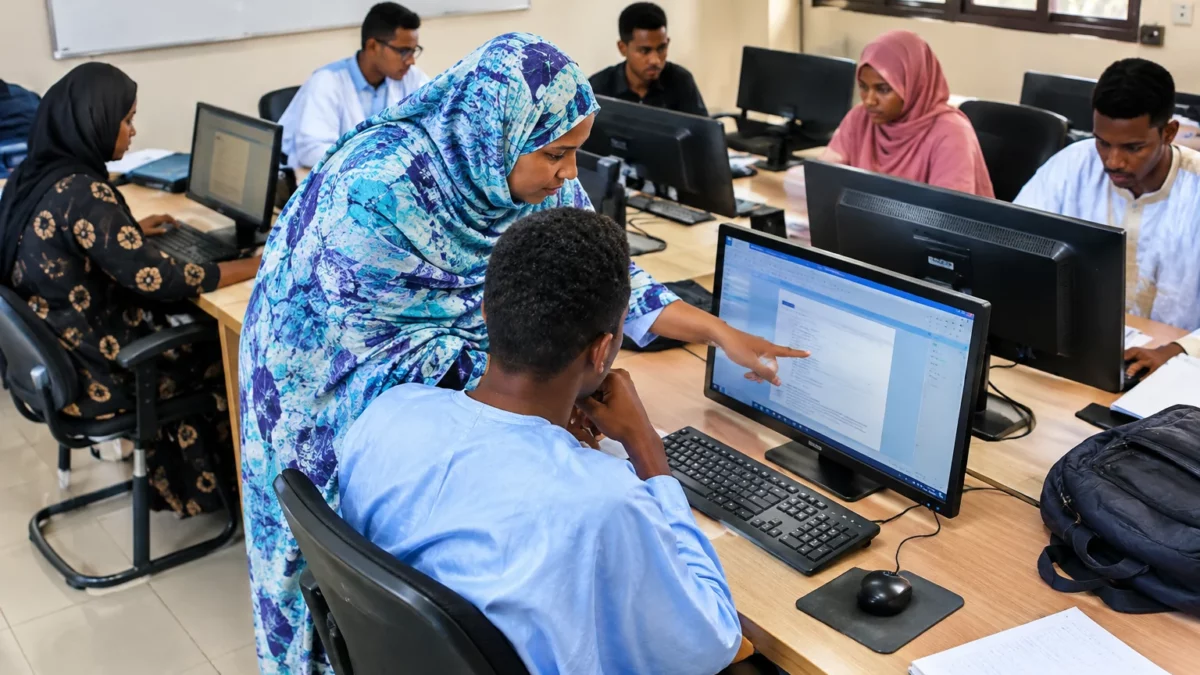
A fast network on a campus is not enough to transform higher education. Students must also be able to connect, teachers must know how to use the tools, and courses must lead to skills in demand. In Mauritania, a new agreement between Nouakchott University and Moov Mauritel puts these issues to the test.
A partnership that goes beyond an internet connection
Signed in Nouakchott on Thursday 12 November 2026, the framework agreement brings together the country’s main university and a telecoms operator. Two Mauritanian media outlets reported the signing and its main provisions. The partnership provides for fibre-optic connectivity and very high-speed internet access on campus, as well as the introduction of 5G and technologies linked to the Internet of Things, which connect devices and allow them to exchange data.
The project also refers to a “smart campus”, without publicly setting out, in the information available, its timetable, cost or the services involved. The university strand provides for support for applied research and doctoral work, internships and employment opportunities. The agreement thus aims to bring infrastructure, education and employment closer together, rather than limiting digital transformation to the installation of new equipment.
This ambition forms part of the National Higher Education Strategy to 2030. Adopted in 2022, it identifies digital technology and quality assurance as two drivers of reform. Its aims include strengthening equipment and connectivity, developing digital skills and expanding distance learning. UNESCO lists the national strategy, which covers the period 2022-2030.
From network coverage to real access
The agreement comes as commercial 5G is launched in Mauritania. Moov Mauritel says that, in its first phase, its network covers Nouakchott, the 12 regional capitals and 22 moughataas, administrative subdivisions. These figures come from the operator and describe its announced rollout, not an independent assessment of service quality or affordability.
For students and researchers in Nouakchott, a more stable connection could make it easier to access scientific journals, online courses and remote-working tools. But the benefits will not automatically be the same for institutions outside the capital. They will depend on actual connectivity, the cost of access, the availability of devices and the ability of staff to integrate these tools into courses.
The issue therefore goes beyond technical performance. A connected campus can support research and exchanges with other universities. It can also widen disparities if only some students have a computer, a subscription or a suitable environment in which to work. The central question will be which services are available, at what cost and to which groups of students.
Skills still need strengthening
The World Bank’s digital economy assessment of Mauritania highlights several obstacles in higher education: insufficient access to computer equipment, weak connectivity and gaps in basic digital skills. The report also notes a limited range of distance-learning courses. It describes a mismatch between courses that are often theoretical and the practical skills expected in the labour market.
This diagnosis gives the agreement’s training strand a practical purpose. Internships can bring students closer to the world of work, while support for doctoral students could encourage research linked to the country’s needs. However, these initiatives will deliver lasting results only if selection rules, the number of places and educational objectives are specified. The quality of supervision will matter as much as the novelty of the technologies.
Another challenge is to measure results more effectively. The World Bank notes the lack of systematic data on graduates’ employment outcomes, making it harder to assess how well courses match businesses’ needs. Without public indicators on usage, skills acquired and employment outcomes, it will be difficult to distinguish tangible progress from equipment announcements.
National and regional reach
University infrastructure also contributes to the country’s research capacity. In July 2026, the authorities inaugurated the Mauritanian Network for Higher Education and Scientific Research, designed to connect higher education and research institutions. The creation of such a network, followed by an agreement with an operator, points to two complementary levels of action: connecting institutions and developing services on a campus. The next challenge is to ensure they work together over the long term.
In West Africa, Mauritania is not a member of ECOWAS. It belongs to the Arab Maghreb Union, whose integration activities remain limited, and maintains economic and university links with its Sahelian and Atlantic neighbours. Its digital choices therefore also matter for cross-border research co-operation and the movement of skills. They form part of the African Union’s 2020-2030 digital transformation ambition, which presents technology as a driver of development across the continent.
What happens next will depend less on the “smart campus” label than on verifiable results: equitable access, teacher training, available scientific resources and prospects for graduates. For students in Nouakchott and in the regions, success will be judged by everyday use and the quality of learning, not just by the advertised speed.