Algeria
 Egypt
 Libya
 Morocco
 Sudan
 Tunisia
 Benin
 Burkina Faso
 Cabo Verde
 Côte d'Ivoire
 Ghana
 Guinea
 Guinea-Bissau
 Liberia
 Mali
 Mauritania
 Niger
 Nigeria
 Senegal
 Sierra Leone
 The Gambia
 Togo
 Cameroon
 Central African Republic
 Chad
 DR Congo
 Equatorial Guinea
 Gabon
 Republic of the Congo
 São Tomé and Príncipe
 Burundi
 Comoros
 Djibouti
 Eritrea
 Ethiopia
 Kenya
 Madagascar
 Malawi
 Mauritius
 Rwanda
 Seychelles
 Somalia
 South Sudan
 Tanzania
 Uganda
 Angola
 Botswana
 Eswatini
 Lesotho
 Namibia
 South Africa
 Zambia
 Zimbabwe

A project changing course
In Mozambique, major energy projects have often moved forward without much involvement from national businesses. This time, the signal is different: with Mphanda Nkuwa, the idea is not just to generate electricity, but also to engage a network of Mozambican entrepreneurs from the earliest stages. This is a tangible issue for Maputo, but also for provinces that too often experience megaprojects without capturing their value.
The issue goes beyond the dam itself. In a country where access to electricity is still expanding unevenly, every major project is now judged on two criteria: installed capacity, and the share of work left to SMEs, local services and skilled employment. Mphanda Nkuwa is being closely watched precisely on this front.
The national and regional context
Mphanda Nkuwa is part of a broader effort by a country seeking to become a net energy supplier in southern Africa. Mozambique already has a major asset in Cahora Bassa, one of the continent’s largest hydroelectric dams, also located on the Zambezi in Tete province. The new project is about 60 kilometres downstream from this historic facility, on the same river.
At regional level, the stakes are clear. The World Bank estimates that southern Africa faces a shortfall of about 10,000 MW, weighing on industry, services and household supply. In this context, a major site such as Mphanda Nkuwa is not just a national project. It is becoming part of the regional electricity market within the Southern African Development Community, or SADC.
The chosen structure reflects this ambition. The consortium responsible for developing the project brings together EDF, TotalEnergies and Sumitomo Corporation, alongside the Mozambican state through Electricidade de Moçambique and Hidroeléctrica de Cahora Bassa. The partners signed a joint development agreement in December 2023, with a reported split of 70% for the consortium and 30% for Mozambican public operators.
The facts: local suppliers enter the picture
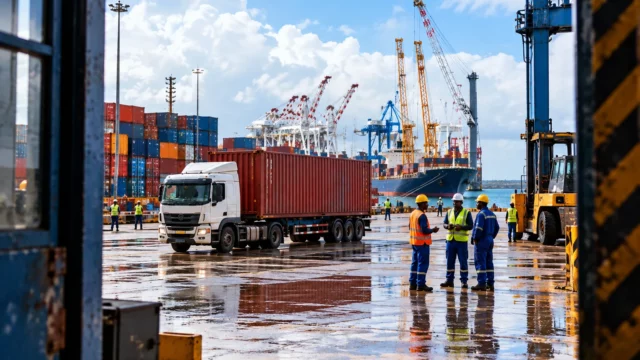
On 16 July 2026, Mozambican entrepreneurs signed their first service agreements related to the future dam at a ceremony organised by the project’s development body. These contracts do not yet launch the main construction work, but they open the door for local companies to enter the value chain.
The announcement comes as the government has strengthened its legal framework. In May 2026, Mozambique’s parliament approved a local content law, which the authorities presented as a tool to increase the participation of national businesses and workers in major projects, particularly in oil and gas. Although Mphanda Nkuwa is a hydroelectric project, the principle is the same: to ensure that major investments leave more economic capacity in the country.
The project itself is exceptional in scale. Its target capacity is 1,500 MW. The total cost, according to World Bank documents, exceeds $5 billion for the first phase and transmission component. The institution says its support will mainly take the form of guarantees to reduce political and financial risks for private investors. The African Development Bank is also working on a risk-mitigation mechanism.
The transmission component is crucial. The partners are considering a line of about 1,300 kilometres to carry electricity to industrial centres and neighbouring countries. In other words, Mphanda Nkuwa is not just about generating megawatts: it must also fit into a transmission system, without which the electricity would remain trapped at the generating site.
What this means for Mozambique’s economy
The first impact is industrial. If local contracts multiply, Mozambican SMEs can gain experience in areas where they are often absent: maintenance, logistics, technical services, goods supply, catering, security and light civil engineering. In July 2026, the Mozambican business confederation also signed a memorandum with the project office to strengthen local content, train SMEs and support women’s entrepreneurship.
The second impact is political. President Daniel Chapo has made local content a matter of economic sovereignty. By enacting and championing the new law, the government is sending investors a message: major projects remain welcome, but they will have to make more room for national players. For the state, the stakes are also fiscal and social: turning megaprojects into jobs, subcontracting opportunities and lasting skills.
The third impact concerns local communities. Tete and the areas crossed by the future infrastructure will not just see a power station and an electricity line pass through. They will also face needs around training, access to land, compensation, security and environmental monitoring. The quality of local consultation will matter as much as the speed of construction. This is often where the difference lies between a major project that is announced and one that is genuinely integrated into the local economy.
Significance beyond Mozambique
For southern Africa, Mphanda Nkuwa is a test. The region is seeking to secure supplies, reduce outages and better connect its networks. If the project is completed on schedule, with commissioning targeted for 2031, it will strengthen Mozambique’s position as a regional electricity exporter. It will also complement the country’s strategy, which is advancing in parallel on gas from the Rovuma Basin and new solar projects.
At continental level, the project illustrates a broader shift: development lenders and governments are increasingly talking about “de-risking” to attract private capital into energy infrastructure. But for African countries, the real questions remain the same: who builds, who supplies, who owns and who benefits? Mphanda Nkuwa offers a partial answer by finally putting Mozambican companies at the start of the chain. What happens next will show whether this opening remains symbolic or becomes a model.