Algeria
 Egypt
 Libya
 Morocco
 Sudan
 Tunisia
 Benin
 Burkina Faso
 Cabo Verde
 Côte d'Ivoire
 Ghana
 Guinea
 Guinea-Bissau
 Liberia
 Mali
 Mauritania
 Niger
 Nigeria
 Senegal
 Sierra Leone
 The Gambia
 Togo
 Cameroon
 Central African Republic
 Chad
 DR Congo
 Equatorial Guinea
 Gabon
 Republic of the Congo
 São Tomé and Príncipe
 Burundi
 Comoros
 Djibouti
 Eritrea
 Ethiopia
 Kenya
 Madagascar
 Malawi
 Mauritius
 Rwanda
 Seychelles
 Somalia
 South Sudan
 Tanzania
 Uganda
 Angola
 Botswana
 Eswatini
 Lesotho
 Namibia
 South Africa
 Zambia
 Zimbabwe
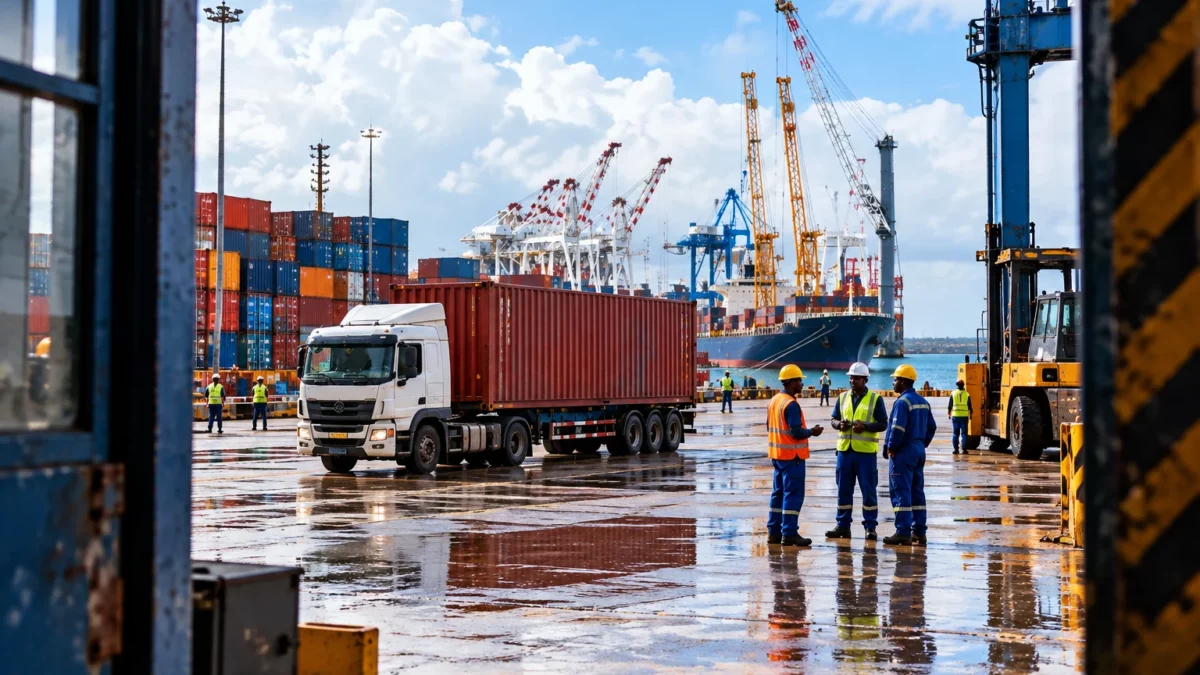
A larger port alone cannot make a corridor a competitive trade route. For Mozambique, the challenge is to turn Maputo’s increased capacity into tangible gains for businesses, carriers and the areas linked to its port.
The port serves both Mozambique’s economy and inland markets, particularly in South Africa. This regional role is part of the Maputo Corridor, which connects the port to South Africa’s Gauteng and Mpumalanga provinces by road and rail. The Southern African Development Community (SADC), a regional organisation for economic and political co-operation, identifies the corridor as one of the main routes for sub-regional trade. It remains in competition with other routes, including those serving Durban, Beira and Nacala.
Target raised before work is complete
On 18 November 2026, DP World announced an additional $35 million investment in its container terminal at the port of Maputo. The total planned investment has now reached $200 million, up from $165 million under the initial programme. The announcement followed a meeting in Maputo between Mozambican President Daniel Chapo and the group’s executive chairman, Essa Kazim.
The operator is now targeting annual capacity of 650,000 TEU in the second quarter of 2027. A TEU, or twenty-foot equivalent unit, is a measure that standardises containers to the size of a 20-foot container. The previous target was 530,000 TEU. Before the expansion, baseline capacity stood at 225,000 TEU. The new projected level is therefore nearly three times that starting point.
DP World says the project will also enable the terminal to handle larger vessels and improve operational efficiency. Work began in May 2025. These targets and figures have been announced by the company; they describe intended capacity, not volumes already handled. Mozambique’s local content office also reported the increased investment and the 650,000 TEU target.
Port capacity, however, is only one link in the chain. Goods must then move without excessive delays between quays, border posts, roads and railways. Congestion, customs delays or poor co-ordination can erode the advantage of a more efficient terminal. For importers, exporters and carriers, performance will therefore also be measured in transit time and cost.
Connecting Maputo to regional and Asian markets
DP World is also planning a new weekly shipping service between several Chinese ports and African ports, including Maputo and Dar es Salaam in Tanzania. The announced service is to call at Shanghai, Ningbo and Nansha, then Port Klang in Malaysia, before heading to Africa. It could give businesses in Mozambique and neighbouring countries regular connections to several Asian trading hubs.
The service could expand the port’s reach, but its impact will depend on its reliability, costs and demand. Shipping services must be integrated with land networks so that goods arriving in Maputo can reach their final destinations. DP World highlights its cross-border road and rail links, as well as its logistics platform in Komatipoort, South Africa.
How the benefits are shared also merits attention. Major port companies and exporters can directly benefit from increased container handling. Carriers, port workers and small local businesses will benefit from this growth only if jobs, contracts and related services also expand. Cargo in transit to neighbouring markets can strengthen the port’s regional role without, by itself, guaranteeing a corresponding increase in activity for Mozambican producers.
DP World operates the terminal and holds an indirect stake in Maputo Port Development Company (MPDC), which manages the port concession, extended until 2058. This long horizon provides a framework for investment, but it also makes oversight important: meeting commitments, service quality, integration with public infrastructure and benefits for the country.
The corridor is the next test of competitiveness
SADC describes the Maputo Corridor as a strategic link between the port and South Africa’s industrial centres. This regional integration depends on infrastructure in several countries. The port’s performance will therefore also depend on co-ordination among authorities, rail operators, road managers and customs services on both sides of the border.
For Mozambique, the expansion adds to other port development projects announced by the authorities, particularly those involving dredging and infrastructure modernisation. Maputo is not the country’s only maritime gateway: Beira and Nacala serve other regions and corridors. Their complementarity, rather than concentrating all flows in the capital, matters for connecting different production areas to external markets.
At regional level, this development illustrates competition among southern African ports to capture cargo flows and connect landlocked economies to the Indian Ocean. The next concrete milestone will be the second quarter of 2027, when DP World expects to reach its newly announced capacity. It will then be necessary to distinguish installed capacity from actual throughput and assess whether sea and land links make the corridor more reliable and accessible to its users.