Algeria
 Egypt
 Libya
 Sudan
 Tunisia
 Benin
 Burkina Faso
 Cabo Verde
 Côte d'Ivoire
 Ghana
 Guinea
 Guinea-Bissau
 Liberia
 Mali
 Mauritania
 Niger
 Nigeria
 Senegal
 Sierra Leone
 The Gambia
 Togo
 Cameroon
 Central African Republic
 Chad
 DR Congo
 Equatorial Guinea
 Gabon
 Republic of the Congo
 São Tomé and Príncipe
 Burundi
 Comoros
 Djibouti
 Eritrea
 Ethiopia
 Kenya
 Madagascar
 Malawi
 Mauritius
 Mozambique
 Rwanda
 Seychelles
 Somalia
 South Sudan
 Tanzania
 Uganda
 Angola
 Botswana
 Eswatini
 Lesotho
 Namibia
 South Africa
 Zambia
 Zimbabwe
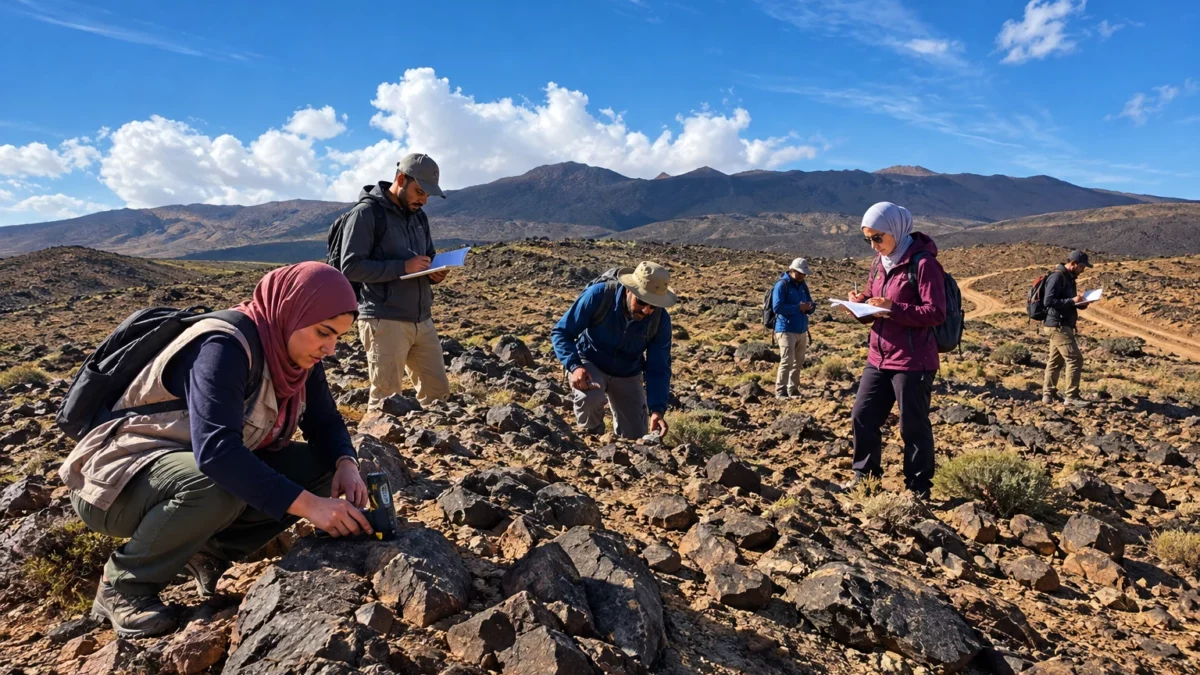
A nearly 10,000 sq km area is once again drawing attention to Morocco’s subsurface. But at Missour, the agreement signed with Australian Oil opens first with a study phase: it confirms neither a gas discovery nor exploitable reserves.
A first step, before any drilling
On 13 November 2026, in Rabat, the National Office of Hydrocarbons and Mines (ONHYM) and Australian company Australian Oil Company signed an exclusive reconnaissance contract for the onshore Missour area in north-eastern Morocco. The area covers 9,990.2 sq km. ONHYM, the public body responsible in particular for developing Morocco’s subsurface resources, confirmed the area and work programme. The African Press Agency (APA) also reports that no deposit has been confirmed under the agreement. APA’s details on the Missour reconnaissance contract.
This distinction matters. Reconnaissance involves gathering and analysing data to gain a better understanding of an area’s geology. It is not yet a production licence and does not mean that drilling will take place. Australian Oil has an initial 12-month period to carry out the planned work. It may then negotiate a separate petroleum agreement with ONHYM, which could open an eight-year exploration phase. This next step remains conditional on a new agreement between the parties.
The initial programme draws on historical data and new analytical methods. The area includes 3,415 kilometres of 2D seismic lines — measurements used to map geological structures underground — as well as results from five old wells. Australian Oil also plans to study hyperspectral satellite, gravity and aeromagnetic data, and then conduct airborne electromagnetic surveys. The announced minimum cost of this first phase is $150,000. Australian Oil’s programme for Missour.
A basin already studied, but still uncertain
Missour is not a blank slate. Shell and Repsol had previously worked in the area and identified a structure considered promising for gas. The two groups are said to have considered drilling an initial exploration well, but did not do so. The new agreement therefore allows an already documented prospect to be reassessed, but inherited data do not guarantee that a hydrocarbon accumulation is present, accessible or commercially viable.
The decision to use reconnaissance methods before any potential drilling reflects this uncertainty. The aim is to refine the picture of underground structures and identify targets that would justify more costly work. For ONHYM, the partnership brings a new operator to an inland basin. For Australian Oil, it opens an early-stage exploration position whose value will depend on technical results and future negotiations.
This cautious approach forms part of a broader trajectory. Morocco is seeking a better understanding of its gas resources while diversifying its supplies. Gas can support some industrial uses and electricity generation, but any discovery at Missour would not meet these needs in the short term. The resources, their commercial viability, the necessary infrastructure and the conditions for exploitation would all still need to be confirmed.
Different choices onshore and offshore
Australian Oil’s arrival contrasts with decisions made recently by some offshore operators. In May 2025, Energean transferred its interests in the offshore Lixus and Rissana licences to Chariot. The Anchois-3 well encountered several gas-bearing reservoirs, but did not deliver the additional volumes needed to expand the initial project. The decision did not therefore mean that all gas potential had disappeared: it put Chariot back in a position to continue assessing these licences. Chariot’s statement on the return of its offshore interests.
The situations are not directly comparable. Missour is an onshore area at the reconnaissance stage; Lixus and Rissana are offshore licences where drilling has already taken place. Together, these cases illustrate Moroccan exploration marked by selective progress and reassessment, rather than a uniform advance towards production. Moroccan media have also highlighted the need to attract partners to inland basins, while offshore activity remains more prominent in ONHYM’s portfolio. Moroccan media coverage of onshore and offshore licences.
The immediate effects of the contract are therefore mainly technical and institutional. The region’s residents and economic activities are not yet benefiting from production-related returns, since no commercial discovery has been established. Any subsequent phase would require further decisions, additional investment and suitable infrastructure. At this stage, the main expected outcome is a better understanding of the subsurface.
An energy issue that extends beyond the basin
At regional level, Morocco is a member of the Arab Maghreb Union (AMU), a North African cooperation organisation whose economic integration remains limited. The country also has energy links with Europe, notably through the Maghreb-Europe gas pipeline, which connects Morocco’s gas network to the Iberian Peninsula. This infrastructure gives any potential discovery strategic significance, but it is no indication that gas exists at Missour or will be exported in the future.
The case highlights a shared challenge across the continent: balancing energy security, investment costs and national control over decision-making. For Morocco, the next steps are concrete: the results of the 12-month reconnaissance period, any decision to negotiate a petroleum agreement, and then the selection — or otherwise — of drilling targets. Until these milestones are reached, Missour remains a geological prospect to be investigated, not a new source of gas secured.