
 Algeria
 Egypt
 Libya
 Sudan
 Tunisia
 Benin
 Burkina Faso
 Cabo Verde
 Côte d'Ivoire
 Ghana
 Guinea
 Guinea-Bissau
 Liberia
 Mali
 Mauritania
 Niger
 Nigeria
 Senegal
 Sierra Leone
 The Gambia
 Togo
 Cameroon
 Central African Republic
 Chad
 DR Congo
 Equatorial Guinea
 Gabon
 Republic of the Congo
 São Tomé and Príncipe
 Burundi
 Comoros
 Djibouti
 Eritrea
 Ethiopia
 Kenya
 Madagascar
 Malawi
 Mauritius
 Mozambique
 Rwanda
 Seychelles
 Somalia
 South Sudan
 Tanzania
 Uganda
 Angola
 Botswana
 Eswatini
 Lesotho
 Namibia
 South Africa
 Zambia
 Zimbabwe
A promise of greater purchasing power, but not yet of trust
In Morocco’s cities, the question is not only how much people earn. It is whether a salary still allows them to find somewhere to live, get around and build an adult life. In Casablanca, as in other urban centres, many young workers feel they are chasing prices that rise faster than their incomes. It was against this backdrop that the promise to raise the minimum wage to 5,000 dirhams was brandished during the parliamentary election campaign.
The announcement gained traction because it touched on a very concrete issue. In Morocco, the guaranteed interprofessional minimum wage, or SMIG, sets the legal wage floor in part of the formal economy. The debate over this threshold therefore goes beyond social policy technicalities. It says something about the place of work, the cost of living and the ability of parties to speak to young urban people, many of whom are precariously employed, freelance or in irregular work.
A decisive election in a Kingdom in flux
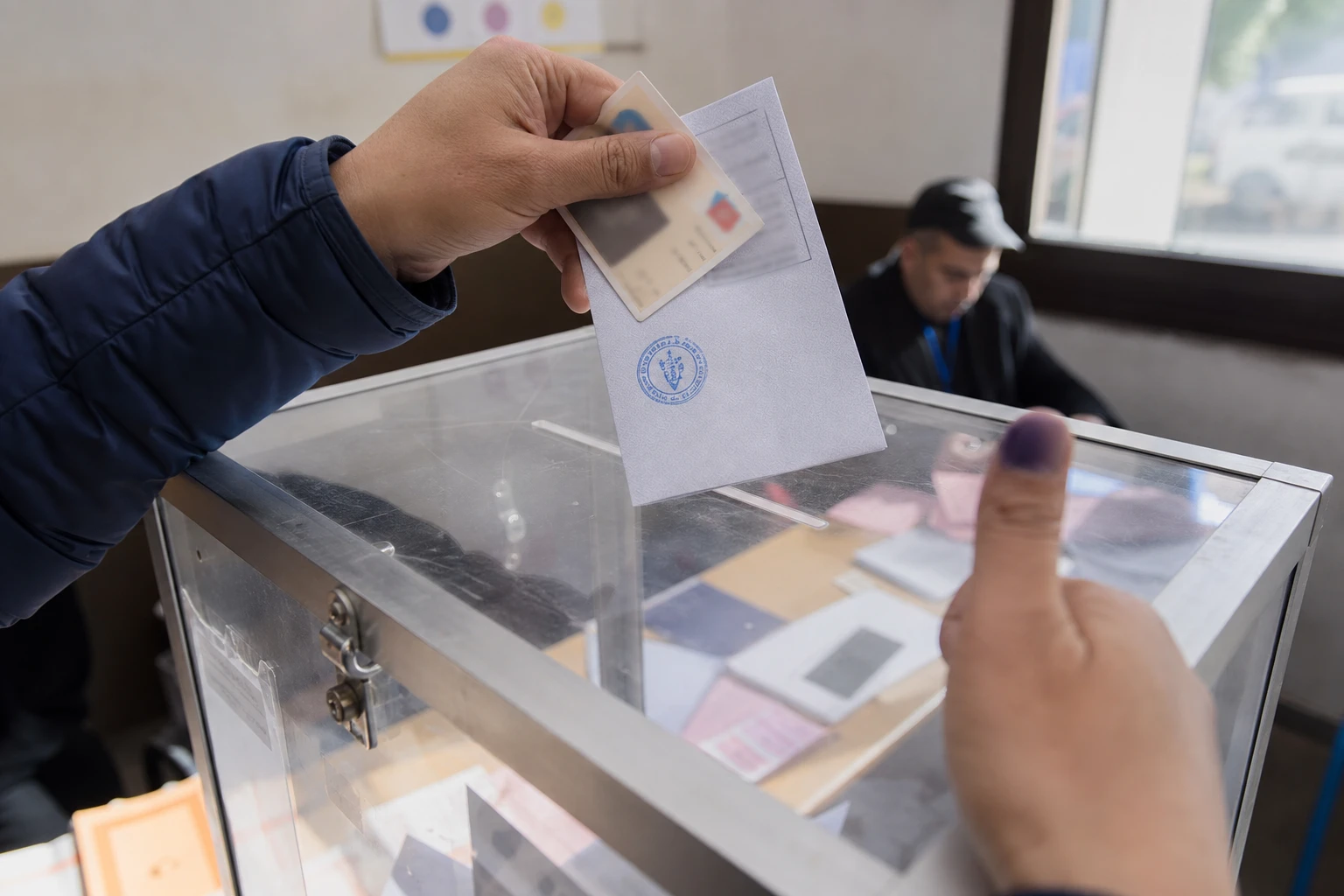
The parliamentary vote on 8 September 2021 brought an important political chapter in Morocco to a close. The elections put the National Rally of Independents and the Authenticity and Modernity Party in the spotlight; both would later form part of the future governing majority alongside the Istiqlal Party. The official election timetable is confirmed by the Kingdom’s electoral institutions.
This election also took place as part of a broader regional sequence. In North Africa, social policy choices carry considerable weight at the ballot box, as demographic pressure, rapid urbanisation and the rising cost of living shift political debate towards purchasing power. Morocco, part of both North Africa and the Maghreb, is no exception.
In Rabat, Morocco’s capital, the campaign therefore focused heavily on jobs, wages and social protection. But the point of tension remained the same: who can promise what, and how quickly? In a system where several economic levers are shared between the government, social dialogue and budgetary constraints, campaign announcements do not carry the same weight as a decision that has already been funded and negotiated. It is precisely this gap that makes many voters cautious.
Young people are present in the country, but less so on the electoral rolls
The figures confirm this distance. According to data from the High Commission for Planning (HCP), people aged 18-34 accounted for 19% of registered voters in 2021, even though they made up a larger share of the country’s population. As of 31 July 2021, Morocco had 17.509 million people registered on the electoral rolls, with a registration rate of 69.4%. The rate fell to 33.6% among 18-24-year-olds, pointing to a clear disconnect between young people’s place in society and their participation in elections.
This disconnect is not limited to voting. It also reflects the precarious nature of economic integration. In 2021, national unemployment remained high among 15-24-year-olds, at more than 31% in the third quarter and then 32.7% in the fourth quarter, according to HCP publications. The same source notes that a significant proportion of young people remain outside the labour market, often without training, a job or any immediate prospect of a stable income.
In this context, raising the minimum wage to 5,000 dirhams may seem significant symbolically, but insufficient for a generation facing high urban rents, discontinuous career paths and a proliferation of informal contracts. The contrast is particularly visible in Casablanca: the metropolis concentrates opportunities, but also the heaviest expenses. The problem is therefore not just the level of the SMIG. It is the gap between this threshold and the reality of the labour market.
The real challenge: moving from promise to mechanism
The controversy over 5,000 dirhams reveals a broader issue: the credibility of parties in the eyes of a generation that no longer identifies with slogans. Many young Moroccans are not just asking for a nominal increase. They want clear pathways: a first job, a salary that keeps pace with inflation, accessible social protection and a real chance to plan for the future. Without this, the wage pledge is seen as a campaign figure, not a change in people’s lives.
The issue also affects both the formal and informal economies. In registered companies, an increase in the wage floor changes costs, wage hierarchies and, at times, sectoral negotiations. In informal activities, it may have no direct effect. That is why young freelancers, intermittent employees and service workers often feel doubly frustrated: they face the rising cost of living but do not fully benefit from the protections meant to accompany salaried employment.
In Morocco in 2021, the campaign thus served as a litmus test. Parties highlighted purchasing power, health, education and employment. Yet the decisive question remained the same: how can a campaign promise be turned into sustainable public policy without widening the gap between cities and outlying areas, graduates and non-graduates, stable employees and precarious workers? This is what voters, especially younger ones, used to judge the political offer.
A signal to watch well beyond Morocco
This Moroccan episode goes beyond the national context. In several African countries, young urban people are looking for more tangible answers on employment, housing and social mobility. When the minimum wage becomes a central issue, the debate acts as a test of trust between parties and a generation that pays less attention to party initials than to concrete results. Morocco, in North Africa, thus illustrates a continental trend: elections are increasingly won by speaking to people’s everyday social concerns, not just by addressing major institutional balances.
The day after the vote, the real question was not who had come up with the best slogan. It was whether the future majority could turn its commitments into higher incomes, employment policies and better integration of young people. This is where the difference lies, in Morocco as elsewhere in North Africa, between a skilful campaign and social expectations left disappointed over the long term.



