
 Algeria
 Egypt
 Libya
 Sudan
 Tunisia
 Benin
 Burkina Faso
 Cabo Verde
 Côte d'Ivoire
 Ghana
 Guinea
 Guinea-Bissau
 Liberia
 Mali
 Mauritania
 Niger
 Nigeria
 Senegal
 Sierra Leone
 The Gambia
 Togo
 Cameroon
 Central African Republic
 Chad
 DR Congo
 Equatorial Guinea
 Gabon
 Republic of the Congo
 São Tomé and Príncipe
 Burundi
 Comoros
 Djibouti
 Eritrea
 Ethiopia
 Kenya
 Madagascar
 Malawi
 Mauritius
 Mozambique
 Rwanda
 Seychelles
 Somalia
 South Sudan
 Tanzania
 Uganda
 Angola
 Botswana
 Eswatini
 Lesotho
 Namibia
 South Africa
 Zambia
 Zimbabwe
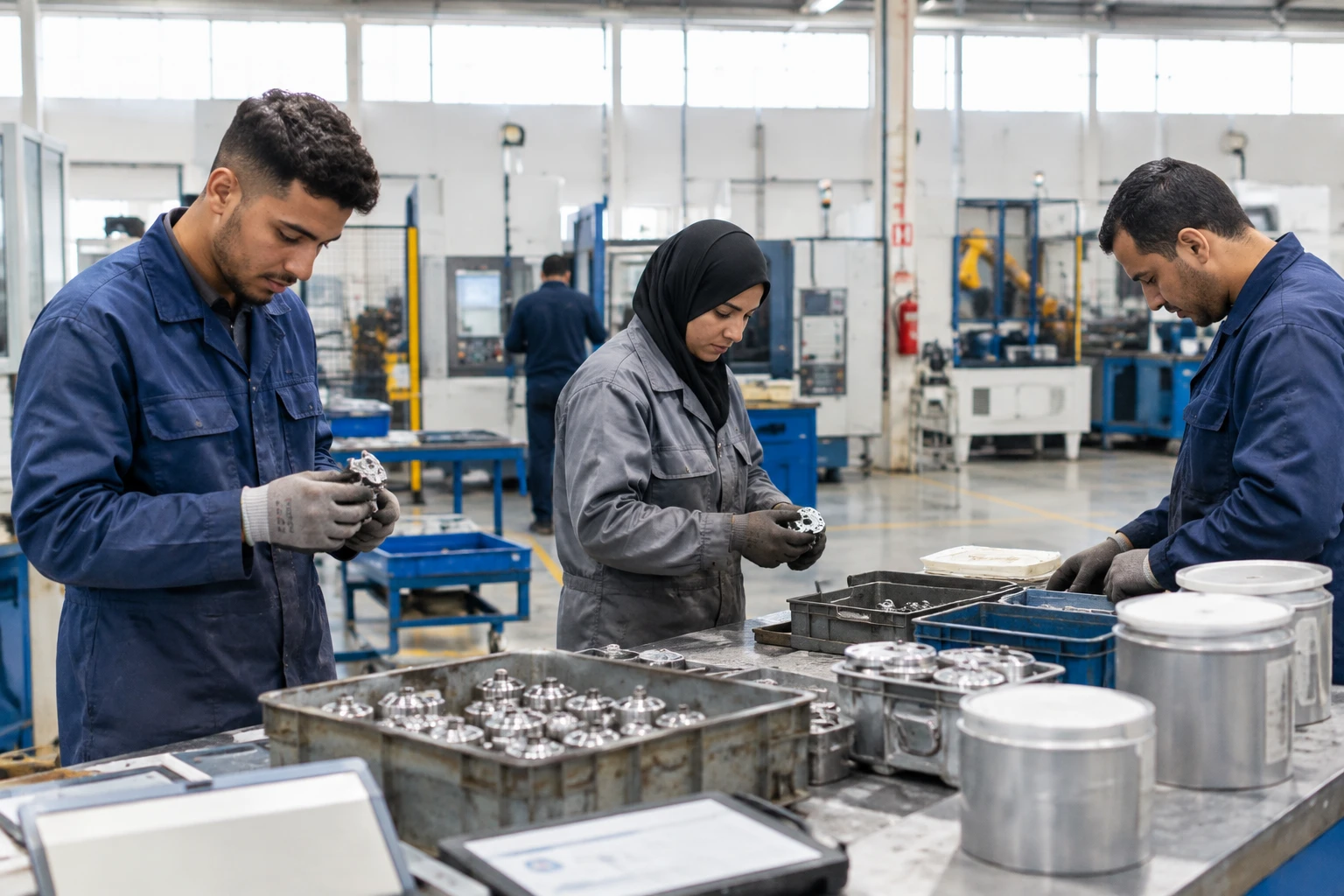
In Kénitra, the next stage of Morocco’s automotive industry is taking shape upstream of assembly: in the materials used to make batteries. The project brings together two foreign groups, but its real significance will also depend on the role played by local suppliers, skills and jobs.
An established industrial hub
The Rabat-Salé-Kénitra region is no newcomer to the automotive industry. The Moroccan industrial barometer, published in 2025 using 2024 data, attributes 29% of national automotive revenue to the region. Tanger-Tétouan-Al Hoceïma accounts for 53%, while Casablanca-Settat represents 14%. Kénitra is therefore part of a sector spread across several hubs, rather than an activity concentrated in a single city.
Nationwide, the automotive industry generated nearly 196 billion dirhams in revenue in 2024, according to Morocco’s Ministry of Industry and Trade. The sector employed more than 250,000 people directly. These figures describe an industry that has become central to Morocco’s economy, but they do not, by themselves, show what share of the value goes to local businesses.
The Rabat-Salé-Kénitra region generated nearly 101 billion dirhams in industrial revenue in 2024, up 6.6% year on year. The barometer says this total has almost doubled since 2021. The automotive industry accounts for nearly half of the region’s industrial jobs. However, its workforce fell by 1% in 2024, while mechanical engineering and metallurgy grew by 25.6%, plastics by 14.6% and chemicals and para-chemicals by 9.1%.
Batteries add a new link in the chain
On 28 September 2026, Volkswagen, its battery-focused subsidiary PowerCo and Chinese manufacturer Gotion High-Tech announced several joint ventures. One is to produce LFP battery cathode materials in Kénitra, using lithium iron phosphate technology. The cathode is an essential battery component. LFP refers to a chemistry used in, among other things, electric vehicles.
The Moroccan project is part of a broader partnership between the groups, which also includes projects in Spain and Slovakia. According to information provided to Moroccan media, Gotion is to hold 51% of the Kénitra joint venture and PowerCo 49%. The announced investment by PowerCo in the Moroccan and Slovak sites is about €470mn by 2030. Annual production of 100,000 tonnes of cathode materials is envisaged in Kénitra, although no start date has been confirmed for the facility.
The announcement builds on a project already under way. In July 2026, the African Development Bank announced a $110mn loan to Gotion Power Morocco to support an integrated LFP battery plant in the Rabat-Salé-Kénitra free zone. The bank also said it intended to mobilise up to a further $162.6mn from financial partners. This is a distinct project in its components, but is linked to the development of the same industrial battery ecosystem.
For the groups, Kénitra could bring component production closer to their sites and markets. For Morocco, the challenge is to turn this investment into benefits beyond financial flows: local subcontracting, technical training, skills transfer and the ability of Moroccan businesses to supply components that meet quality and cost requirements.
Local benefits remain to be measured
The region’s industrial diversity could help forge these links. Plastics, chemicals, mechanical engineering and metallurgy provide expertise that could serve several branches of the automotive industry. But geographical proximity does not guarantee that a Moroccan small or medium-sized business will win a contract. Technological requirements, volumes and competition between suppliers will all influence how orders are allocated.
Employment deserves the same attention. The automotive industry accounts for a large share of the region’s industrial jobs, but the fall in its workforce in 2024 is a reminder that revenue growth and employment growth do not always go hand in hand. The benefits of a new facility will also depend on the qualifications required, the training offered and the jobs actually available to workers in the region.
The barometer also reports 6.4 billion dirhams of industrial investment in Rabat-Salé-Kénitra in 2024, up 27.1% year on year. It does not specify what share went to the automotive industry. Nationwide, automotive investment reached 15.7 billion dirhams in 2024, compared with 8.1 billion in 2021. These figures point to an acceleration, but do not make it possible to attribute the entire increase to Kénitra.
A Moroccan project with regional implications
Morocco is seeking to strengthen its position as an industrial base serving overseas markets. Adding battery materials to Kénitra’s ecosystem could reduce some supply-chain steps currently carried out elsewhere. However, announcing a plant is not enough to show that a complete supply chain will be produced in the country. The share of local inputs, the site’s actual ramp-up and the destination of the materials will need to be monitored.
Across Africa, the project speaks to a broader question: can the continent take part in manufacturing and processing components linked to the energy transition, beyond extracting raw materials or importing finished products? The African Development Bank presents the integrated battery plant as a lever for developing an African ecosystem. That ambition will need to be assessed through concrete results: jobs, skills, local procurement and access to markets for regional producers.
For Kénitra and Morocco, the next decisive indicator will therefore not be announced capacity alone. It will be how the project connects with existing plants, Moroccan businesses and workforce training, while construction and production timelines remain to be specified.



