Algeria
 Egypt
 Libya
 Sudan
 Tunisia
 Benin
 Burkina Faso
 Cabo Verde
 Côte d'Ivoire
 Ghana
 Guinea
 Guinea-Bissau
 Liberia
 Mali
 Mauritania
 Niger
 Nigeria
 Senegal
 Sierra Leone
 The Gambia
 Togo
 Cameroon
 Central African Republic
 Chad
 DR Congo
 Equatorial Guinea
 Gabon
 Republic of the Congo
 São Tomé and Príncipe
 Burundi
 Comoros
 Djibouti
 Eritrea
 Ethiopia
 Kenya
 Madagascar
 Malawi
 Mauritius
 Mozambique
 Rwanda
 Seychelles
 Somalia
 South Sudan
 Tanzania
 Uganda
 Angola
 Botswana
 Eswatini
 Lesotho
 Namibia
 South Africa
 Zambia
 Zimbabwe
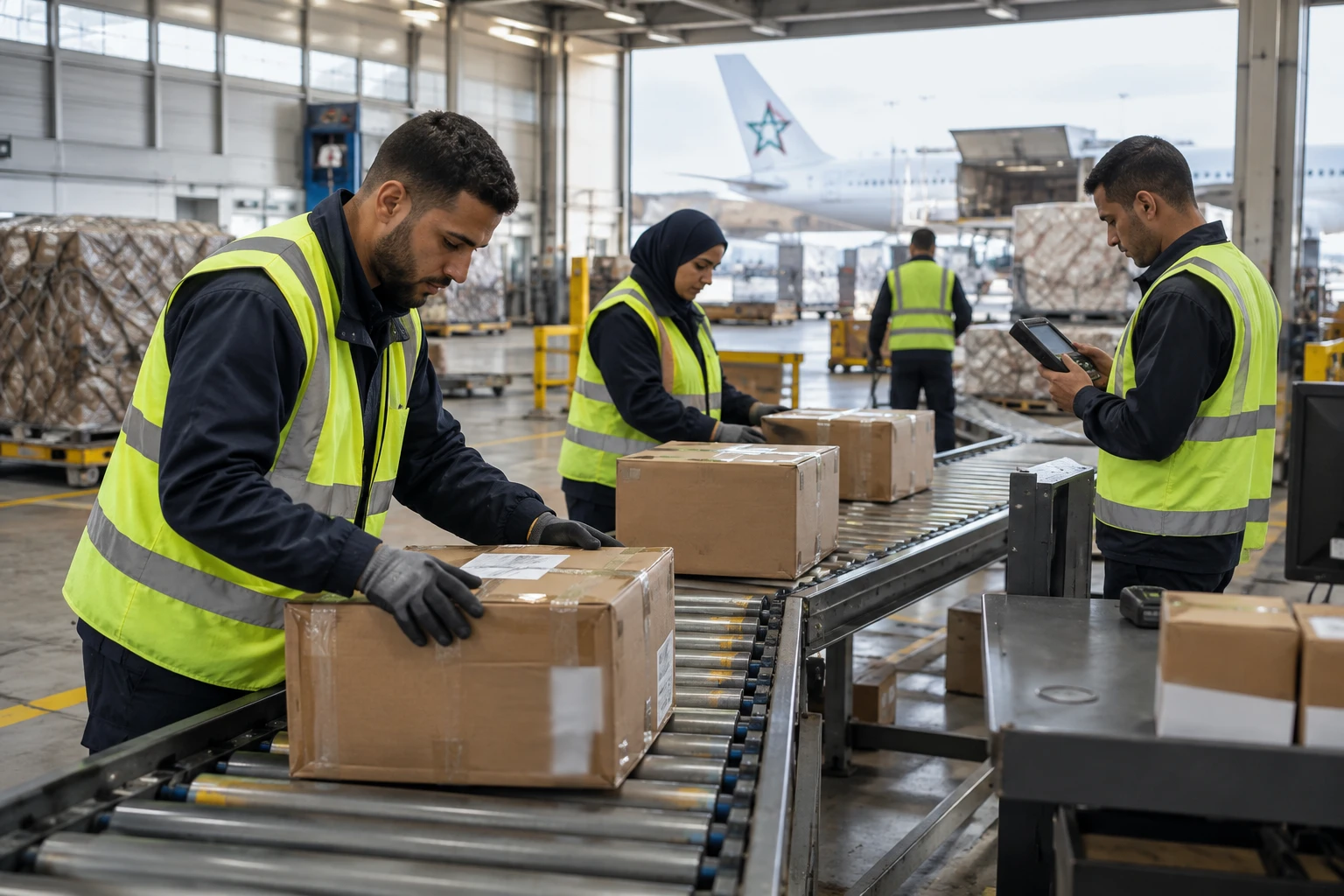
Nearly six in ten passengers pass through Casablanca or Marrakech. This concentration gives the two airports a central role in Morocco’s mobility, but it also raises a practical question: how can rising traffic be accommodated without leaving other regions behind in air links and investment?
A network dominated by two major hubs
Between January and September 2026, Moroccan airports handled 29,330,764 passengers, up 8.74% on the same period in 2025. Figures from the National Airports Office (ONDA), carried by SNRT News, citing a MAP dispatch, were also reported by Moroccan media outlet LeBrief.
Casablanca Mohammed V led with 9.36 million travellers. Marrakech-Menara followed with 8.11 million. Together, the two hubs handled around 17.47 million passengers, nearly 60% of the national total. Agadir Al Massira welcomed 2.79 million, Tangier Ibn Battouta 2.33 million and Rabat-Salé 1.90 million.
The increase is not confined to the two largest airports. It spans international flights and domestic travel. International traffic reached 26.15 million passengers, up 8.73%. Domestic traffic rose 8.88% to 3.18 million. Comparable percentage growth does not, however, mean the two markets are of equal size: international routes account for most activity.
Growth driven by international routes
Europe remains by far Morocco’s largest international market. It accounted for 21.67 million passengers over nine months, an increase of 9.05%. Traffic on routes to Africa rose 13.62% to 1.58 million travellers. Routes to North America were up 13.23%, to 771,932 passengers. The published figures therefore show growth across several markets, although their volumes remain very different.
Across the network, aircraft movements reached 214,607, up 9.70% on a year earlier. Air freight also grew: 83,744.45 tonnes, an increase of 14.29%. These indicators broaden the picture of traffic. Airports serve travellers, but also trade in goods and activities that depend on their rapid transport.
Passenger growth is therefore only part of the equation. Terminal capacity, aircraft movement management and freight handling must keep pace. Investment in airports will need to meet these requirements while taking account of differences in passenger numbers between hubs.
Regional links, another measure of performance
A major airport concentrates flights and can make connections easier. But for travellers, access to the network also depends on whether suitable routes are available from their city. Flight frequency, cost and available connections vary from place to place. Residents of major cities and tourist destinations therefore do not necessarily have the same choices as those in less well-served towns.
Passenger numbers alone are not enough to measure accessibility. They do not show the number of direct destinations, the frequency of routes or their price. Nor do they establish that less busy airports are underused: their role may depend on local travel, the seasons and the economic needs of each region.
For policymakers, the challenge is therefore twofold. Capacity must be expanded where demand is strongest, particularly in Casablanca and Marrakech, while the needs of the rest of the network are also assessed. More balanced coverage does not mean mechanically dividing investment into equal shares. It requires an assessment of the routes that serve populations and regional economies, as well as ways to connect them to the main hubs.
A Moroccan issue with regional resonance
The debate forms part of Morocco’s efforts to strengthen its air links with Europe, Africa and North America. The increase in traffic with Africa is notable, but its volume remains far below that of European routes. The available data show growth, but not yet a balanced distribution of flows between markets.
Across North Africa, air travel also depends on co-operation between countries. The Arab Maghreb Union (AMU) brings Morocco and its neighbours together within a regional framework, but rising traffic alone cannot gauge the state of integration or the ease of cross-border travel. The published statistics also distinguish the Maghreb from other African markets: they report 396,080 passengers travelling to and from Maghreb countries, while the figure of 1.58 million applies to the Africa category.
The next step will be to see how announced or committed capacity translates into practice at the different airports. Future figures will show whether growth continues and whether it brings better connectivity beyond Casablanca and Marrakech. Morocco’s network will be judged not only by the number of passengers it handles, but also by the quality of the links available to travellers and regions.