Algeria
 Egypt
 Libya
 Sudan
 Tunisia
 Benin
 Burkina Faso
 Cabo Verde
 Côte d'Ivoire
 Ghana
 Guinea
 Guinea-Bissau
 Liberia
 Mali
 Mauritania
 Niger
 Nigeria
 Senegal
 Sierra Leone
 The Gambia
 Togo
 Cameroon
 Central African Republic
 Chad
 DR Congo
 Equatorial Guinea
 Gabon
 Republic of the Congo
 São Tomé and Príncipe
 Burundi
 Comoros
 Djibouti
 Eritrea
 Ethiopia
 Kenya
 Madagascar
 Malawi
 Mauritius
 Mozambique
 Rwanda
 Seychelles
 Somalia
 South Sudan
 Tanzania
 Uganda
 Angola
 Botswana
 Eswatini
 Lesotho
 Namibia
 South Africa
 Zambia
 Zimbabwe
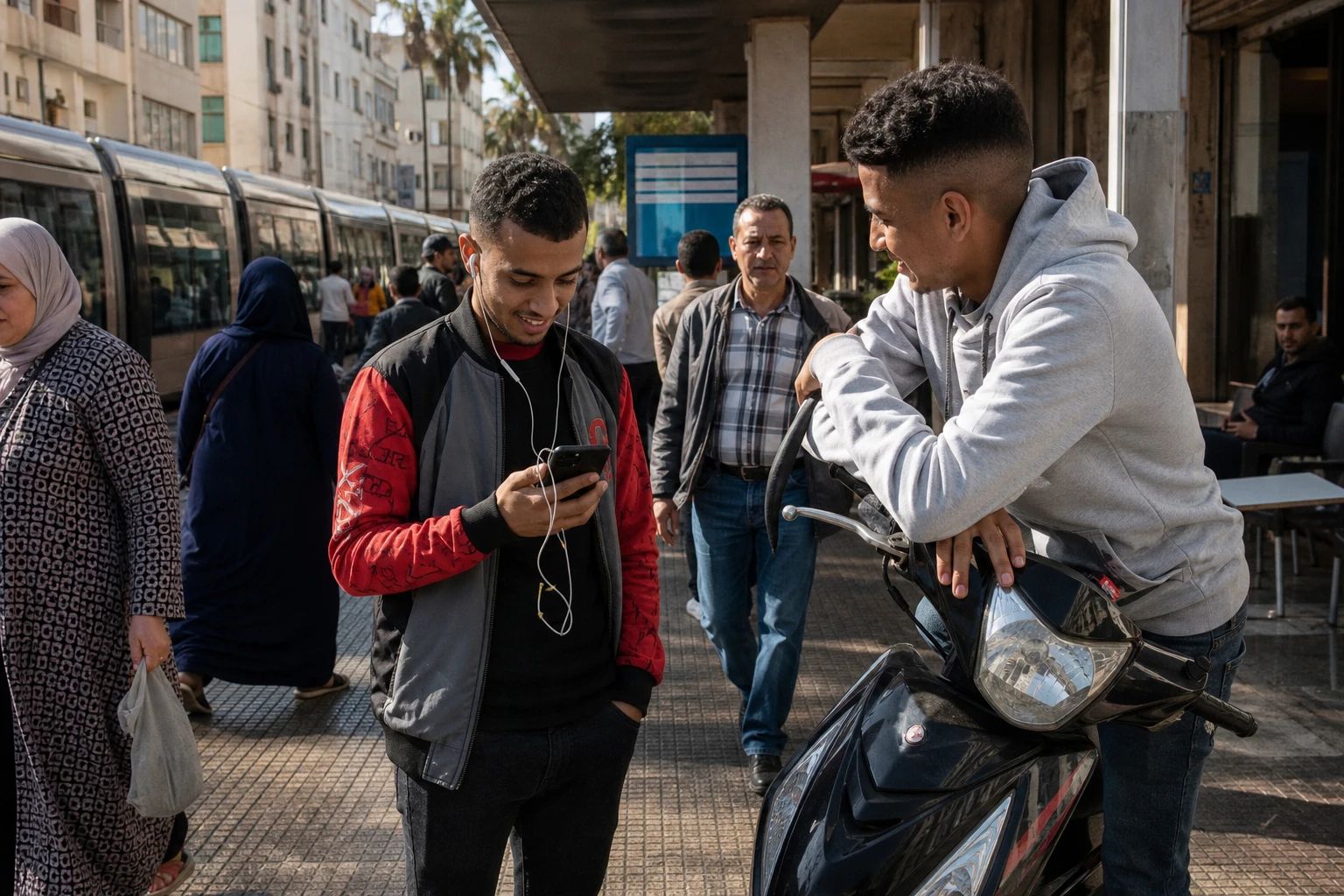
Two Moroccan trajectories, two ways of inhabiting the European scene
In L’Hospitalet de Llobregat, in the Barcelona metropolitan area, two rappers of Moroccan origin have turned the same starting point into two opposing strategies. Morad occupies the public space. Beny Jr, by contrast, advances through scarcity. Both have made the urban margins and migrant memory into a language that now travels well beyond Spain, reaching scenes in the UK, France, Germany and Italy. This circulation also says something about contemporary Morocco: a culture that travels with its diaspora and no longer needs validation from a single market to exist.
Their anchor remains La Florida, a working-class neighbourhood in L’Hospitalet often cited as the source of their aesthetic. Spanish sources recall that Morad grew up there and that both artists’ families trace their roots to Larache, in northern Morocco, while Beny Jr is linked to Chefchaouen before moving to Catalonia. In this trans-Mediterranean geography, Rabat is not a backdrop but the symbolic centre of a country whose young people also look towards Europe without ceasing to bring Moroccan references back with them, including linguistic ones, with darija woven into multilingual tracks.
Collaborations that broaden audiences, not just the honours list
On 23 July 2026, Morad features on “SEPA”, a single with Big Papa313 and D-Block Europe. The platform listing gives its release date as 23 July 2026 and says the 3-minute-54-second track was released by Zero Games Records under an exclusive distribution deal with Universal Music Spain. The release extends an already highly international run. In spring 2026, Morad also took part in “Moros”, a track assembled by Farid Bang with La Fouine, Baby Gang and 3robi.
This kind of collaboration says a great deal about today’s European urban music scene. It is built through blocks of audiences, linguistic bridges and movement between Paris, Barcelona, London, Milan and Berlin. On “Moros”, languages intersect without prior translation. On “SEPA”, Morad follows the same export logic: his name serves as a link between scenes that share neither a language nor a market, but do share neighbourhood codes, melodies and social narratives.
Cooperation between Morad and Beny Jr is nothing new. Their joint project “Capítulo 1”, released in 2022 under the K y B label, spent 43 weeks in Spain’s albums chart. This confirms it was not just a brief spotlight, but a lasting work capable of establishing a duo in the pop landscape without erasing its neighbourhood roots.
Morad, between mass popularity and repeated legal disputes
In 2024 and 2025, Morad was also in the legal news. In October 2024, a judge ended the ban preventing him from entering the blocks of La Florida after a case opened following disturbances in 2022 was dismissed. In April 2024, he had already begun serving a six-month sentence for an offence against road safety. Then, in November 2025, he was arrested again for an alleged breach of a restraining order against his stepfather, before being released, with proceedings still open.
These episodes do not negate his musical trajectory. Above all, they highlight the constant tension between an artist born in a stigmatised neighbourhood and a public sphere that exposes him as much as it consumes his work. Morad has often discussed his fraught relationship with social scrutiny and the “Moroccan” label used in Spain to mark otherness. In a 2025 interview, he stressed that his Moroccan identity and his work in Spain were not mutually exclusive. This resonates directly with the Moroccan diaspora in Europe: cultural success does not erase conflicts over representation, especially when the artist’s body remains under surveillance, subject to comment and entangled in legal proceedings.
By contrast, Beny Jr cultivates absence. His name circulates mainly through his appearances, collaborations and occasional releases. This discretion fosters a different economy of presence: rarer, more controlled, almost the opposite of Morad’s. In both cases, however, the result is the same: Spanish-Moroccan rap is no longer peripheral. It does more than accompany the rise of the Spanish scene. It is redefining it, firmly establishing Moroccan references, Maghrebi accents and a vocabulary born in the mixed neighbourhoods of the Mediterranean region.
What this moment says about Morocco and the Mediterranean region
For Morocco, the stakes extend beyond music. These careers show how the diaspora has become a leading cultural force, sometimes more audible than traditional channels. They also illustrate the strength of an imagination shared between Tangier, Nador, Larache and Chefchaouen on one side, and Barcelona, Paris and London on the other. Morocco does not appear here as a place of origin on the periphery, but as a centre of references, language and memory.
At the regional level, the phenomenon deserves attention because it is part of an increasingly dense Mediterranean circulation. Cultural exchanges between Spain, France, Italy, Germany and the UK now take place through tracks, videos and platforms, without waiting for the green light from a centralised industry. For Rabat, as for other capitals in the north of the continent, this dynamic matters as much as chart positions: it shows that a Moroccan imagination can cross borders, be reshaped in Europe and then return enriched by other languages, audiences and codes.
What happens next will depend less on grand pronouncements than on the next run of releases and concerts and, for Morad, on how the legal cases that could still weigh on his career develop. Beny Jr, meanwhile, will probably continue to rely on distance and carefully targeted appearances. Two ways of enduring, two ways of speaking to the same transnational audience, and one certainty: Moroccan diaspora rap is now a fully fledged force on the European scene.