Algeria
 Egypt
 Libya
 Morocco
 Sudan
 Tunisia
 Benin
 Burkina Faso
 Cabo Verde
 Ghana
 Guinea
 Guinea-Bissau
 Liberia
 Mali
 Mauritania
 Niger
 Nigeria
 Senegal
 Sierra Leone
 The Gambia
 Togo
 Cameroon
 Central African Republic
 Chad
 DR Congo
 Equatorial Guinea
 Gabon
 Republic of the Congo
 São Tomé and Príncipe
 Burundi
 Comoros
 Djibouti
 Eritrea
 Ethiopia
 Kenya
 Madagascar
 Malawi
 Mauritius
 Mozambique
 Rwanda
 Seychelles
 Somalia
 South Sudan
 Tanzania
 Uganda
 Angola
 Botswana
 Eswatini
 Lesotho
 Namibia
 South Africa
 Zambia
 Zimbabwe
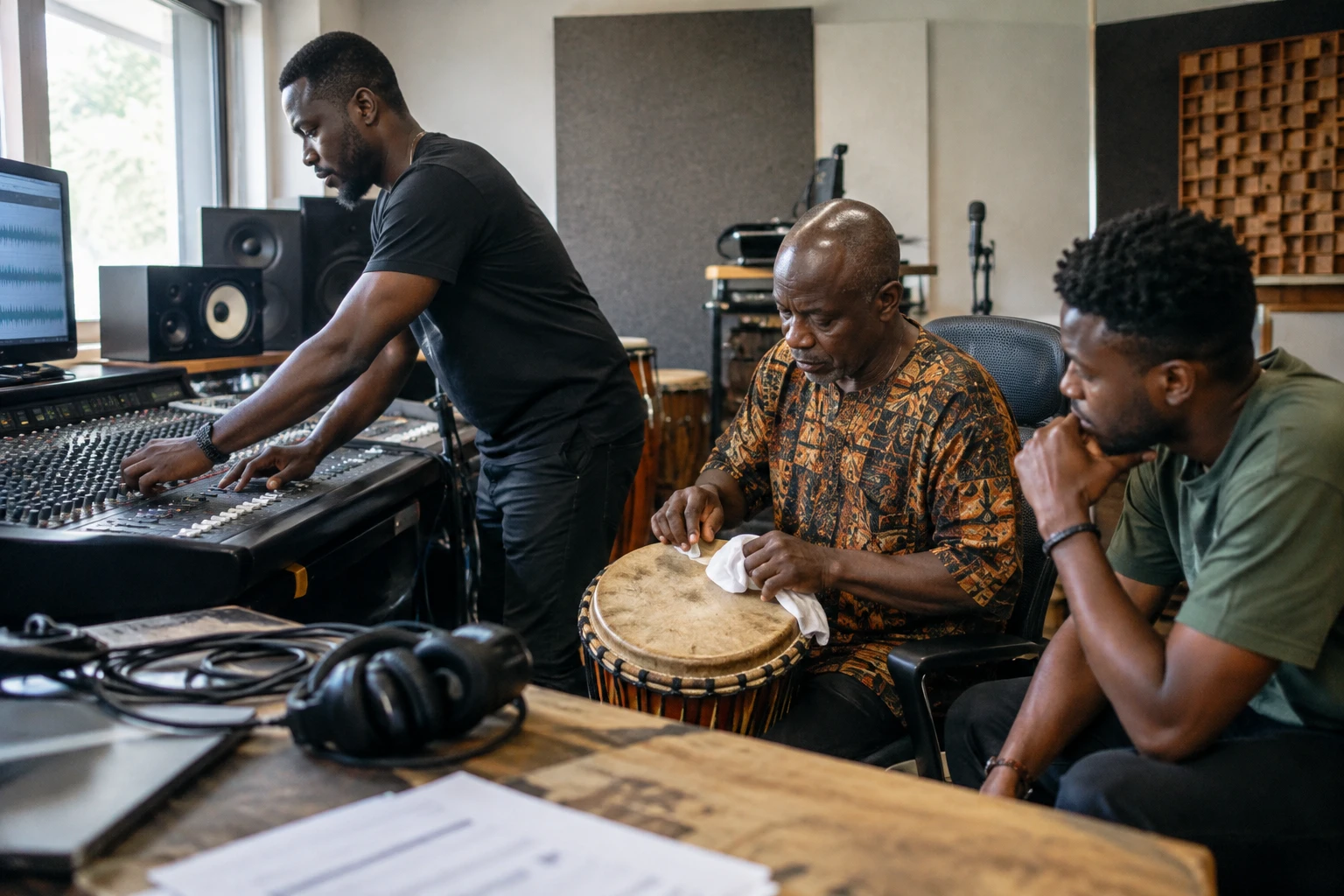
A rhythm can become a signature, then a shared heritage. In Côte d’Ivoire, Meiway’s zoblazo has crossed generations without losing touch with its roots: today, his exchanges with young artists such as Didi B extend this story and raise questions about the passing on of musical heritage in an industry in flux.
A sound born in Côte d’Ivoire, open to influences
Born in Grand-Bassam, Frédéric Désiré Ehui, known as Meiway, launched his recording career with Ayibebou in 1989. He went on to shape zoblazo, a style of dance and music inspired in particular by rhythms from southern Côte d’Ivoire. His official website describes this creation as the thread running through his career. Meiway’s official biography traces the main stages of his discography.
Zoblazo combines dance rhythms, brass and choreographed movements. The dance of the white handkerchiefs, which often accompanies this music, is one of its recognisable hallmarks. But reducing the work to a festive formula would overlook its lyrics and evolution. From his first albums, Meiway developed a distinctive musical identity while varying the arrangements.
This openness is clear on Extraterrestre – 600 % Zoblazo. The album was released in 1999, on the occasion of the artist’s tenth year in the business — not in 2000, a date sometimes associated with its distribution or presentation. African music specialist Afrisson lists contributions from Cameroonian saxophonist Manu Dibango, Antillean guitarist Jacob Desvarieux and Jean-Claude Naimro, a member of Kassav’. These collaborations place the record within a musical flow linking West Africa, Cameroon and the Antilles. Afrisson’s album entry details these contributions.
Collaboration as a passing of the baton
Dialogue between generations is another constant in his career. Meiway recently recorded “On a loupé” with Ivorian rapper Didi B. The song brings together two artists from different eras and musical idioms: one has established zoblazo over the long term, while the other has made his mark in contemporary Ivorian rap. This meeting does not mean that their worlds merge. Rather, it shows how a local scene can accommodate several aesthetics.
An Ivorian media outlet reported that Didi B described Meiway’s music as timeless. This praise reflects recognition between artists, but is not enough on its own to gauge the public’s response to the track. The collaboration nevertheless fits into a long-standing pattern of crossovers: Meiway has worked with musicians from other francophone and African spheres without abandoning the Ivorian touchstones of his repertoire.
The collaborations with Manu Dibango and Jacob Desvarieux are documented for Extraterrestre. Other pairings, notably with Lokua Kanza and Congolese singer Koffi Olomidé, are also mentioned in music catalogues and presentations of works. The dates and credits for each track are not always consistently established in the sources consulted. It is therefore best to avoid assigning them a precise chronology without further verification.
For young artists, this kind of duet can offer a musical memory and a wider audience. For established figures, it provides a way to engage with new codes, particularly those of rap and digital platforms. Collaboration guarantees neither commercial success nor the automatic passing on of a legacy. It does, however, create a space where references can circulate, change and be reinterpreted.
A national career in a regional market
Côte d’Ivoire has a music scene whose influence extends beyond its borders. Abidjan, the country’s main economic and cultural centre, is home to studios, media outlets and performance venues, while Yamoussoukro remains the political capital. Ivorian artists also operate within a West African sphere in which languages, dances, audiences and production models circulate. This regional reality gives collaborations a reach beyond the meeting of two celebrities alone.
Meiway’s career also illustrates the role artists play in representing the country’s culture. Zoblazo draws on Ivorian references, but its development has been shaped by musicians and influences from elsewhere. It is therefore not a fixed tradition or an isolated marker: it is an artistic proposition that has been built, disseminated and renewed through contact with other scenes.
This circulation nevertheless raises practical questions. Revenue from recorded music, concerts and platforms does not always benefit artists, producers and technical teams equally. Young musicians need visibility, but also structures capable of supporting creation, rights management and touring. The profile of a collaboration attracts attention; it does not replace these working conditions.
What comes next will show how the legacy is passed on
For Ivorian music, the challenge is not to choose between heritage and novelty. It is to enable artists to build their own idioms while gaining access to the works that came before them. The meeting between Meiway and Didi B can then be seen as a bridge, without standing for the full diversity of the Ivorian scene.
What comes next will be judged over time: new joint projects, live performances, reach among diaspora audiences and the place given to young creators in local productions. Across West Africa, where collaborations readily cross borders, the ability to protect rights and recognise each person’s contribution will matter as much as visibility. Zoblazo continues to travel, carried by an Ivorian signature that remains open to the changes of its time.