Algeria
 Egypt
 Libya
 Morocco
 Sudan
 Tunisia
 Benin
 Burkina Faso
 Cabo Verde
 Ghana
 Guinea
 Guinea-Bissau
 Liberia
 Mali
 Mauritania
 Niger
 Nigeria
 Senegal
 Sierra Leone
 The Gambia
 Togo
 Cameroon
 Central African Republic
 Chad
 DR Congo
 Equatorial Guinea
 Gabon
 Republic of the Congo
 São Tomé and Príncipe
 Burundi
 Comoros
 Djibouti
 Eritrea
 Ethiopia
 Kenya
 Madagascar
 Malawi
 Mauritius
 Mozambique
 Rwanda
 Seychelles
 Somalia
 South Sudan
 Tanzania
 Uganda
 Angola
 Botswana
 Eswatini
 Lesotho
 Namibia
 South Africa
 Zambia
 Zimbabwe
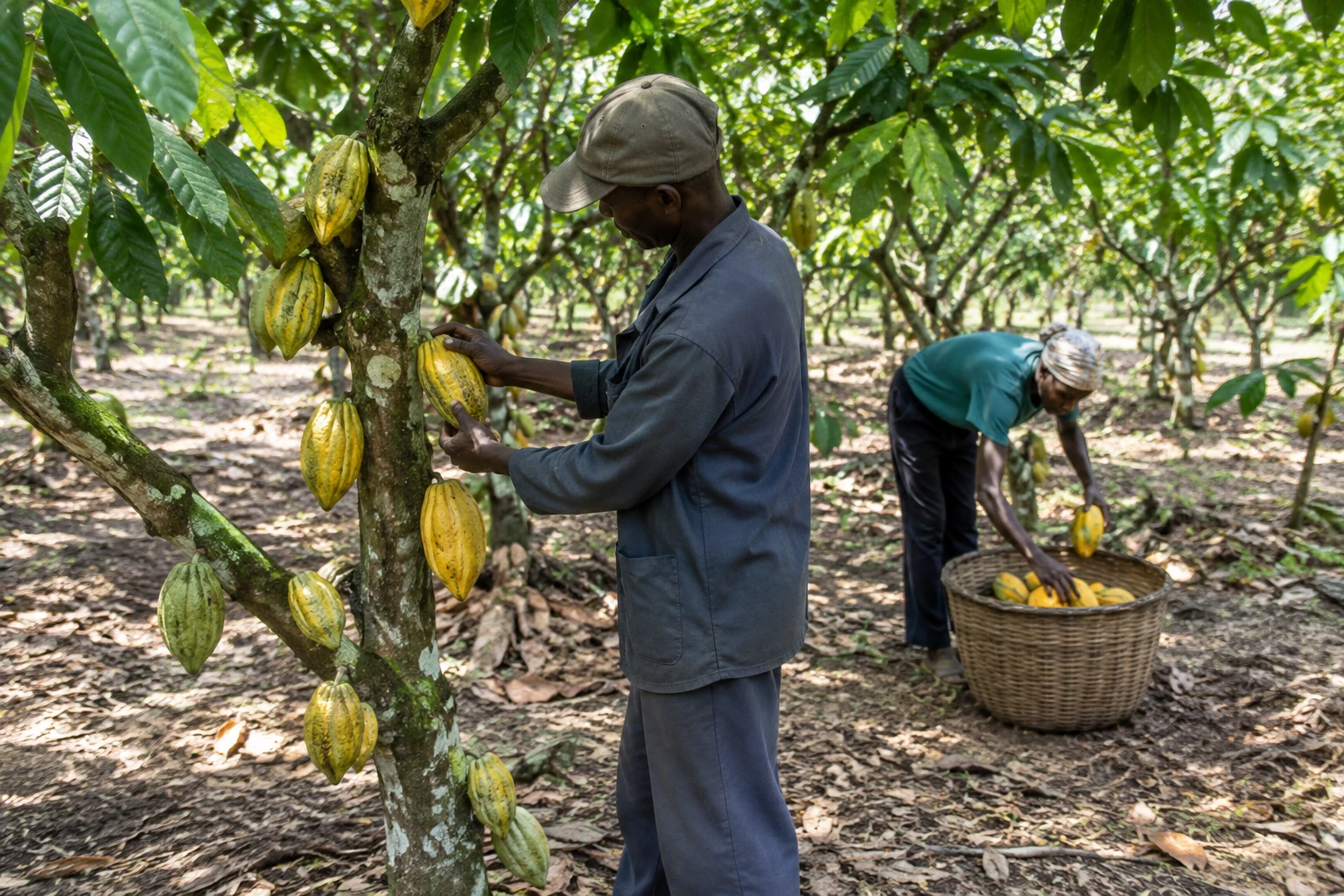
In Côte d’Ivoire’s cocoa-growing regions, rain is measured not only in the sky: it determines the next harvest and farm incomes. For the 2026-27 season, a forecast rainfall deficit is adding climate uncertainty to a sector already tested by orchard diseases and sharp price movements.
Weather warning, not yet a harvest assessment
The Société d’exploitation et de développement aéroportuaire, aéronautique et météorologique (Sodexam), Côte d’Ivoire’s public weather service, estimates that the El Niño episode could lead to a 21% to 25% fall in national cocoa production. The projection appears in a note consulted on 10 November 2026. It remains a risk estimate, not a report of a harvest already measured.
Sodexam expects rainfall to decline by 10% to 27%, temperatures to rise and the dry season to last longer. Its bulletin of 20 October had already flagged a risk of below-average rainfall in the south between October and December. Cocoa is exposed, but coffee, rubber and oil palm could also face water and heat stress.
The El Niño phenomenon is the periodic warming of surface waters in the equatorial Pacific. It can alter rainfall patterns far away. The World Meteorological Organization’s update and forecasts from the US climate centre NOAA indicate that it is intensifying and could persist into early 2027. Local effects nevertheless vary: a global forecast does not, on its own, determine the weather in each Ivorian production area.
Farms already under pressure
The climate risk adds to the plantations’ health problems. Swollen shoot virus, which causes cocoa trees to die back, and black pod disease are already weighing on some orchards. Heat and water shortages can weaken trees and limit pod formation. The scale of these effects will depend in particular on how long the deficit lasts and how it is distributed between regions.
The consequences will not be evenly distributed. A smaller harvest can reduce the volumes sold by farmers, as well as activity for co-operatives, transporters and local buyers. Farms with fewer resources to renew their trees or diversify their income also have less room to absorb a poor season. The information available does not yet allow these losses to be quantified by region or type of farm.
The main crop season began on 1 September 2026. For this season, the guaranteed minimum price for farmers is set at 1,200 CFA francs per kilogram. The price protects the amount paid for beans that meet quality criteria, but it does not guarantee the volume each producer will be able to harvest. The Ivorian Press Agency has also reported authorities’ calls for the price to be enforced and bean traceability strengthened.
Global prices and local incomes: two realities to distinguish
Market forecasts illustrate the uncertainty without resolving it. In July, consultancy StoneX projected an Ivorian harvest of 1.7 million tonnes in 2026-27, against 2 million tonnes a year earlier. It then estimated that the global market could move from an expected surplus to a deficit of 64,000 tonnes. These figures remain private-sector projections, liable to change with the weather and actual harvests.
The prospect of lower supply could support international prices. But a rise in futures contracts does not automatically translate into an equivalent increase in an Ivorian farmer’s income: the farmgate price is administered for the season, and income also depends on yield, quality and actual payment. On 6 November, a fund manager quoted by Bloomberg spoke of a possible return of New York contracts to $8,000 a tonne. This expectation should be read as a market scenario, not an official forecast; the investor quoted held financial exposure to cocoa.
Recent events also show that prices can turn quickly. In 2026, falling global prices had contributed to slower exports and a build-up of unsold stocks, according to information published by the Associated Press. The risk for the sector is therefore not only that of a global shortage: farmers remain exposed to marketing difficulties and price fluctuations, even when production outlooks change.
A shared concern with Ghana and West Africa
Côte d’Ivoire supplies about 40% of the world’s cocoa and shares a central role in international supply with Ghana. Adverse conditions affecting the two countries can therefore influence chocolate makers, traders and markets. The September 2026 economic outlook from the Central Bank of West African States already notes that crop prospects in Côte d’Ivoire and Ghana are fuelling uncertainty over prices. At regional level, the issue concerns agricultural economies and rural incomes, not just financial markets.
The response will depend on the ability to monitor rainfall closely, limit disease and support orchard renewal, while ensuring that the guaranteed price is respected and beans are marketed. For now, the 21% to 25% figure should be understood as a conditional warning from Sodexam. The next weather observations and the volumes actually harvested will show whether this threat materialises. Yamoussoukro, Côte d’Ivoire’s political capital, and agricultural institutions will need to monitor these indicators as the season progresses.