Algeria
 Egypt
 Libya
 Morocco
 Sudan
 Tunisia
 Benin
 Burkina Faso
 Cabo Verde
 Côte d'Ivoire
 Ghana
 Guinea
 Guinea-Bissau
 Liberia
 Mali
 Mauritania
 Niger
 Nigeria
 Senegal
 Sierra Leone
 The Gambia
 Togo
 Cameroon
 Central African Republic
 Chad
 Equatorial Guinea
 Gabon
 Republic of the Congo
 São Tomé and Príncipe
 Burundi
 Comoros
 Djibouti
 Eritrea
 Ethiopia
 Kenya
 Madagascar
 Malawi
 Mauritius
 Mozambique
 Rwanda
 Seychelles
 Somalia
 South Sudan
 Tanzania
 Uganda
 Angola
 Botswana
 Eswatini
 Lesotho
 Namibia
 South Africa
 Zambia
 Zimbabwe

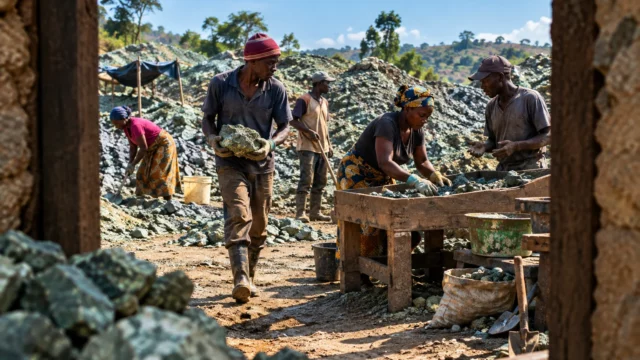
In Manono, in Tanganyika province, international authorisation could affect the timetable for mining exploration. The case highlights a practical tension: how to enforce security rules without blocking civilian activities in a sector that has become strategic for the Democratic Republic of the Congo.
Civilian equipment subject to security checks
KoBold Metals is awaiting a United Nations exemption to bring a measuring instrument into DR Congo for an airborne exploration campaign. The device, a tensor gravimeter, measures slight variations in the gravitational field. These data help map underground structures and guide mineral exploration.
The technology can, however, have both civilian and military uses. It is this so-called “dual-use” nature that makes its transfer sensitive under the UN sanctions regime concerning DR Congo. The exemption request, submitted by the US Department of State, had not received a response by the time the case became public on 30 October 2026.
The Security Council renewed the regime on 29 June 2026, through Resolution 2825, until 1 July 2027. Since 2008, the arms embargo has applied to non-governmental individuals and entities operating in DR Congo, not to the Congolese government. The committee responsible for monitoring these measures is part of the framework established by Resolution 1533. The text of the Security Council’s Resolution 2825 confirms this deadline and the scope of the regime.
A project already under way in Manono
The timing matters because the airborne campaign is intended to complement work already carried out on the ground. KoBold is continuing geological sampling and drilling at part of the site. The company also uses artificial intelligence tools to analyse the data and select areas for study. The proposed aerial survey would cover much larger areas.
At a meeting organised in Kinshasa on 29 October by the Mining Registry, exploration geologist Yves Ilayao said KoBold had already surveyed 15,000 line kilometres in southern Katanga for a copper project. He said the same effort was planned in Manono, without giving a date. This information comes from the company’s presentation, made public by KoBold; it is not independent confirmation of the progress of operations.
According to statements by its managing director in DR Congo, Benjamin Katabuka, the company holds 18 exploration permits, two of which are still being processed, covering about 3,500 sq km. Twelve relate to lithium and six to copper. He also announced a planned investment of $50 million in the first quarter of 2027, including more than $20 million paid to the Mining Registry for permits. These figures and dates remain projections attributed to KoBold’s executive.
The company fears that late authorisation could cause it to miss the most favourable period for aerial surveys, which is linked to the dry season, and delay the operation by about a year. This risk has been raised by the company; the UN has not publicly confirmed that a refusal or formal objection has been filed.
Competition also plays out through procedures
In Manono, the groups have different positions. The Manono Lithium joint venture, in which Zijin Mining plays a majority role alongside Congolese partners, is developing the north-eastern part of the deposit. Shipments of spodumene concentrate left the port of Mutowa, near Kalemie, on 22 July 2026, bound for Kigoma in Tanzania. The Centre of Expertise, Evaluation and Certification of Mineral Substances announced the certification of these first batches for export; Congolese outlet Mines.cd also reported the shipment.
KoBold, a US company, is exploring another part of the site. In correspondence sent to the Department of State in September, the company is reported to have expressed concern that China was seeking to slow its activities through the UN process. Beijing rejected the accusation, according to available reports. The public documents reviewed do not establish that a formal Chinese objection was filed. The company’s concern must therefore be distinguished from a verified diplomatic fact.
This caution matters for DR Congo. A security-related procedure does not, in itself, prove the existence of a commercial manoeuvre. But when underground resources are contested by foreign players, administrative delays can alter timetables and economic positions. Control rules, as well as mining permits and contracts, thus influence the distribution of opportunities as much as geological findings do.
Local benefits remain to be established
For the Congolese authorities, the issue is not limited to the choice of an American or Chinese partner. It also concerns control of permits, contract transparency, public revenues and local processing. Concentrate exports mark a commercial milestone, but they are not enough to measure the benefits for Tanganyika residents, the jobs created or the share of added value retained in the country.
The effects may differ among the parties. Companies seek to secure access to the deposit and organise transport. The state collects fees and must regulate operations. People living around Manono have an interest in understanding the consequences for land, services, employment and infrastructure. The information available on the exemption request does not specify these local impacts; they cannot therefore be inferred from the survey timetable alone.
DR Congo lies at the crossroads of several regional spaces: Central Africa, the Great Lakes and Southern Africa, via export corridors. The passage of shipments through Tanzania is a reminder that a project’s value also depends on roads, ports and cross-border agreements. At a continental level, the case raises a broader question: how can investment in critical minerals be attracted while keeping regulatory decisions and value creation under national control?
The next development to watch is the outcome of the exemption request before the UN sanctions committee. For KoBold, it will determine the timetable for an exploration tool; for Kinshasa, it will test the ability to reconcile security, mining competition and Congolese economic priorities.