Algeria
 Egypt
 Libya
 Morocco
 Sudan
 Tunisia
 Benin
 Burkina Faso
 Cabo Verde
 Côte d'Ivoire
 Ghana
 Guinea
 Guinea-Bissau
 Liberia
 Mali
 Mauritania
 Niger
 Nigeria
 Senegal
 Sierra Leone
 The Gambia
 Togo
 Cameroon
 Central African Republic
 Chad
 Equatorial Guinea
 Gabon
 Republic of the Congo
 São Tomé and Príncipe
 Burundi
 Comoros
 Djibouti
 Eritrea
 Ethiopia
 Kenya
 Madagascar
 Malawi
 Mauritius
 Mozambique
 Rwanda
 Seychelles
 Somalia
 South Sudan
 Tanzania
 Uganda
 Angola
 Botswana
 Eswatini
 Lesotho
 Namibia
 South Africa
 Zambia
 Zimbabwe
A corridor reshaping the geography of Congolese lithium
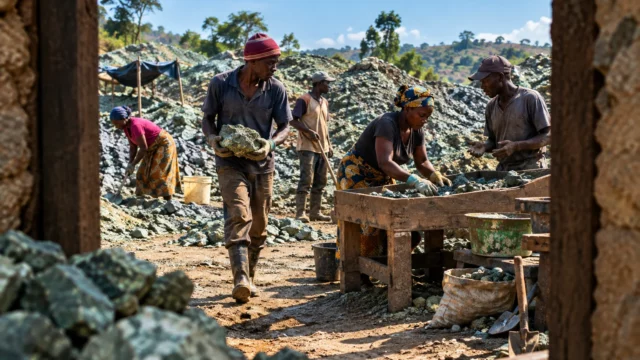
In Manono, in Tanganyika province, the question is no longer simply whether the subsoil contains lithium. It is now logistical, industrial and political: how to move a strategic mineral out of a region long cut off from the outside world, then bring it into credible commercial networks, from the Democratic Republic of the Congo to East Africa. The first shipment of spodumene concentrate from Mutowa, near Kalemie, is putting precisely this equation to the test.
This move is part of a broader sequence. In Kinshasa, the authorities have for several years championed the idea of a local value chain for critical minerals, particularly lithium, with processing closer to extraction sites. The presidency has already presented Manono as a future industrial processing hub, and Tanganyika province as a region to be connected to new transport routes.
What the facts announced in Kalemie show
On 22 July 2026, the first batches of spodumene concentrate produced by Manono Lithium left the port facilities at Mutowa bound for Kigoma, Tanzania. Before loading, the shipment was inspected and certified by the Centre for Expertise, Evaluation and Certification of Mineral Substances (CEEC), the public body responsible for certifying the compliance of exported minerals. The operation was presented by the authorities as the first lithium export from the Democratic Republic of the Congo. The exact volume, the concentrate’s grade, its commercial value, the buyer’s name and its final destination after Kigoma have not, however, been made public.
The shipment departed under the supervision of Tanganyika Governor Christian Kitungwa Muteba. In the public statements available, the provincial executive hailed the move as an important step in integrating Tanganyika into regional mining trade networks, while calling for local labour to be prioritised so that the logistics chain creates more jobs in the province. Christian Kitungwa is the sitting governor of Tanganyika, whose provincial capital is Kalemie.
The Manono Lithium SAS project in the north-east of the Manono deposit is being developed by a joint venture between a foreign subsidiary of Zijin Mining and COMINIERE, the Congolese state-owned mining company. The announced ownership shares are 54.9% for Zijin’s subsidiary, 35.1% for COMINIERE and 10% for the Congolese state. The Chinese group also says the project was designed to process five million tonnes of ore a year and produce about one million tonnes of spodumene concentrate annually, with crude lithium sulphate planned for a later phase.
A test of infrastructure and governance credibility
On paper, the stakes go beyond extraction alone. The corridor connects the Manono deposit to Mutowa by road, then Mutowa to Kigoma across Lake Tanganyika. It thus partly bypasses the historic isolation of an area where a lack of infrastructure has long held back the development of its mining potential. The industrial port being developed by Golden Lake Logistics at Mutowa is intended to serve as a link between the DRC and East Africa. The announced first phase includes two berths for vessels of about 2,000 tonnes, with an annual transit capacity of one million tonnes, rising to 1.8 million tonnes in a subsequent phase.
This is crucial for the DRC. A deposit can attract capital, but without roads, a port, energy and certification, it remains a promise. Manono illustrates precisely the shift from a mining project to a complete logistics chain. The presidency has already cited the rehabilitation of the Manono–Kalemie route and the Mpiana Mwanga dam as necessary support for lithium production. COMINIERE, for its part, says it is also working on energy, with works around Mpiana Mwanga. In other words, the ore does not sell itself: it requires infrastructure, electricity and an administration capable of securing the flows.
But the fundamental question remains one of transparency. At this stage, the authorities have not published the data needed to assess the shipment’s real commercial significance: tonnage, quality, price, counterparty and schedule for future shipments. Without these details, the event marks more of an operational opening than a measurable economic turning point. This matters for the people of Tanganyika, but also for Kinshasa, which wants to show that it can move its critical minerals up the value chain while retaining control over certification and export rules.
Significance beyond Tanganyika
The Manono case resonates far beyond the DRC. First, lithium is one of the minerals most closely watched in the global energy transition. Second, Tanganyika province is looking eastwards towards East Africa, with Kigoma as a link, at a time when several countries in the region are seeking to better connect mines, dry ports, lake routes and overseas markets. For the DRC, this corridor adds to other regional discussions on strategic minerals, local value addition and export routes to the Indian or Atlantic oceans.
It is also worth considering what this first shipment says about the local balance of power. In Tanganyika, expectations centre on jobs, local procurement, tax revenues and the role of provincial businesses. In Kinshasa, the stakes are broader: to prove that the DRC can turn a global resource into an industrial lever without repeating a raw-material export model. The project nevertheless remains in a sensitive environment, marked by longstanding disputes over Manono and competing accounts of mining rights. This calls for strict caution: the July 2026 shipment is a milestone, not yet a final victory.
What happens next will show whether Mutowa becomes merely a transit point or the first link in a genuine industrial corridor. Everything will depend on the regularity of exports, the expansion of infrastructure, the publication of commercial data and the Congolese state’s ability to build on this start. For the DRC, the issue is clear: Manono could become a symbol of mineral sovereignty. It could also remain a prestigious deposit if roads, energy and governance fail to keep pace.