Algeria
 Egypt
 Libya
 Morocco
 Sudan
 Tunisia
 Benin
 Burkina Faso
 Cabo Verde
 Côte d'Ivoire
 Ghana
 Guinea-Bissau
 Liberia
 Mali
 Mauritania
 Niger
 Nigeria
 Senegal
 Sierra Leone
 The Gambia
 Togo
 Cameroon
 Central African Republic
 Chad
 DR Congo
 Equatorial Guinea
 Gabon
 Republic of the Congo
 São Tomé and Príncipe
 Burundi
 Comoros
 Djibouti
 Eritrea
 Ethiopia
 Kenya
 Madagascar
 Malawi
 Mauritius
 Mozambique
 Rwanda
 Seychelles
 Somalia
 South Sudan
 Tanzania
 Uganda
 Angola
 Botswana
 Eswatini
 Lesotho
 Namibia
 South Africa
 Zambia
 Zimbabwe
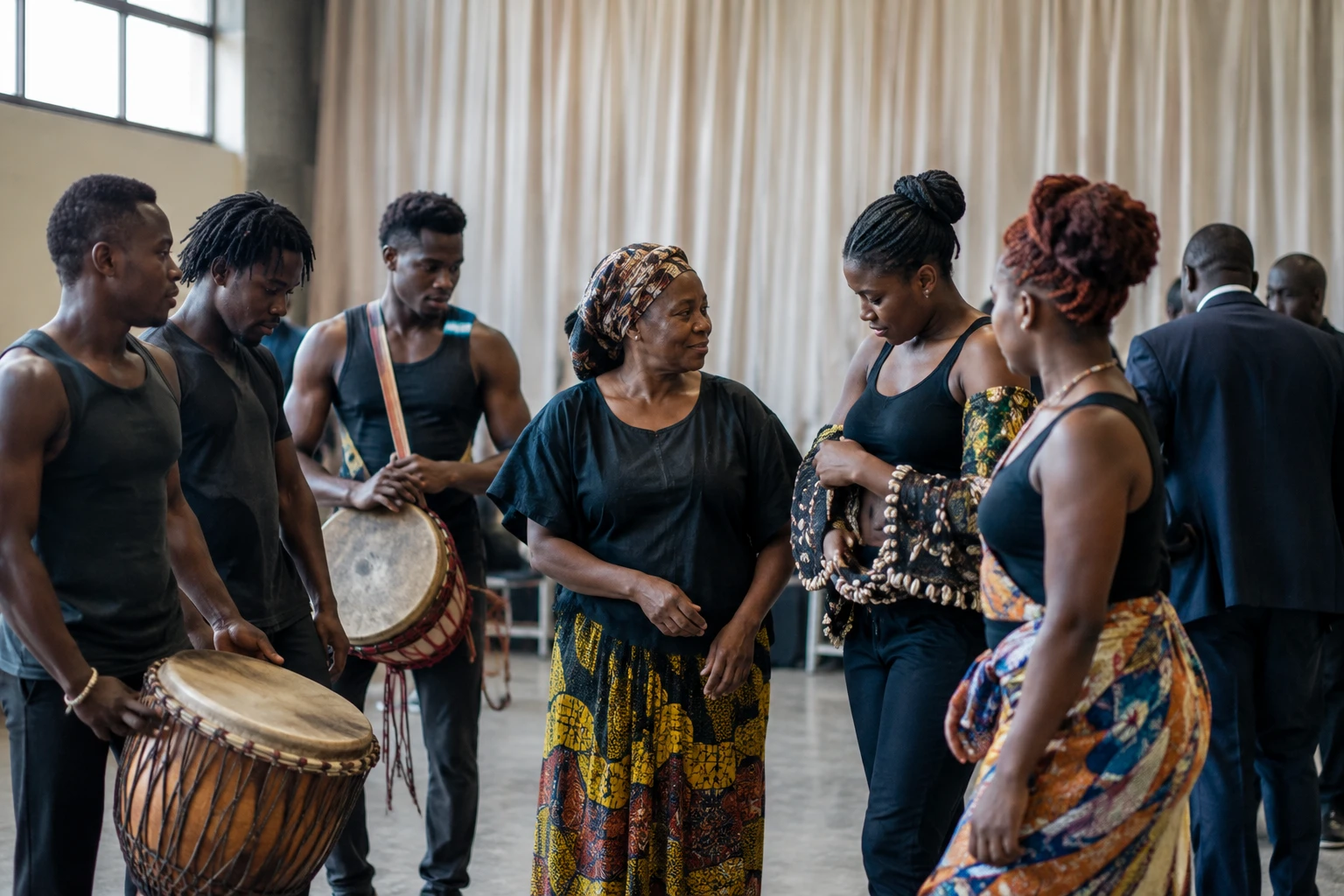
Dance can carry far more than a performance. For Manana Cissé, it connects a girl from Boké to a company that became one of the cultural faces of independent Guinea. Approaching 80, the dancer continues to champion this legacy on stage and through its transmission.
A calling born in Boké at the time of independence
Born in 1947 in Boké, Manana Cissé joined the Ballets africains in 1959, at the age of 12. She says she attracted the attention of Keïta Fodéba and Ahmed Sékou Touré by singing and dancing at a gathering in her town. Her entry into the troupe was therefore due to a talent recognised at an early age, but also to a period when culture occupied a central place in Guinea’s national project.
Guinea became independent on 2 October 1958. The company, until then known as the Ballets africains de Keïta Fodéba, became part of the cultural institutions of the young republic. Fodéba, a Guinean artist — dancer, writer, musician and politician — had founded an initial theatre group in the late 1940s. The Ballets africains took their name in Paris in 1952 and went on to perform on several international stages. The Guinean embassy in Liberia traces the company’s history, while the Ballets africains’ official website outlines its founder’s career.
In Manana Cissé’s account, her father’s involvement as an imam and local mediator sheds light on the link between the troupe and the politics of the time. He is said to have helped rally local people to the cause of independence and to Sékou Touré. This personal recollection recalls the mobilising role attributed to artists and community figures in the building of the state. It does not, however, sum up the political history of the regime that took shape after 1958.
A national institution, between memory and creation
The Ballets africains are more than a dance company. They served as a cultural showcase for a newly independent country, giving international visibility to music, movement and storytelling rooted in several traditions. For Manana Cissé, the mission remains simple: to bring joy and “peace of heart”. She describes the ballet as a link with the audience, not as heritage frozen in archives.
This ambition presents a practical challenge: passing on traditions without turning Guinea’s diversity into a uniform backdrop. The songs and dances are rooted in different languages and practices. Artists must bring them to life on stage while meeting the demands of touring, working with available resources and renewing the generations. The company now lists Manana Cissé as a member of its artistic direction. The official programme for Mansa Moussa, Roi d’Or assigns her this responsibility for the production.
Her presence in this role also demonstrates a form of transmission led by a long-standing artist. She joined the troupe as a child, experienced its different periods and now helps shape its artistic work. Archives of performances abroad attest to her presence among the performers as early as the 1960s, although they are not sufficient to document every stage of her career.
Mansa Moussa, a West African story brought to the stage
The show “Mansa Moussa, Roi d’Or” turns its attention to the 14th-century Mali Empire and its ruler, known in historical accounts for his pilgrimage and the wealth associated with his reign. This history transcends today’s borders: the empire left its mark on several West African territories. Telling it through dance allows the Guinean company to draw on a shared regional memory, without conflating the legacies of medieval Mali with the borders of contemporary states.
On 25 September 2026, the troupe presented the show’s European premiere in Limoges, as part of the Zébrures festival. The date and cast are confirmed by the festival programme. The performance gives the production an international stage, but its significance cannot be measured solely by its reception abroad. For Guinean artists, a tour can also open up work opportunities, increase the company’s visibility and encourage new audiences in Guinea to make its repertoire their own.
The circulation of a show nevertheless depends on very practical conditions: funding, scheduling, logistics and the ability to keep a troupe active. Manana Cissé attributes some of this renewed momentum to support from the Ministry of Culture and the company’s management. This is her assessment; it nonetheless highlights the role of public policy in preserving a national cultural institution.
An impact beyond Guinea’s borders
The regional context has also changed. Following the 2021 coup, Guinea experienced a period of political transition and restrictions in its relations with ECOWAS, the Economic Community of West African States. The African Union monitored the process of returning to constitutional order. In January 2026, the Guinean prime minister’s office announced the lifting of ECOWAS’s remaining measures and the country’s reintegration into the organisation’s bodies. This official account should be read alongside ongoing debate about the quality and inclusiveness of the political process.
In this landscape, artistic exchanges help maintain links between societies beyond diplomatic developments. The Ballets africains carry a Guinean history, but their repertoire and trajectory resonate across West Africa. It remains to be seen whether the momentum generated by “Mansa Moussa, Roi d’Or” will lead to a regular presence on Guinean and regional stages, as well as sustainable conditions for artists. For Manana Cissé, supporting the troupe for the rest of her life is a personal promise. For the company, the challenge now is to make this legacy a living creation, accessible to today’s audiences.