Algeria
 Egypt
 Libya
 Morocco
 Sudan
 Tunisia
 Benin
 Burkina Faso
 Cabo Verde
 Côte d'Ivoire
 Ghana
 Guinea-Bissau
 Liberia
 Mali
 Mauritania
 Niger
 Nigeria
 Senegal
 Sierra Leone
 The Gambia
 Togo
 Cameroon
 Central African Republic
 Chad
 DR Congo
 Equatorial Guinea
 Gabon
 Republic of the Congo
 São Tomé and Príncipe
 Burundi
 Comoros
 Djibouti
 Eritrea
 Ethiopia
 Kenya
 Madagascar
 Malawi
 Mauritius
 Mozambique
 Rwanda
 Seychelles
 Somalia
 South Sudan
 Tanzania
 Uganda
 Angola
 Botswana
 Eswatini
 Lesotho
 Namibia
 South Africa
 Zambia
 Zimbabwe
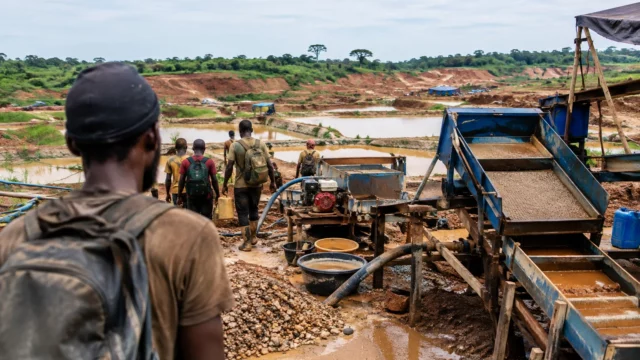
In Siguiri, gold sustains families and supports a long-established economic activity. But when mining sites damage land and waterways, a question arises beyond the miners’ own responsibility: who should have prevented the damage, and who must answer for it? The Court for the Repression of Economic and Financial Offences (CRIEF) is examining this question in Conakry.
A local activity with stakes beyond the prefecture
In north-eastern Guinea, Siguiri is one of the main centres of artisanal gold mining. The activity is part of Upper Guinea’s economic history and provides income for many households. It also extends across the Upper Niger Basin, whose waterways link several West African territories.
The economic benefits come with documented risks. A strategic study of the Niger Basin notes that artisanal mining can leave excavations, weaken soils and contribute to the pollution or diversion of waterways. In Guinea, the national assessment linked to the Minamata Convention also describes the risks associated with the use of mercury in some gold-processing methods. These general findings, however, do not prejudge the specific facts being examined by the court in this case.
The challenge is also social. A basin study highlights the importance of gold mining to household incomes in the region, while Guinea’s assessment notes that a significant share of the activity remains informal. A response limited to arrests could therefore displace workers without addressing the causes of clandestine mining: access to sites, income opportunities and oversight of supply chains.
Twenty-two territorial officials facing prosecution
On 11 November 2026, Siguiri’s former interim prefect, Colonel Fayimba Mara, appeared before the CRIEF trial chamber. He is one of 22 former territorial administrators prosecuted in the case. According to the Guinean press, the accusations include complicity in or alleged facilitation of clandestine gold mining, as well as damage to land, water and the environment. These allegations remain to be proved before the Court.
Fayimba Mara denied the allegations against him. He said he had been appointed on 12 June 2026 and argued that he took office in an environment that was already degraded. He also said that he spent part of his first month appointing sub-prefects and mayors. These points form part of his defence, not a judicial finding.
The case was joined to that of 202 people prosecuted for illegal mining, environmental degradation, destruction and water pollution. The Guinean Press Agency reports that the defendants are of Guinean, Malian, Burkinabè, Togolese and Beninese nationality. The proceedings therefore involve 224 people, but their circumstances and the alleged acts are not necessarily the same.
The hearings have also exposed disagreement over how responsibility should be pursued. A lawyer for several miners disputed the portrayal of people arrested at the sites as the owners of heavy machinery, and called for those with greater resources to be investigated. This challenge should be understood as the defence’s position, not as a fact established by the court.
State oversight put to the test
The proceedings raise a concrete institutional question: how can an administrator be held responsible for practices that may be longstanding, widespread and carried out across several sites? The date an official took office may be relevant in assessing what they could have known or done. But that date alone is not enough to establish or rule out responsibility. The hearings will need to clarify the acts alleged, the periods concerned and the evidence presented by each party.
For communities whose livelihoods depend on gold, the consequences of a crackdown on illegal activity cannot be measured solely by the number of arrests. Workers may lose their immediate income, while villages remain exposed to the effects of poorly rehabilitated sites and tensions over access to land and water. Conversely, better-regulated mining can help protect these resources, provided the rules are enforceable and alternative economic opportunities are available.
The question of minors calls for particular caution. The Guinean Press Agency reports a disagreement at the hearing: the defence lawyer referred to minors among the defendants, while the special prosecutor disputed this claim. The agency also says that a separate procedure involving minors was to fall under the jurisdiction of the Children’s Court. The ages and cases concerned must therefore be distinguished, without conflating these proceedings.
Stakes for the Niger Basin and regional justice
The environmental impact extends beyond Siguiri’s administrative boundaries. The Niger Basin crosses several West African countries; protecting its waters and soils requires cooperation between administrations in the riparian states. This does not mean that the acts prosecuted in this trial have already been shown to have had cross-border effects. Rather, it is a reminder that monitoring mining sites and reducing pollution do not stop at national borders.
The trial, being heard in Conakry by an economic and financial court, must also shed light on how responsibility is shared among territorial authorities, mining operators and any actors in the commercial chain. The next hearings will show whether the accusations are substantiated and whether the Court distinguishes the functions, periods and roles attributed to each person. For the Guineans concerned, the stakes are twofold: fair justice and management of gold resources that protects livelihoods as well as land and water.