Algeria
 Egypt
 Libya
 Morocco
 Sudan
 Tunisia
 Benin
 Burkina Faso
 Cabo Verde
 Côte d'Ivoire
 Ghana
 Guinea-Bissau
 Liberia
 Mali
 Mauritania
 Niger
 Nigeria
 Senegal
 Sierra Leone
 The Gambia
 Togo
 Cameroon
 Central African Republic
 Chad
 DR Congo
 Equatorial Guinea
 Gabon
 Republic of the Congo
 São Tomé and Príncipe
 Burundi
 Comoros
 Djibouti
 Eritrea
 Ethiopia
 Kenya
 Madagascar
 Malawi
 Mauritius
 Mozambique
 Rwanda
 Seychelles
 Somalia
 South Sudan
 Tanzania
 Uganda
 Angola
 Botswana
 Eswatini
 Lesotho
 Namibia
 South Africa
 Zambia
 Zimbabwe
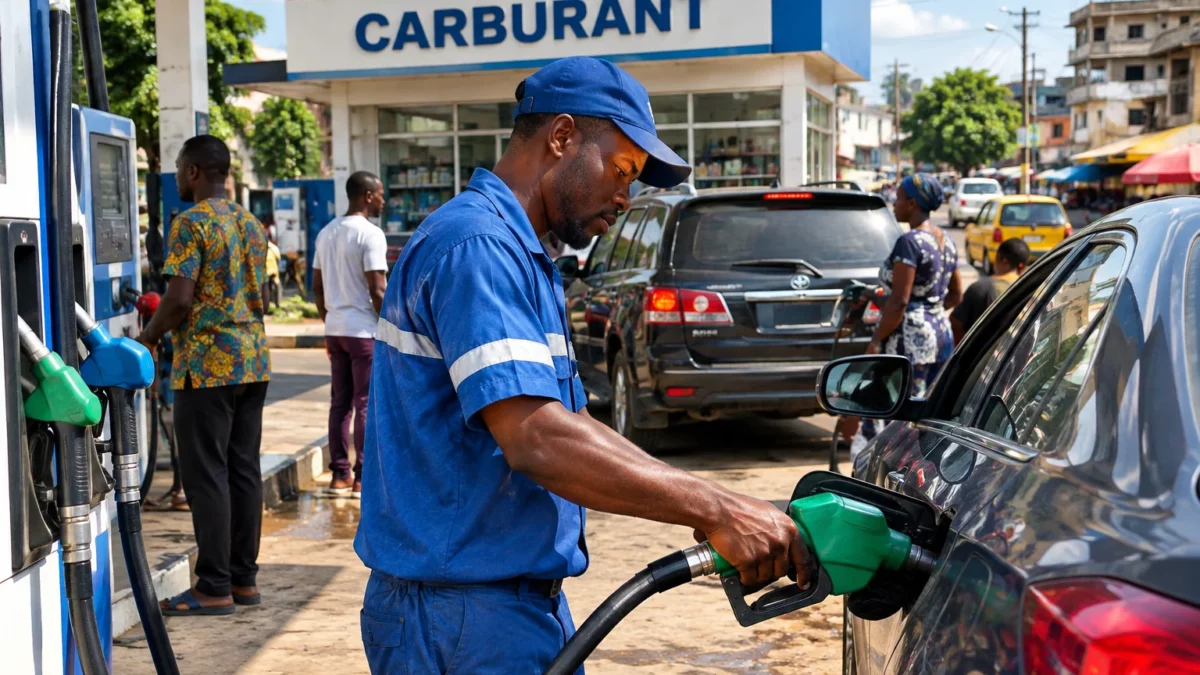
A litre of petrol at 12,000 Guinean francs protects household budgets in the short term. But keeping the price at that level when international prices soar shifts the bill to public finances. In Guinea, the question is therefore not only whether prices will rise in 2027, but also how long the state can absorb the shock.
A budgetary choice in a region under pressure
Guinea imports petroleum products and remains exposed to fluctuations in global markets, transport costs and fuel availability. A surge in crude or refined product prices can therefore feed through to import costs, even if the price displayed at service stations does not change.
Neighbouring countries have taken different approaches. Côte d’Ivoire raised the price of premium petrol from 875 to 905 CFA francs per litre and diesel from 700 to 725 CFA francs on 1 August 2026. Senegal adjusted its prices on 15 August, to 990 CFA francs for premium petrol and 755 CFA francs for diesel. These differences show that governments make different trade-offs between supporting purchasing power and the cost of public subsidies. The Ivorian Press Agency confirms the new prices applied in Côte d’Ivoire, while the Senegalese Prime Minister’s Office statement sets out those in Senegal.
Guinea is a member of ECOWAS, the Economic Community of West African States, which facilitates regional co-operation but does not set a single fuel price. National choices can therefore differ, with possible effects on transport costs and cross-border trade. The official list of ECOWAS member states includes Guinea.
Keeping prices steady now comes with a quantified cost
At the pump, petrol and diesel remain at 12,000 GNF per litre, according to figures from the National Institute of Statistics. Its September 2026 note confirms this level. The INS consumer price data therefore make it possible to verify the current price.
The draft supplementary finance bill presented on 24 October put the cost of keeping petroleum prices down at 5,489.7 billion GNF. This comprised 4,576.7 billion in revenue forgone by the state and a provision of 913 billion to stabilise hydrocarbon prices. The National Assembly has since adopted the supplementary budget: the support is therefore no longer just a budget proposal. Guinéenews reported on the adoption of the spending component, and the Guinean embassy in Senegal also detailed the fuel-related items.
The two components work differently. Forgone revenue reduces the resources the state could have collected. The provision, by contrast, is an allocation set aside to cushion fluctuations. This support can limit price rises for all motorists, but it comes at an opportunity cost: the same resources are unavailable for other public priorities.
Keeping prices steady can also benefit households unevenly. People who buy fuel directly gain immediately. But families without a vehicle do not necessarily benefit as much, even though they may feel the indirect effects of higher costs for public transport and deliveries, as well as higher prices for goods. A general subsidy therefore protects the price at the pump without, by itself, ensuring that support reaches the most vulnerable households first.
A decision for 2027 remains open
Speaking on the sidelines of the Simandou Mining Summit, the Minister of the Economy, Finance and Budget, Mariama Ciré Sylla, said it was difficult to predict future fuel prices. She said the government would assess the situation next year in light of developments in the international crisis. The statement does not announce a price rise: it leaves the decision open, depending in particular on supply prices and the available budgetary headroom.
Markets eased after their October surge. In its report of 13 November 2026, the International Energy Agency put North Sea crude at around $93 a barrel, down from a peak of $136 on 8 October. It forecast a larger replenishment of global stocks in 2027, while warning that attacks on ships could disrupt the recovery in supplies. The IEA’s November report thus points to both a recent easing and persistent risks.
For Guinea, the stakes are in the budget as well as at service stations. Prolonged stability would support purchasing power and could contain transport costs. Conversely, it would extend the mobilisation of already substantial public resources. A price revision could ease that budgetary pressure, but would pass part of the shock directly on to consumers.
Conakry’s decision will also have regional significance. With several ECOWAS states adjusting their prices in 2026, Guinea’s strategy illustrates the national trade-offs involved in responding to the same global market. Monitoring supplies, price movements and budget execution will show whether the policy can last until 2027 — and at what cost to public finances and households.