Algeria
 Egypt
 Libya
 Morocco
 Sudan
 Tunisia
 Benin
 Burkina Faso
 Cabo Verde
 Côte d'Ivoire
 Ghana
 Guinea-Bissau
 Liberia
 Mali
 Mauritania
 Niger
 Nigeria
 Senegal
 Sierra Leone
 The Gambia
 Togo
 Cameroon
 Central African Republic
 Chad
 DR Congo
 Equatorial Guinea
 Gabon
 Republic of the Congo
 São Tomé and Príncipe
 Burundi
 Comoros
 Djibouti
 Eritrea
 Ethiopia
 Kenya
 Madagascar
 Malawi
 Mauritius
 Mozambique
 Rwanda
 Seychelles
 Somalia
 South Sudan
 Tanzania
 Uganda
 Angola
 Botswana
 Eswatini
 Lesotho
 Namibia
 South Africa
 Zambia
 Zimbabwe

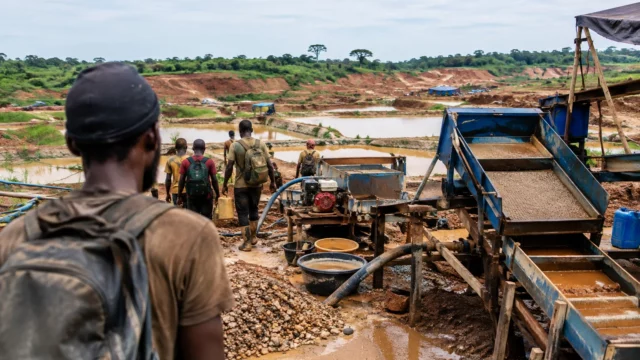
In Siguiri, gold supports thousands of people’s livelihoods while also damaging the land, waterways and families that depend on them. The closure of artisanal mining sites has brought these competing concerns into conflict, with consequences extending well beyond Guinea’s borders.
In Siguiri, a vital activity that is hard to regulate
In this prefecture of Upper Guinea, artisanal gold panning is part of a long-established local economy. It provides income for residents and also attracts workers from other West African countries. But unauthorised mining can leave dangerous pits, degrade the land and pollute waterways.
A study by the African Development Bank on the Niger Basin describes Siguiri as a major gold-panning hub. It estimates that the activity contributes to the incomes of many households and highlights the risks of erosion and pollution linked to mining practices. These findings, based on earlier research, shed light on the dynamics at play but do not measure the current situation.
The Guinean state’s response is part of a broader drive to tighten control over mineral resources. This policy affects local economic interests, riverside communities and workers who depend directly on the sites. It is also being pursued in a country where gold mining, like bauxite extraction, looms large in debates over control of national resources.
A ban, departures and court proceedings
After a suspension was announced locally on 29 October, the Guinean authorities banned what they called anarchic gold panning in the Siguiri region on 2 November 2026. Enforcement operations followed. The authorities justified the measure as a way to combat illegal mining and the damage it causes to farmland and waterways.
Arrest figures changed over the course of official statements. An official tally reported on 9 November said 1,412 people had been arrested in several mining areas, including Siguiri. Some defendants later appeared before the Court for the Suppression of Economic and Financial Offences, a Guinean court that handles, among other cases, economic crime. The proceedings also concern local officials suspected of facilitating illicit activities.
The measure prompted departures to Mali, notably through the Kouremalé border crossing. Malian authorities reported a large influx, but available estimates differ and their counting methods are not always specified. They should therefore be treated with caution. Burkinabè nationals were among those who left Siguiri; however, there is no basis for reducing the operation to a measure targeting a single nationality.
On 12 November, people who had arrived in Bamako spoke of leaving the mines and being uncertain about what would come next. Some said they had sent part of their earnings to relatives displaced or remaining in Burkina Faso. Their accounts show one direct consequence of the closure: the sudden loss of income, with no immediate alternative.
Protecting rivers without shifting the cost on to workers
Environmental concerns are tangible. Gold-panning operations can disrupt soils and affect waterways in the Niger Basin, of which the Tinkisso is a tributary. In a basin shared by several countries, degradation upstream can also affect communities further downstream. Regulating mines is therefore about more than policing resources: it involves protecting water and land.
Yet a ban alone does not address the reasons workers are driven to the sites. When activity stops abruptly, miners lose their income, as do the sellers, transporters and families who depend on money transfers. People living near the sites, migrant workers and residents whose land is affected do not all face the same consequences.
Local reactions reported by Guinéenews reflect this distinction. Several people interviewed support the principle of better regulation and environmental protection. Others criticise how the suspension was implemented, particularly the lack of time workers were given to decide whether to leave. The debate is as much about the legitimacy of the aim as it is about the safeguards and solutions offered to those affected.
The public response must therefore address several fronts: enforcing mining law, investigating allegations with judicial safeguards, preventing accidents and limiting environmental damage. It also requires scrutiny of the role of intermediaries and officials who profit from the activity, rather than placing the entire burden of enforcement on the workers at the bottom of the pits.
A regional issue between ECOWAS and Sahelian cooperation
Departures to Mali show how a national decision can quickly become a regional issue. Guinea and Mali are members of ECOWAS, the Economic Community of West African States. Burkina Faso, meanwhile, belongs with Mali and Niger to the Alliance of Sahel States (AES), a confederation distinct from ECOWAS. The reception, registration and return of workers therefore involve several administrations and test coordination between neighbouring countries.
The case also underscores how artisanal mining economies cross borders: workers move to areas where income is available, while environmental and social consequences spill over to neighbouring communities. For Conakry, the challenge is to make regulations enforceable without conflating the fight against illegal mining with the stigmatisation of foreign workers. For Bamako and Ouagadougou, it is to organise reception and returns without overlooking the needs of displaced people.
The next steps are judicial and practical: proceedings in Guinea must establish responsibility, while the countries concerned must clarify how arrivals will be monitored and the conditions for their return. In the longer term, the episode raises a central question for West Africa: how can common resources be protected and the law enforced without a site closure turning precarious workers into people left without income or recourse?