Algeria
 Egypt
 Libya
 Morocco
 Sudan
 Tunisia
 Benin
 Burkina Faso
 Cabo Verde
 Côte d'Ivoire
 Ghana
 Guinea
 Guinea-Bissau
 Liberia
 Mauritania
 Niger
 Nigeria
 Senegal
 Sierra Leone
 The Gambia
 Togo
 Cameroon
 Central African Republic
 Chad
 DR Congo
 Equatorial Guinea
 Gabon
 Republic of the Congo
 São Tomé and Príncipe
 Burundi
 Comoros
 Djibouti
 Eritrea
 Ethiopia
 Kenya
 Madagascar
 Malawi
 Mauritius
 Mozambique
 Rwanda
 Seychelles
 Somalia
 South Sudan
 Tanzania
 Uganda
 Angola
 Botswana
 Eswatini
 Lesotho
 Namibia
 South Africa
 Zambia
 Zimbabwe
In Bamako, a military speech case becomes a test for the state
In Mali, some court cases quickly go beyond the fate of one man. They say something broader about the place of public debate in a country at war with armed groups, and the latitude given to those documenting the darker aspects of that war.
The case of Alpha Yaya Sangaré reflects this tension. A former gendarmerie officer, he published a book on counter-terrorism in Mali and was then arrested after extracts accusing the army of alleged abuses were circulated. The case was followed in Bamako as a political as well as a judicial signal. Human Rights Watch had already noted in March 2024 that his arrest came amid severe restrictions on critical voices and serious allegations of abuses during counter-terrorism operations.
Harsh verdict delivered by a specialised court
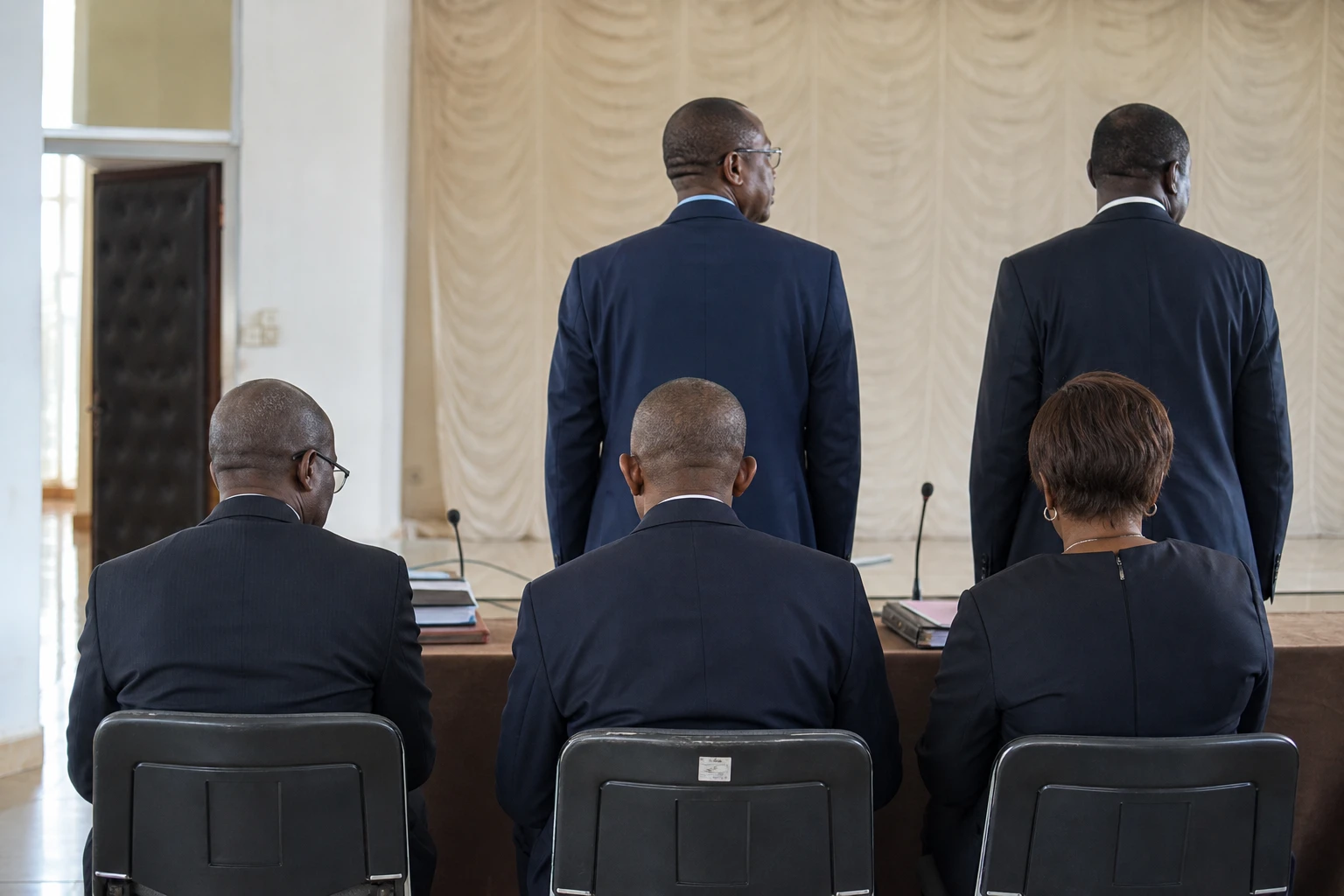
On Thursday 3 September 2026, the criminal chamber of the National Cybercrime Control Centre sentenced Alpha Yaya Sangaré to 20 years in prison. Two separate news sources, the pan-African agency APA and the Malian media outlet AMAP, confirmed the verdict, date and court. Both sources also said the charges had been reclassified as “undermining the external security of the state”, after prosecutors had initially charged him with treason.
The sentence is severe. It is all the more so given that the trial was heard by a court established to deal with digital offences and offences related to online spaces. In effect, the case thus shifted from a debate about the contents of a book to a criminal interpretation of state security. Prosecutors had sought the death penalty, which is not applicable in Mali, according to several reports published at the time of the verdict. APA and AMAP also said that a symbolic one franc was sought on behalf of the state, showing that the stakes went beyond imprisonment alone.
The case dates back to February 2024. The launch of the book Mali: The Challenge of Terrorism in Africa was held in Bamako, in the presence of government officials, before certain passages provoked a strong reaction from the defence ministry. Malian media reported that the military hierarchy considered the book offensive because it relayed allegations of abuses attributed to Malian forces and referred to the lack of serious investigations into those claims.
In Mali under the Transition, security remains the central pillar of power
The case comes as Mali remains dominated by the logic of the military Transition, with national security shaping much of public debate. Since the end of the French presence in Mali and the country’s rapprochement with Russia, the authorities have made counter-terrorism the cornerstone of their legitimacy. Human Rights Watch nevertheless notes that counter-insurgency operations have been accompanied by repeated allegations of serious abuses against civilians, particularly in the centre of the country.
The Bamako verdict cannot therefore be read in isolation. It can also be understood as an institutional response in a context where the state is seeking to control its account of the war. When an officer speaks from within the security apparatus, his words carry a different weight. The authorities may see them as mere opinion. They may also interpret them as a threat when they expose failings, particularly in a country where the army remains one of the pillars of the Transition and national cohesion.
The fact that Sangaré was initially presented as a senior officer integrated into the security apparatus, before being dismissed from the army by decree in December 2025, adds a political dimension to the case. APA confirmed the disciplinary dismissal, published under reference No. 2025-861/PT-RM. In other words, he was no longer serving when the verdict was handed down, but he remained a sensitive figure within the military institution, at the intersection of professional expertise, prestige and dissent.
A case to be viewed in a West African context too
The case extends beyond Bamako. Mali officially left ECOWAS, the Economic Community of West African States, on 29 January 2025, along with Burkina Faso and Niger. This break has reduced the traditional regional channels for political dialogue and institutional pressure, at a time when security, governance and human rights remain at the centre of tensions in the Sahel.
In this new landscape, sensitive cases are increasingly handled within states or through ad hoc mechanisms. This amplifies the symbolic significance of a trial such as that of Alpha Yaya Sangaré. It shows that in Mali, the battle is not being fought solely on the military front. It is also being fought over whether institutions can tolerate the voices describing the war from within. For the population, the issue remains concrete: whether alleged crimes will be investigated. For the state apparatus, the priority is the opposite: preserving discipline, unity and the chain of command in the face of a persistent threat.
At continental level, the case feeds into a broader question about justice in times of conflict: how can African states pursue security without narrowing the space for testimony and civilian oversight? In the Sahel, where military transitions have multiplied and regional mechanisms have been weakened, this question concerns more than Mali. It also touches on the credibility of armed forces, the status of whistleblowers and the ability of national justice systems to handle highly political cases without becoming entangled in the balance of power of the moment.