Algeria
 Egypt
 Libya
 Morocco
 Sudan
 Tunisia
 Benin
 Cabo Verde
 Côte d'Ivoire
 Ghana
 Guinea
 Guinea-Bissau
 Liberia
 Mali
 Mauritania
 Niger
 Nigeria
 Senegal
 Sierra Leone
 The Gambia
 Togo
 Cameroon
 Central African Republic
 Chad
 DR Congo
 Equatorial Guinea
 Gabon
 Republic of the Congo
 São Tomé and Príncipe
 Burundi
 Comoros
 Djibouti
 Eritrea
 Ethiopia
 Kenya
 Madagascar
 Malawi
 Mauritius
 Mozambique
 Rwanda
 Seychelles
 Somalia
 South Sudan
 Tanzania
 Uganda
 Angola
 Botswana
 Eswatini
 Lesotho
 Namibia
 South Africa
 Zambia
 Zimbabwe
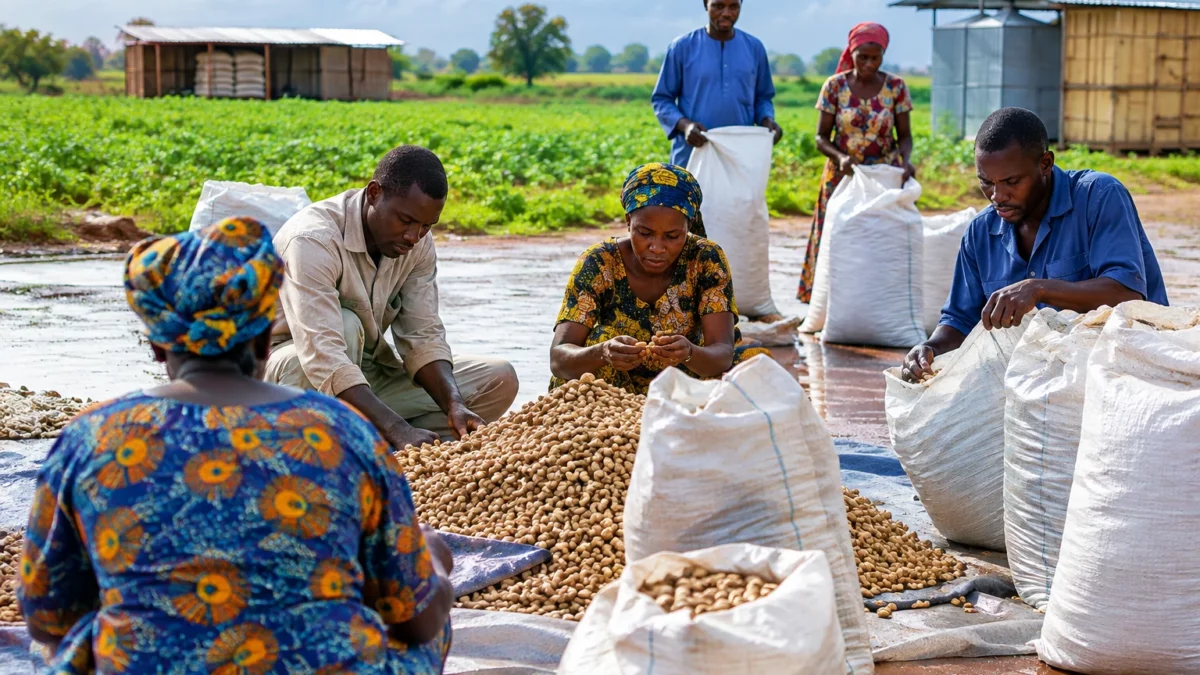
Keeping peanuts at the border could supply Niger’s oil mills. But without remunerative prices, storage and processing capacity, the ban could also reduce producers’ market outlets. The challenge is to align a trade decision with realities across the entire value chain.
A national decision, with a Sahelian exception
Niger’s Minister of Trade and Industry, Abdoulaye Seydou, announced on 13 November 2026 a ban on peanut exports from Niger. The measure stems from an order signed on 11 November. The authorities say they want to reserve the raw material for the domestic market and supply local plants, particularly those producing cooking oil. The country still imports this commodity. The ministry says an exceptional authorisation may allow exports to the other members of the Alliance of Sahel States (AES), the confederation bringing together Niger, Mali and Burkina Faso.
This exception distinguishes the ban from a complete halt to trade within the Sahel region. But it leaves operators facing an authorisation process and tighter checks. According to the Nigerien News Agency, authorised agents may seize cargoes exported in breach of the rules. The practical arrangements for implementation will therefore matter as much as the text itself: they will determine what volumes move, to which destinations and under what conditions.
The measure comes amid a broader push by Sahelian governments to process more raw materials locally. In Mali, an order dated 3 October 2024 suspended exports of several products, including peanuts, to encourage local processing. In Burkina Faso, peanuts are among the products subject to special export authorisation. The instruments therefore differ: a ban with exemptions in Niger, a suspension in Mali and administrative controls in Burkina Faso.
Significant volumes, hard-to-measure trade
According to FAOSTAT figures for 2024, peanut harvests reached about 677,000 tonnes in Niger, 611,000 in Burkina Faso and 497,000 in Mali. These three countries account for a notable share of West African supply. These estimates indicate production, not the quantities actually available to industry: seeds, household consumption, local sales and losses must also be taken into account.
Reported export data do not necessarily capture all flows. A 2023 study of Niger’s peanut sector estimated exports at 20,000 tonnes for the reference year 2022, or about 3% of the production figure used in its analysis. Officially recorded flows were, according to the study, far lower. This gap highlights the limitations of statistical monitoring of cross-border trade; it calls for caution when assessing the effect of a ban using customs data alone.
The regional implications are all the greater because Niger, Mali and Burkina Faso left ECOWAS on 29 January 2025. The Economic Community of West African States nevertheless asked that goods originating in the three countries continue, until further notice, to benefit from its trade liberalisation regime. Niamey’s announced exemption for AES partners and the continuation of these regional arrangements form two frameworks that must be reconciled. For traders, the boundary between national rules, Sahelian trade and the ECOWAS regime could prove decisive.
Local processing faces a capacity test
A restriction can give oil mills access to more raw material. But it cannot, by itself, create the equipment, financing or markets needed to absorb the harvest. Storage must also be secured, and collection organised from production areas to processing plants, particularly around Niamey and in other centres of consumption. The needs of small-scale women processors and industrial operators are not the same, but both depend on a regular supply.
For producers and traders, the immediate issue is the price at which peanuts will be bought on the domestic market. If local capacity remains inadequate or there are few buyers, restricting external outlets could weaken their bargaining power. Conversely, predictable purchase contracts and processing that rewards quality can retain more value in the country. The balance between affordable prices for consumers and incomes for producers cannot therefore be achieved through controls on exports alone.
The ministry also presents the measure as a way to support local oil production and limit imports. To assess its results, it will be necessary to monitor the actual supply of plants, volumes of oil produced, prices paid to producers and exceptional authorisations granted. The published text confirms the decision, but the sources consulted do not yet provide an implementation review or a timetable for reassessment.
A test for Sahelian industrial policies
Beyond Niger, this decision tests a shared AES policy direction: retaining a greater share of agricultural value in the region. Experiences in Mali and Burkina Faso show, however, that the tools are not uniform. The central question will be not simply whether exports are regulated, but whether producers can find buyers, factories are operating and regional supply chains remain viable.
Monitoring will also need to distinguish formal flows from local cross-border trade, which is often poorly recorded. If trade shifts into undeclared channels, the measure could be difficult to evaluate and unevenly enforced. If, by contrast, local plants absorb harvests on viable terms, it could strengthen Niger’s oil production. Between these two paths, the key indicators in the coming months will be farmgate prices, processor activity and export authorisations to Sahelian partners.