Algeria
 Egypt
 Libya
 Morocco
 Sudan
 Tunisia
 Benin
 Burkina Faso
 Cabo Verde
 Côte d'Ivoire
 Ghana
 Guinea
 Guinea-Bissau
 Liberia
 Mali
 Mauritania
 Niger
 Nigeria
 Senegal
 Sierra Leone
 The Gambia
 Togo
 Cameroon
 Central African Republic
 Chad
 Equatorial Guinea
 Gabon
 Republic of the Congo
 São Tomé and Príncipe
 Burundi
 Comoros
 Djibouti
 Eritrea
 Ethiopia
 Kenya
 Madagascar
 Malawi
 Mauritius
 Mozambique
 Rwanda
 Seychelles
 Somalia
 South Sudan
 Tanzania
 Uganda
 Angola
 Botswana
 Eswatini
 Lesotho
 Namibia
 South Africa
 Zambia
 Zimbabwe
When a prison empties, the entire justice system is shaken
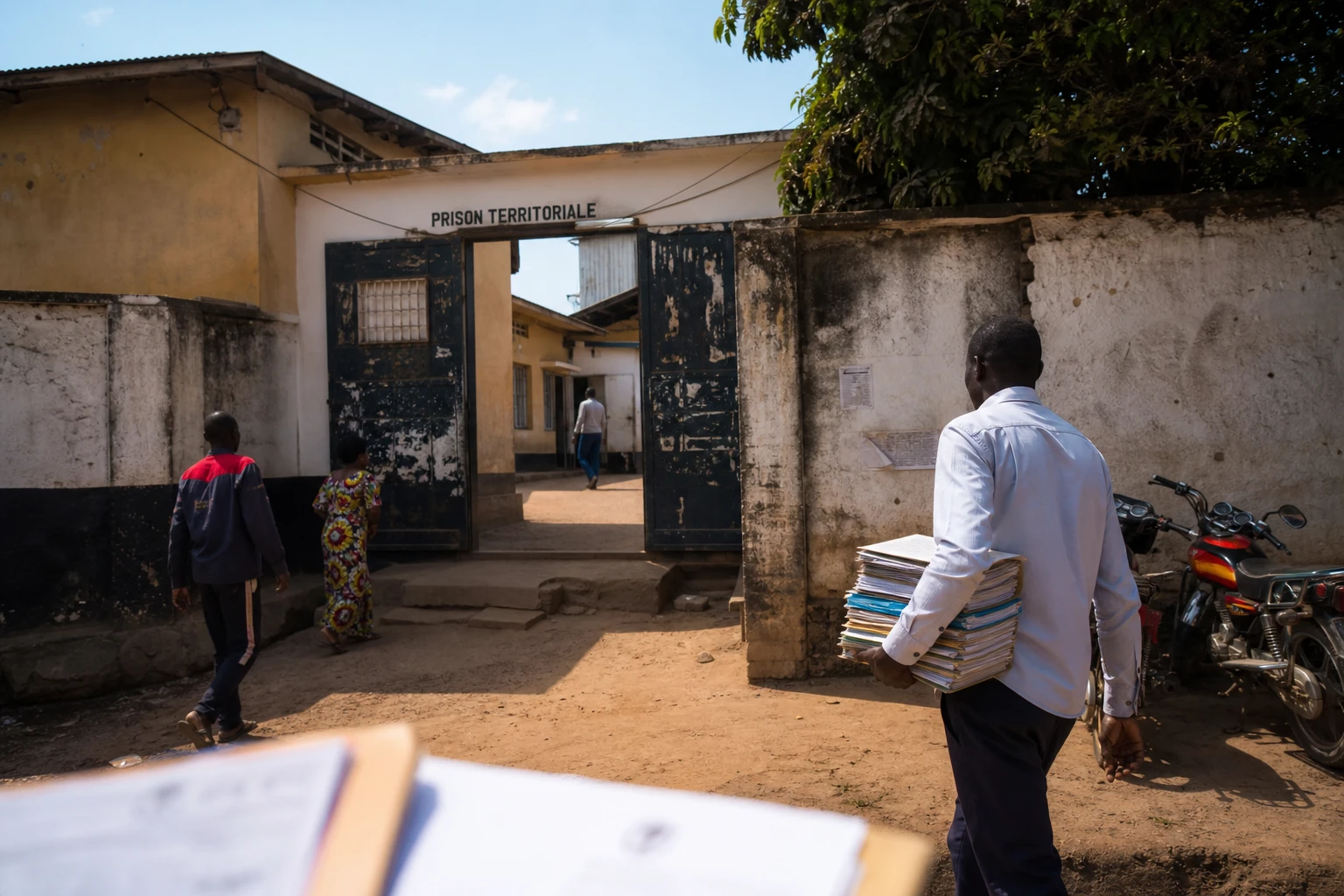
In Luebo, in Kasaï, a mass escape does not merely mean that a gate has given way. Above all, it highlights the fragility of a prison system in which custody, justice and public security are often caught up in the same failings. In a town where everyone knows the escaped inmates, the shock is immediate: fear spreads through neighbourhoods, and the state must race to catch up with a situation that has been developing for years.
The territory of Luebo lies in a province in the centre of the Democratic Republic of the Congo, far from Kinshasa but close to the country’s major tensions: slow justice, prolonged pre-trial detention, dilapidated prisons and insufficient staffing. These weaknesses are not isolated. They form part of a broader national picture, long documented by human rights organisations and Congolese media, of overcrowded facilities and detention conditions often described as deteriorating.
In Luebo, fugitives disappeared into an already troubled setting
According to information gathered on the ground by local authorities, the escape involved all the inmates present at the prison. Territorial officials describe it as an organised operation. They suspect meticulous planning and do not rule out complicity within the security apparatus. According to the same sources, the prisoners forced open the doors without unlocking the padlocks, then left with three weapons.
The following day, the town slowed to a crawl. Residents limited their movements, fearing reprisals by some of the escapees. Patrols were stepped up and the authorities asked the public to report any fugitives seen in the town or nearby villages. In this kind of crisis, the challenge is twofold: to reassure the population while preventing fear from turning into vigilante justice.
The Luebo case is all the more sensitive because it is part of a long series. In September 2021, 45 of the 51 inmates at Luebo central prison had already escaped, according to the Congolese press. In February 2026, local civil society was still raising the alarm over prolonged pre-trial detention and a prison that had become, for many, a symbol of administrative neglect.
A fragile prison, an exposed territory, a justice system under pressure
The problem extends beyond the prison walls. When a prison operates in dilapidated buildings, with little food, few medical services and too few guards, escapes become a recurring possibility. In Luebo, civil society has been denouncing the poor state of the infrastructure for years. As early as 2023, local actors reported that the prison had gradually been eaten away by bad weather and erosion, further evidence of chronic neglect.
This situation has a direct effect on the ordinary justice system. When defendants remain behind bars for a long time without trial, prison ceases to be a place where sentences are served and becomes a space of indefinite waiting. Like many African countries, DR Congo faces heavy pressure on its prisons, with remand facilities holding a majority of inmates awaiting trial. Recent international reports confirm that prison overcrowding remains a major problem, exacerbated by capacity far below the actual number of people detained.
In Kasaï, this reality has a particular dimension. The province still bears the scars of the Kamuina Nsapu conflict, which deeply destabilised relations between security forces, the justice system and local communities. In Luebo, mobile court hearings were still being held in 2026 on cases linked to the crisis, proof that the territory remains marked by sensitive cases from the recent past. A weak prison in such a context is not merely a prison issue; it is a breaking point for local public order.
What this escape says about DR Congo and Central Africa
For Kinshasa, the incident is a reminder of a simple imperative: internal security is measured not only by military or police operations, but also by the actual state of prisons, court registries and tribunals. When inmates repeatedly escape, residents pay the price, with greater insecurity, investigations to be restarted and victims increasingly doubtful of the state’s ability to protect them. For the prison service, the issue is not merely disciplinary. It is also budgetary, logistical and institutional.
For the provincial authorities in Kasaï, the stakes are also political. Luebo is becoming a test of credibility: either the failings are fixed, or the territory remains associated with a succession of escapes and a justice system seen as weak. For residents, the difference between the administrative capital and rural or semi-urban areas is immediate: in Kinshasa, prison crises make the headlines; in Luebo, they alter daily life, travel, markets and the social climate.
Across Africa, the case speaks to a broader issue: prisons as an invisible link in the rule of law. From DR Congo to the Sahel, and across Central and West Africa, the same symptoms often recur — overcrowding, lengthy pre-trial detention, poor maintenance, insufficient staffing and possible complicity. Until these weaknesses are tackled at their roots, every mass escape will continue to be less an accident than a revelation. In DR Congo, the next signal to watch will be the judicial and administrative response in Luebo: an investigation, accountability, arrests and prison repairs. Without that, the town risks seeing the same scenario play out again.