Algeria
 Egypt
 Morocco
 Sudan
 Tunisia
 Benin
 Burkina Faso
 Cabo Verde
 Côte d'Ivoire
 Ghana
 Guinea
 Guinea-Bissau
 Liberia
 Mali
 Mauritania
 Niger
 Nigeria
 Senegal
 Sierra Leone
 The Gambia
 Togo
 Cameroon
 Central African Republic
 Chad
 DR Congo
 Equatorial Guinea
 Gabon
 Republic of the Congo
 São Tomé and Príncipe
 Burundi
 Comoros
 Djibouti
 Eritrea
 Ethiopia
 Kenya
 Madagascar
 Malawi
 Mauritius
 Mozambique
 Rwanda
 Seychelles
 Somalia
 South Sudan
 Tanzania
 Uganda
 Angola
 Botswana
 Eswatini
 Lesotho
 Namibia
 South Africa
 Zambia
 Zimbabwe
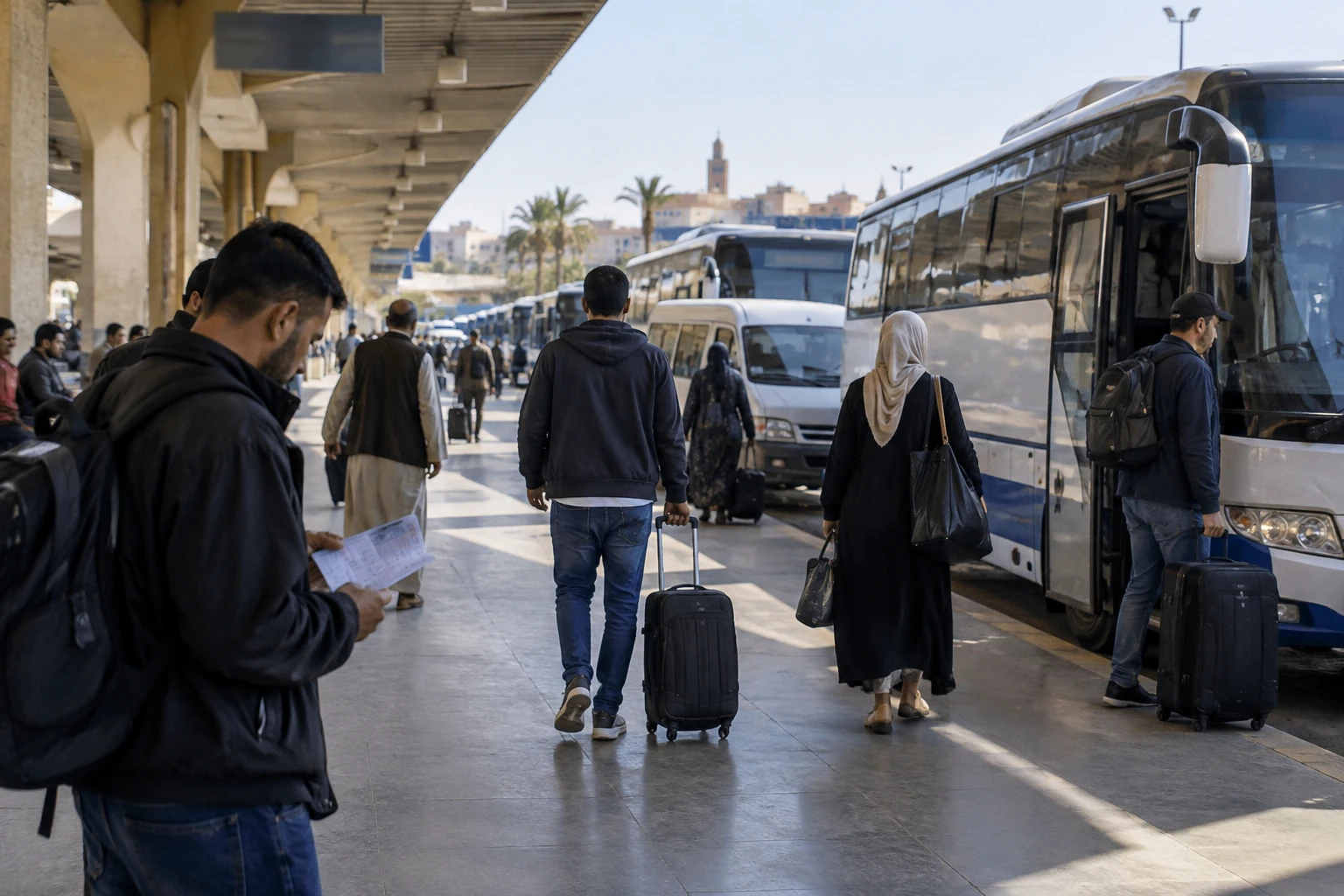
Can a decision taken in Benghazi be enforced at every entry point in a country whose institutions remain divided? In Libya, the ban on Iranian and Afghan nationals highlights the limits of migration policy decided by just one of the rival authorities.
A measure announced in a country with competing authorities
On 28 October 2026, the government based in eastern Libya banned nationals of Iran and Afghanistan from entering the country by land, sea or air. The decision also applies to people already in the country without a valid residence permit: they may be deported, according to the text announced by the eastern authorities.
The government has not publicly explained the reasons for the measure. A Reuters report, carried by several media outlets, says the Benghazi executive tasked its interior ministry with enforcing it. The Libyan outlet Al-Wasat says the decree nevertheless provides for exceptions for diplomatic staff and their families, as well as certain health and education professionals holding the required authorisations.
This qualification matters: the measure is not necessarily a ban without exceptions, but a restriction whose application will depend on the authorities and the documents presented. The practical arrangements at borders, as well as the treatment of people already settled in the country, remain to be seen.
An eastern decision, not a unified national policy
Since the fall of Muammar Gaddafi in 2011, Libya has not regained fully unified national authority. The UN-recognised Government of National Unity is based in Tripoli. In the east, an executive appointed by the House of Representatives exercises authority with the support of forces led by Khalifa Haftar. The two centres of power dispute the legitimacy and control of the institutions.
In this context, an announcement by the eastern government is not enough to establish that all Libyan authorities have adopted or are enforcing the same rule. The ban’s actual reach will depend, in particular, on cooperation between administrations, border services and the actors controlling the various crossing points.
The measure is part of a series of restrictions imposed by the eastern administration. In June 2026, it had banned nationals of Sudan, Eritrea, Ethiopia and Somalia from entering. It presented the decision at the time as a reorganisation of foreign nationals’ entry. The Associated Press also reported this earlier ban, announced by the eastern authorities.
Direct consequences for those affected
For Iranian and Afghan travellers, the new rule could disrupt a business, family or transit journey. Those already living in Libya could face deportation if they lack a valid residence permit. Yet in a country where administrations are fragmented, recognised documents, procedures and practical safeguards may vary depending on the location and the relevant authority.
The consequences are not limited to those targeted. Employers, health and education institutions, families and business networks may also be affected, particularly if workers concerned hold professional authorisations. The exceptions reported by Al-Wasat will need to be verified in practice, rather than assumed to apply automatically.
Libya is home to a large foreign population. According to the International Organization for Migration, nearly 895,000 migrants were in the country in July 2025. This figure describes a diverse population, including people who came to work, displaced people and people in transit. On its own, it cannot be used to assess the ban’s effects on Iranians and Afghans, or to treat all migrants as a single category.
A regional issue that extends beyond Libya’s borders
Libya’s position in North Africa makes it a destination, transit and departure country on routes across the central Mediterranean. Decisions taken in the east may therefore alter the routes and procedures of people on the move, without their effects necessarily being uniform throughout the country. Land borders, ports and airports operate in different administrative contexts.
The issue also concerns the ability of Libyan institutions to adopt common rules. As long as the authorities remain divided, a migration-control decision may bolster the authority of the executive that issues it without resolving the question of coherent national governance. For residents and foreign nationals alike, this fragmentation makes rules harder to predict.
At regional level, the African Union and the Arab Maghreb Union provide frameworks for political dialogue between states, but the decision announced remains, for now, a measure by the eastern administration. The points to watch are its effective implementation, the exceptions provided for, and any response from the Tripoli authorities or common position from Libyan institutions. The reasons for the ban, meanwhile, have not been made public.