Algeria
 Egypt
 Morocco
 Sudan
 Tunisia
 Benin
 Burkina Faso
 Cabo Verde
 Côte d'Ivoire
 Ghana
 Guinea
 Guinea-Bissau
 Liberia
 Mali
 Mauritania
 Niger
 Nigeria
 Senegal
 Sierra Leone
 The Gambia
 Togo
 Cameroon
 Central African Republic
 Chad
 DR Congo
 Equatorial Guinea
 Gabon
 Republic of the Congo
 São Tomé and Príncipe
 Burundi
 Comoros
 Djibouti
 Eritrea
 Ethiopia
 Kenya
 Madagascar
 Malawi
 Mauritius
 Mozambique
 Rwanda
 Seychelles
 Somalia
 South Sudan
 Tanzania
 Uganda
 Angola
 Botswana
 Eswatini
 Lesotho
 Namibia
 South Africa
 Zambia
 Zimbabwe
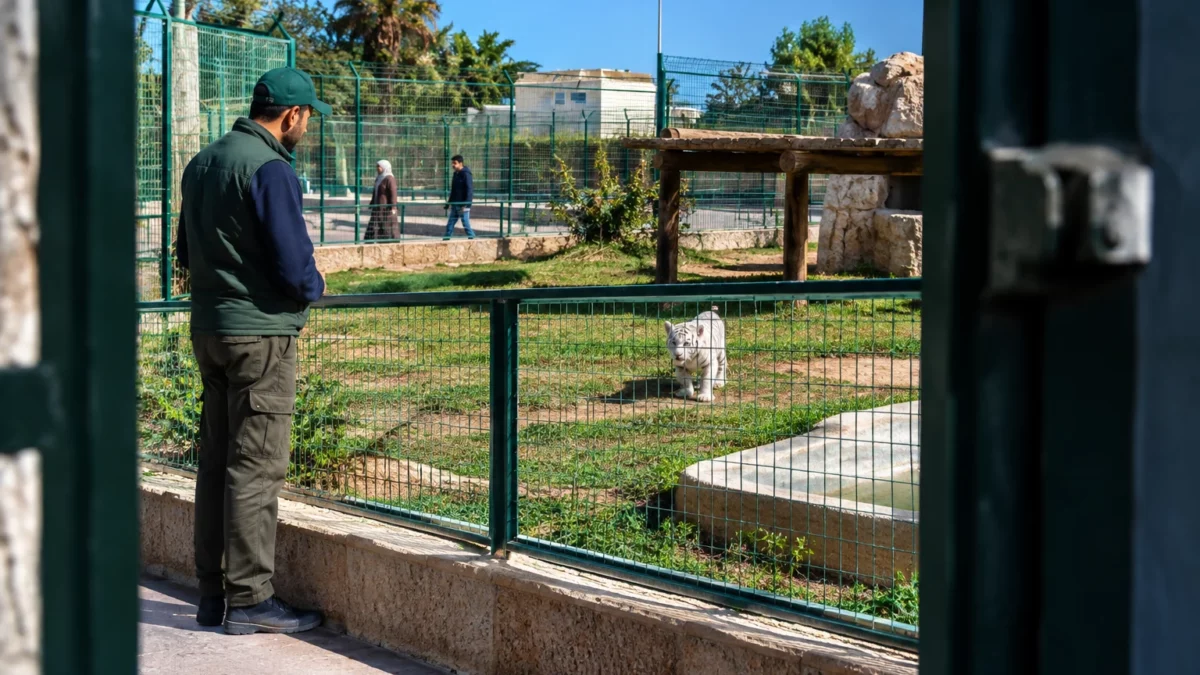
At Tripoli Zoo, the birth of a white tiger is drawing attention to a less spectacular but decisive question: what does it take to ensure animals’ welfare in the long term at an institution marked by years of closure and fighting? The cub, rejected by its mother, is receiving intensive care. Its story is putting the park’s reopening ambitions to the test.
Reopening after years of interruption
The zoo is in the Abu Salim district, south of Tripoli, the Libyan capital. Covering about 45 hectares, it was closed to the public in 2009 for renovations. The clashes that followed the fall of Muammar Gaddafi in 2011 prolonged the closure and disrupted the site’s operations.
The park reopened in March 2026, for Eid al-Fitr. Libyan media had reported the reopening and restoration work. The Libyan News Agency, LANA, for its part, described the site as an upgraded leisure and education venue, with a stated focus on animal safety. Accounts nevertheless differ on the precise length of the closure: officials and media refer to nearly 17 years, while LANA says it was closed for nearly ten years. This difference points to the need to distinguish between periods when the park was closed to the public, undergoing works and under site restrictions.
The park also bears the marks of a more troubled recent history. According to an AFP report carried by Arab News, animals were killed or stolen during the years of violence, and about 700 of the 1,100 recorded were said to remain when it reopened. These figures are attributed to the zoo’s management and have not been independently confirmed by the sources consulted. In 2025, fighting again affected Tripoli and the Abu Salim area, a reminder that the security of public places also depends on local power dynamics.
A newborn under veterinary supervision
The zoo is now home to its first white tiger born on site, according to an announcement reported on 16 November 2026. Rejected by its mother after birth, the cub was placed in an incubator and taken into the care of veterinary teams. Wassim Ali, a park keeper, said staff were monitoring it continuously. The available account says its condition has improved, but no detailed veterinary bulletin or data allowing its progress to be assessed has been published.
These specific details about the birth and care come mainly from a single agency account. Other media outlets have reported the news, but have not provided independent confirmation of the cub’s condition. Its health should therefore be presented as information attributed to zoo staff, rather than as a medical finding verified by an external source.
The birth of an animal in a zoo is not, on its own, enough to demonstrate a contribution to biodiversity conservation. That requires, among other things, suitable breeding conditions, veterinary monitoring, documented genetic management and clearly defined conservation goals. The available information does not specify whether the tiger is part of a co-ordinated breeding programme. The term “white” describes a rare colour variation in tigers, not a distinct species.
Animal welfare, a reopening challenge
For Tripoli’s families, the zoo is also a public space for relaxation and an opportunity to see animals up close. Its reopening restores a leisure activity for residents after a lengthy interruption. It also puts the authorities and park management face to face with practical responsibilities: feeding, care, enclosure security, staff training and oversight of interactions with visitors.
The newborn’s case illustrates this responsibility. An incubator and constant human presence can address an emergency, but they require reliable equipment, specialist skills and sustained resources. The quality of care is therefore not measured solely by the attention given to a highly publicised animal. It also depends on the resources devoted to the other inhabitants, including those who attract less public attention.
Local animal welfare organisations have also voiced concerns about the treatment of animals and the behaviour of some visitors since the reopening. These concerns are a reminder that welcoming the public must go hand in hand with enforced rules and effective oversight. They do not, on their own, establish that any specific shortcomings occurred in the care of the tiger cub.
A local symbol, lasting questions
Libya remains divided politically between the authorities based in Tripoli and a rival administration in the east of the country. In this context, reopening a municipal facility can signal a return to activity in a neighbourhood without proving that stability has been achieved. The zoo is at once a leisure space, a workplace and a service whose continuity depends on funding and regular management.
Across North Africa and the African Union, the episode is a reminder that conservation is not confined to large nature reserves or iconic species living in the wild. Urban zoos also raise questions about public responsibility, animal protection and biodiversity education. For Tripoli’s zoo, the next benchmarks will be less the newborn’s popularity than the publication of regular information about its health, the animals’ living conditions and the resources available to oversee the site.