Algeria
 Egypt
 Morocco
 Sudan
 Tunisia
 Benin
 Burkina Faso
 Cabo Verde
 Côte d'Ivoire
 Ghana
 Guinea
 Guinea-Bissau
 Liberia
 Mali
 Mauritania
 Niger
 Nigeria
 Senegal
 Sierra Leone
 The Gambia
 Togo
 Cameroon
 Central African Republic
 Chad
 DR Congo
 Equatorial Guinea
 Gabon
 Republic of the Congo
 São Tomé and Príncipe
 Burundi
 Comoros
 Djibouti
 Eritrea
 Ethiopia
 Kenya
 Madagascar
 Malawi
 Mauritius
 Mozambique
 Rwanda
 Seychelles
 Somalia
 South Sudan
 Tanzania
 Uganda
 Angola
 Botswana
 Eswatini
 Lesotho
 Namibia
 South Africa
 Zambia
 Zimbabwe
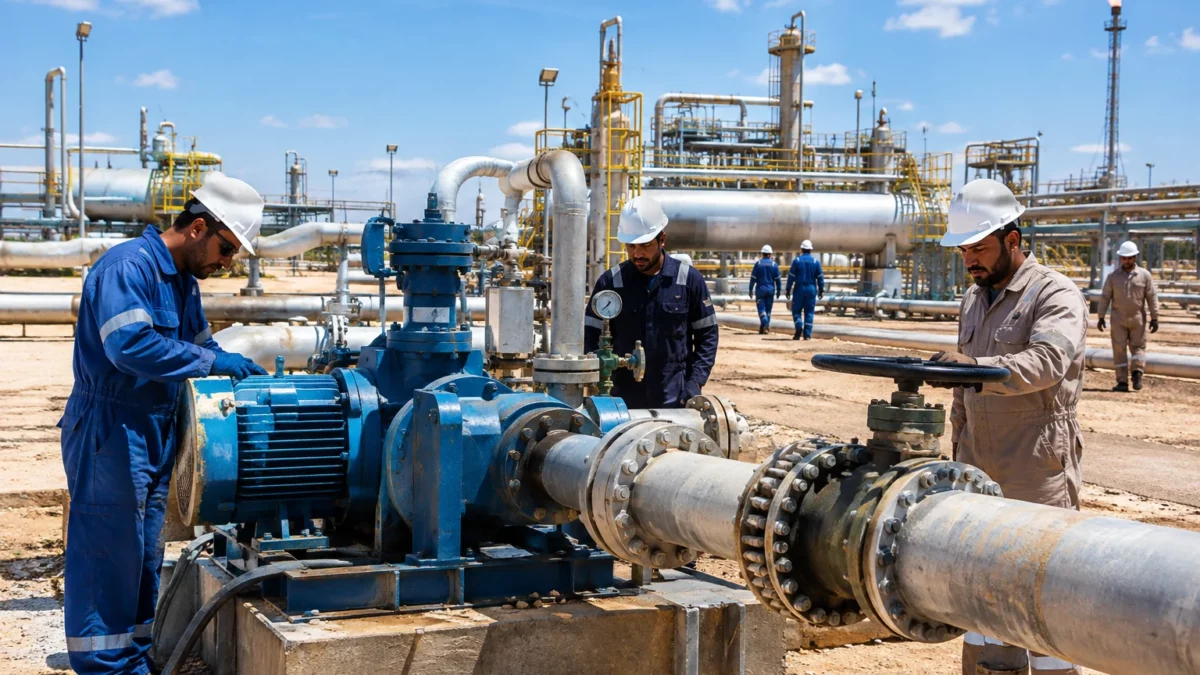
In Libya, finding new deposits is not enough to guarantee sustained growth in oil revenues. Funding drilling, maintaining facilities and ensuring sufficiently stable management are also needed for production to reach markets. Waha Oil’s exploration programme planned for 2027 is part of this equation.
The Sirte Basin at the heart of exploration
On 12 November 2026, the National Oil Corporation (NOC), the state-owned company overseeing Libya’s oil sector, reviewed exploration projects for the following year with Waha Oil. The meeting covered seismic surveys, the reprocessing of existing data and plans to drill three exploration wells.
The proposed work concerns concessions MN 12 and MN 13 in the Sirte Basin, in the country’s interior. Seismic surveys produce an image of the subsurface. They help teams identify structures that may contain hydrocarbons, but do not by themselves prove the existence of commercially recoverable reserves.
The NOC confirmed that the meeting had taken place and outlined the main points of the programme. It did not make public the precise well locations, a detailed timetable or the corresponding budget. These details will be important in assessing the announcement’s real significance: an exploration plan guarantees neither a discovery nor higher production.
The campaign builds on work already under way on these concessions. In 2025, Waha reported two exploration wells associated with an estimated 17 million barrels of crude oil. In the absence of public details on the methodology and classification of these volumes, they should not be described as proven reserves.
A state-owned company with foreign partners
Waha Oil operates historic fields in the Sirte Basin, including Waha, Gialo, Dahra and Defa. According to the NOC, its production stood at around 357,000 barrels per day in August 2026. That month, the company also reviewed a programme covering 29 development, production and water-injection wells. This programme is separate from the three exploration wells announced for 2027.
The NOC holds 59.16% of Waha’s concessions. TotalEnergies and ConocoPhillips each own 20.42%. An agreement signed in January 2026 extended the concessions until 31 December 2050. It provides for a new phase of investment, particularly around the North Gialo field, whose development could increase production in the area.
This structure therefore brings together public ownership and international capital. For the NOC, the challenge is to gain a better understanding of resources and maintain facilities. For the partners, the length of the concessions provides investment visibility. However, the amounts committed and the sharing of costs for the 2027 exploration programme have not been made public.
Production growth faces vulnerabilities
Libyan authorities have set a target of raising national production to 1.6 million barrels per day, and then to 2 million in the medium term. Waha’s programme could contribute to this effort, but exploration is only one stage. Any discoveries will need to be confirmed, their commercial viability established and the necessary infrastructure built before additional extraction can begin.
This ambition comes amid political fragmentation. Since the failure of the electoral process in 2021, rival institutions and authorities have remained divided. This situation has already disrupted production and the management of oil revenues. The World Bank notes that the economic recovery remains closely tied to the hydrocarbons sector and also depends on political stability and better management of public finances.
The effects of higher production would vary among stakeholders. For the state, more oil sales could support public revenues and foreign-exchange reserves. For residents, the impact depends on how those revenues are distributed and whether they translate into services, jobs and infrastructure. Local businesses and contractors could benefit from the work, but the available information does not make it possible to quantify the programme’s expected spillovers.
A Libyan issue with regional implications
Libyan oil matters on international markets and in the Mediterranean’s energy balance. But production targets are not measured solely in barrels. The regularity of exports, equipment maintenance and institutions’ capacity to manage revenues all weigh equally on the economic value of discoveries.
For neighbouring North African countries, the stability of supplies and trade remains a regional concern. Libya belongs to the Arab Maghreb Union, although the organisation does not currently provide a framework for economic integration comparable to that of other African regional communities. Across the continent, the Libyan case is a reminder that the exploitation of natural resources also depends on governance and institutional continuity.
The next step will be to determine whether the 2027 seismic work and drilling receive a specific timetable and funding. The data published by the NOC do not yet make it possible to estimate their impact on national production. For now, the targets of 1.6 million and then 2 million barrels per day remain ambitions, not volumes guaranteed by the announced discoveries.
The NOC outlined the main points of the 2027 programme in its account of the meeting with Waha Oil. The company’s production and planned work for 2026 are set out in an operational review published by the national company. The extension of the concessions until 2050 is detailed in TotalEnergies’ statement.