Algeria
 Egypt
 Morocco
 Sudan
 Tunisia
 Benin
 Burkina Faso
 Cabo Verde
 Côte d'Ivoire
 Ghana
 Guinea
 Guinea-Bissau
 Liberia
 Mali
 Mauritania
 Niger
 Nigeria
 Senegal
 Sierra Leone
 The Gambia
 Togo
 Cameroon
 Central African Republic
 Chad
 DR Congo
 Equatorial Guinea
 Gabon
 Republic of the Congo
 São Tomé and Príncipe
 Burundi
 Comoros
 Djibouti
 Eritrea
 Ethiopia
 Kenya
 Madagascar
 Malawi
 Mauritius
 Mozambique
 Rwanda
 Seychelles
 Somalia
 South Sudan
 Tanzania
 Uganda
 Angola
 Botswana
 Eswatini
 Lesotho
 Namibia
 South Africa
 Zambia
 Zimbabwe
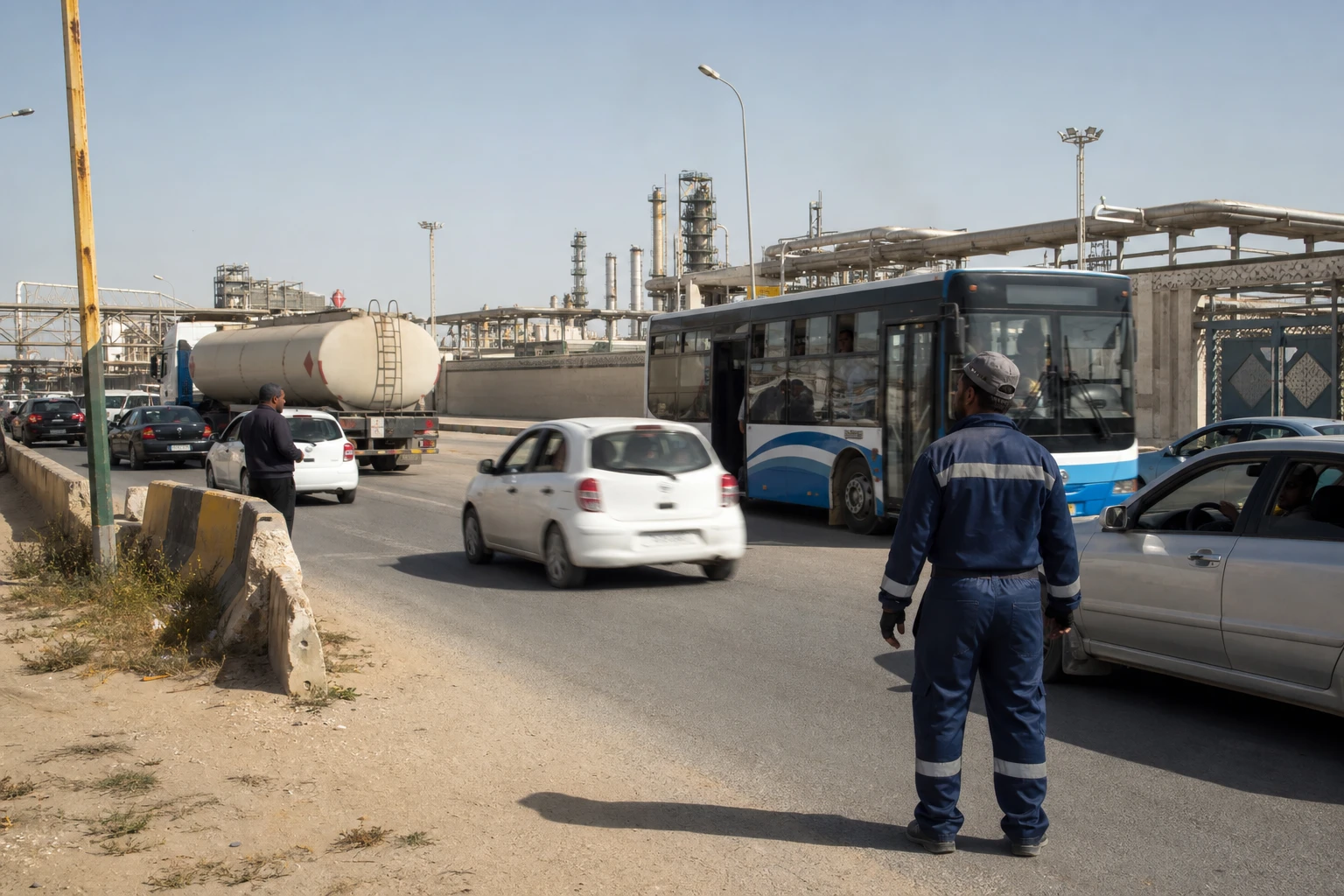
In Libya, oil’s vulnerability is measured not only at the wells. It also plays out at valves, access roads and facilities linking the south-west to the coast. The latest shutdown around Al-Sharara is a reminder of this reality: a few strategic points can quickly affect public revenues, fuel supplies and the country’s commercial commitments.
An oil route under renewed pressure
On 21 September 2026, Libya’s National Oil Corporation, the NOC, reported the closure of valve number 7 on the pipeline linking the Al-Sharara field to the Zawiya complex, west of Tripoli. The facility carries crude extracted in south-western Libya to the Mediterranean coast.
The NOC attributed the closure to members of the Petroleum Facilities Guard, the force responsible for protecting oil sites, backed by an armed group. In its statement, the company said technical teams had been unable to reach the areas around valves 6 and 7. It also said pressure that had built up in the pipeline had led to a significant reduction in production.
The following day, the NOC added that the main gates of the Zawiya refinery and those of Brega Petroleum Marketing had been blocked by members of the same force. Access to the Brega site was later partially restored, but the refinery’s main entrance remained closed. The company believes this is preventing a full and safe resumption of operations. The NOC detailed the technical consequences of the Al-Sharara shutdown in a statement published on 21 September.
According to figures provided by the company, Al-Sharara has a capacity of about 335,000 barrels a day. The closure of the valve could deprive Libya of about 130,000 barrels a day, a figure cited by the NOC that must still be distinguished from the production actually lost.
The national oil company warned that it could declare force majeure if the valve was not reopened. In the oil sector, this procedure temporarily suspends certain contractual obligations when an event is beyond the operator’s control. As of 23 September 2026, the NOC had announced this possibility, but no formal declaration had been published in the material reviewed.
Grievances reach critical infrastructure
The protest is not confined to Al-Sharara. On 13 September, members of the Petroleum Facilities Guard had already blocked access to the Zawiya refinery. They were protesting over their working conditions and financial demands, according to Libyan media. Two days later, the Hamada-Zawiya pipeline was shut down, halting the transport of crude from the Hamada and Al-Tahara fields.
The force’s south-western branch then threatened to shut several other fields. Local reports also point to a dispute related to the governance of Waha Oil, as well as the administrative and financial situation of personnel tasked with protecting the facilities. These details have been reported by separate sources and do not, at this stage, represent a shared position among all the parties concerned.
The case of Al-Sharara is not unprecedented. In January 2024, residents of Ubari halted production to protest fuel shortages and a lack of services in the south. Operations resumed after commitments were made, notably on infrastructure projects. In August of the same year, the field was again affected by the crisis sparked by the dispute over control of the Central Bank of Libya.
These episodes show the particular role oil sites have played in Libya’s trajectory since 2011. They serve at once as a source of revenue, a bargaining tool and a point of contact between the authorities, armed groups, local communities and workers. This interdependence means any shutdown can quickly become a national issue, even when it begins with a sectoral or regional grievance.
Public finances exposed to every shutdown
The state’s financial dependence amplifies the impact of these blockades. Between 1 January and 31 August 2026, the Central Bank of Libya recorded revenues of 98.98 billion dinars. Oil revenues accounted for 80.8 billion dinars, with a further 15.3 billion dinars in oil royalties. Public-sector wages reached 46.9 billion dinars over the same period.
The Central Bank nevertheless highlights a tension between dinar accounts and foreign-currency needs. Foreign-currency expenditure exceeded oil revenues and royalties, creating a deficit estimated at about $4.9 billion. The financial statement published by the Central Bank of Libya sets out these figures for the first eight months of 2026.
A prolonged shutdown would therefore have several effects. First, it would reduce the revenues transferred to the state. It could then complicate the supply of the Zawiya refinery, which plays an important role in distributing petroleum products in the west of the country. Finally, it could increase fuel imports and their cost, with different consequences across regions: major cities can absorb some of the shock, while remote areas depend more heavily on fragile supply chains.
For workers and communities in the south-west, oil also represents the promise of jobs, income and local investment. When that promise is not fulfilled, facilities become sites of pressure. For the authorities in Tripoli, by contrast, each shutdown highlights the difficulty of maintaining a unified chain of command over infrastructure spread across areas where the balance of power remains fragmented.
An issue that extends beyond the Libyan market
The crisis comes as the country remains divided between rival institutions, with no fully stabilised political mechanism. Libya does not have a Maghreb regional economic organisation as integrated as ECOWAS in West Africa or SADC in southern Africa. It nevertheless remains part of the Arab Maghreb Union and the energy balance of North Africa and the Mediterranean.
The immediate priority is now to establish whether the valve will be reopened, whether the Zawiya refinery can resume operations under normal conditions and whether the NOC will actually declare force majeure. The Libyan authorities’ response to the Petroleum Facilities Guard’s demands will also need to be monitored. Without an agreement on site security, staff funding and revenue distribution, Al-Sharara risks remaining a recurring barometer of national tensions.