Algeria
 Egypt
 Libya
 Morocco
 Sudan
 Tunisia
 Benin
 Burkina Faso
 Cabo Verde
 Côte d'Ivoire
 Ghana
 Guinea
 Guinea-Bissau
 Liberia
 Mali
 Mauritania
 Niger
 Nigeria
 Senegal
 Sierra Leone
 The Gambia
 Togo
 Cameroon
 Central African Republic
 Chad
 Equatorial Guinea
 Gabon
 Republic of the Congo
 São Tomé and Príncipe
 Burundi
 Comoros
 Djibouti
 Eritrea
 Ethiopia
 Kenya
 Madagascar
 Malawi
 Mauritius
 Mozambique
 Rwanda
 Seychelles
 Somalia
 South Sudan
 Tanzania
 Uganda
 Angola
 Botswana
 Eswatini
 Lesotho
 Namibia
 South Africa
 Zambia
 Zimbabwe
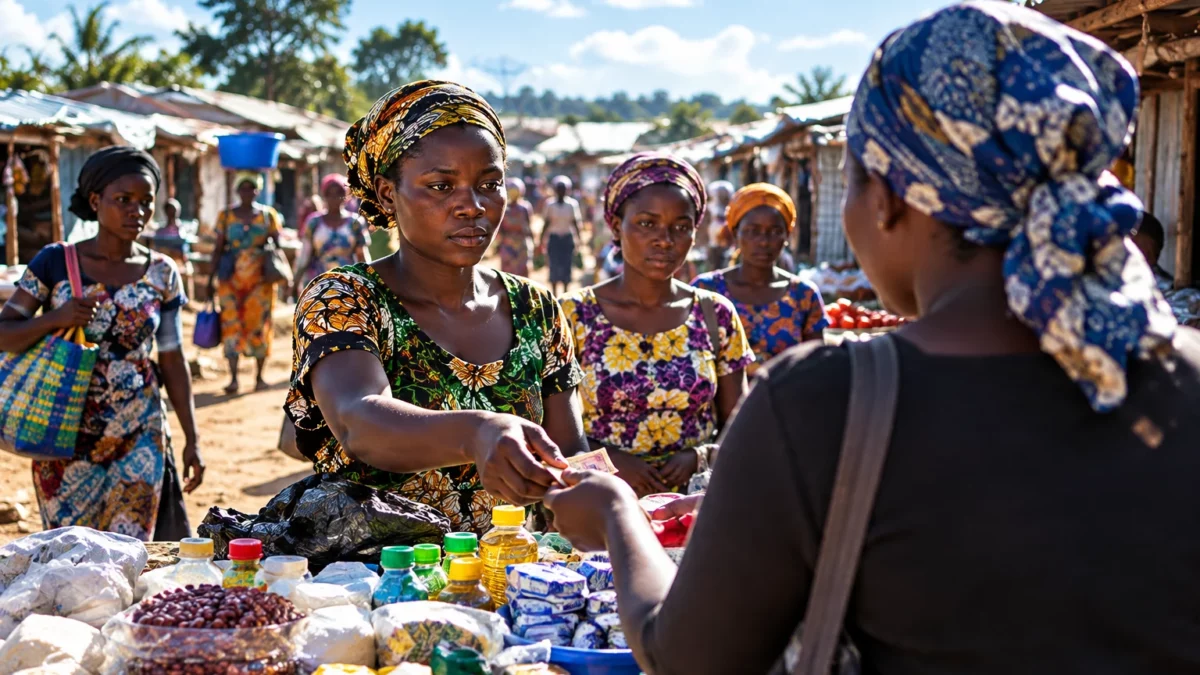
In Bunia, in Ituri, the response to Ebola is not limited to treatment centres. For women who make a living from small-scale trading or are trying to feed their families in a displacement site, fear of infection and upheaval in daily life can also reduce incomes and make it harder to access assistance.
In Ituri, an epidemic amid displacement and insecurity
Ituri province, in the north-east of the Democratic Republic of the Congo, is marked by population displacement and long-running humanitarian needs. Bunia, its provincial capital, is close to areas where the movement of people and insecurity make access to services difficult. The province also shares borders with Uganda and South Sudan, meaning that containing an epidemic there requires coordination beyond local boundaries.
On 15 May 2026, health authorities in the DRC and Uganda announced outbreaks of Ebola virus disease linked to the Bundibugyo virus. This strain is distinct from the one targeted by some tools used during previous outbreaks. The World Health Organization has reported difficulties in tracing contacts and referring patients in several Congolese provinces, notably because of insecurity and insufficient isolation capacity.
These public health constraints overlap with very tangible economic realities. In Bunia and at the Rwampara displacement site, preventive measures and fear of infection can restrict movement and commercial activity. For women who depend on market trading, a day without sales sometimes means less money for food, transport or healthcare.
When lost income also puts care out of reach
Women interviewed in Bunia describe this double impact. Kasemire Mugavu, who used to buy goods to resell, says she has lost this source of work and now works in the fields. Her testimony illustrates the insecurity of informal incomes: they often depend on daily travel and offer little protection when activity stops.
Fear of being infected at a health facility is another obstacle. Mapendo Linganaiso, head of the Bunia office of the Women’s Solidarity for Peace and Integral Development (SOFEPADI), says that some women are reluctant to go there. This concern can delay a consultation, including when someone needs care unrelated to Ebola. It calls for a clear response on preventive measures, as well as accessible and trusted services.
In displacement sites, economic pressure can increase exposure to exploitation. Women may find themselves accepting relationships they would not have chosen in other circumstances because they lack the means to provide for their families. This is not to present the situation as an automatic consequence of the epidemic, but to recognise that loss of resources and isolation reduce people’s scope for choice and protection.
A preliminary report published in November by UNICEF, SOFEPADI and Washington University says that nearly six in ten women and adolescent girls interviewed in five health zones in Ituri reported that violence or abuse had started or increased in their lives since the beginning of the epidemic. This finding relates to those interviewed as part of this monitoring; it is not an exhaustive measure of all violence in the province.
Safe spaces at the heart of the response
With support from UNICEF and in collaboration with researchers from Washington University in St Louis, SOFEPADI monitors the risks of violence against women and girls. Teams gather testimonies and refer people to appropriate services. Safe spaces near Bunia provide medical care, psychosocial support and training to help strengthen economic independence.
This approach is a reminder that a public health response is not limited to screening, isolation and treatment. It must also protect people’s confidentiality, ensure safe reporting channels and maintain the services on which communities depend. Field teams must also explain preventive measures without fuelling stigma against patients or their relatives.
For the Congolese authorities, the challenge is to coordinate the national response with provincial teams and partners without diverting resources from routine healthcare for the long term. For households, the priorities are more immediate: being able to access care, travel when necessary and maintain an income. Women working in informal trade or living in displacement sites are particularly vulnerable when these needs coincide.
An issue that extends beyond Ituri’s borders
Co-operation with Uganda is important because of cross-border movements and the proximity of affected areas. The DRC is also a member of the East African Community and the Southern African Development Community, two regional organisations with distinct mandates. Ebola management is therefore testing health coordination arrangements, while the protection of people must remain a priority beyond administrative borders.
The next indicators to watch will not be solely epidemiological. It will also be important to see whether women can access care without fear, whether support spaces remain available and whether families who have lost income receive assistance. Data gathered in Ituri show that health security and protection from violence must advance together: one does not automatically guarantee the other.