Algeria
 Egypt
 Libya
 Morocco
 Sudan
 Tunisia
 Benin
 Burkina Faso
 Cabo Verde
 Côte d'Ivoire
 Ghana
 Guinea
 Guinea-Bissau
 Liberia
 Mali
 Mauritania
 Niger
 Nigeria
 Senegal
 Sierra Leone
 The Gambia
 Togo
 Cameroon
 Central African Republic
 Chad
 Equatorial Guinea
 Gabon
 Republic of the Congo
 São Tomé and Príncipe
 Burundi
 Comoros
 Djibouti
 Eritrea
 Ethiopia
 Kenya
 Madagascar
 Malawi
 Mauritius
 Mozambique
 Rwanda
 Seychelles
 Somalia
 South Sudan
 Tanzania
 Uganda
 Angola
 Botswana
 Eswatini
 Lesotho
 Namibia
 South Africa
 Zambia
 Zimbabwe
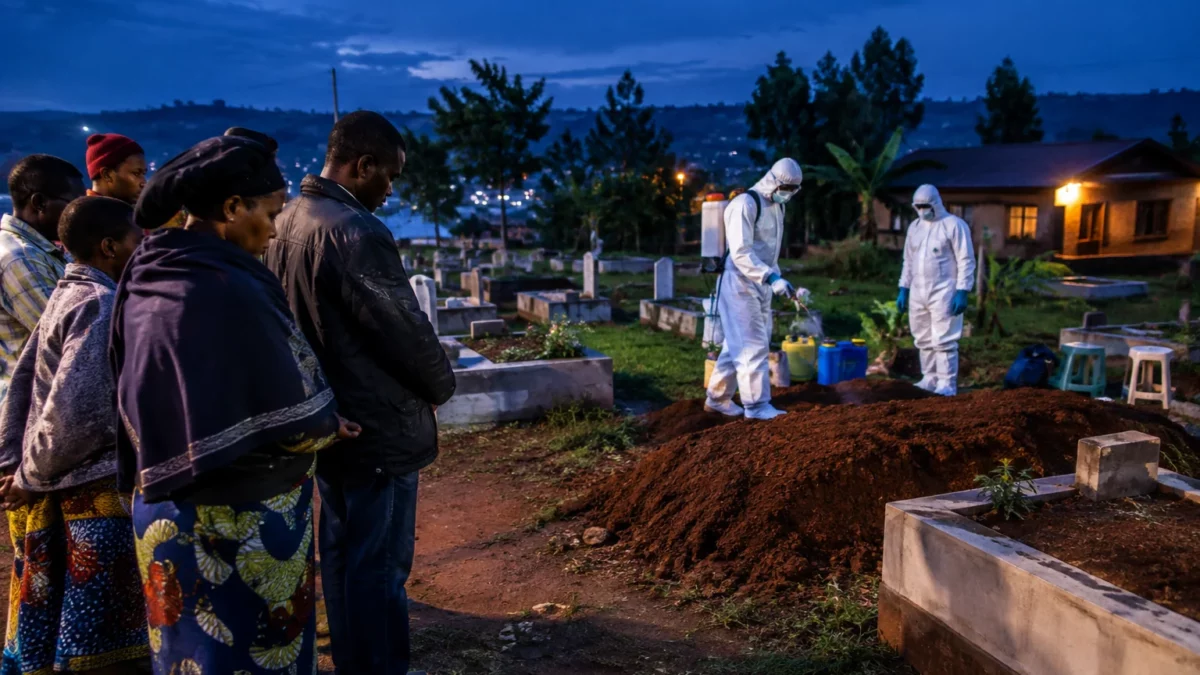
In the Democratic Republic of the Congo, the burial of a loved one must remain dignified without becoming another place of transmission. In North Kivu, provincial authorities are seeking to reduce this risk by strictly regulating gatherings linked to deaths, as Bundibugyo virus disease continues to spread.
Gatherings suspended, burials allowed
Since 26 November 2026, wakes, mourning ceremonies and religious services held in memory of the dead have been suspended in Ebola-affected health zones in North Kivu. The decision was signed by the provincial governor, Major-General Evariste Somo Kakule. The Congolese Press Agency reported that the measure now applies to 18 health zones, with Kibirizi, in Rutshuru territory, added recently.
The directive does not suspend burials. Authorities are asking for them to be conducted safely and with dignity, with no more than 20 family members present. Response teams must also decontaminate the sites concerned, identify people who have been exposed and arrange their monitoring or isolation where necessary. These provisions are set out in the statement reported by the Congolese Press Agency.
The measure targets gatherings, not tributes to the dead. The distinction matters: families must be able to accompany their loved ones while limiting contact that could expose others. The provincial decision comes amid a health crisis in which local buy-in and trust in response teams are as important as official instructions.
An expanding epidemic, with figures to be read cautiously
The current epidemic is caused by Bundibugyo virus, a strain of the Ebola genus different from the one targeted by the vaccine already authorised against Ebola virus disease. As of 8 November, the World Health Organization (WHO) had recorded 10,990 confirmed cases and 5,354 deaths in the Democratic Republic of the Congo. Its assessment indicated that eight provinces were affected and that Ituri remained the worst-hit province, while North Kivu was also experiencing significant transmission.
A tally released on 26 November by the Associated Press, based on data from the Congolese Ministry of Health, reported 12,021 confirmed cases and about 5,800 deaths. Published on different dates from the WHO figures, these numbers show the scale of the spread but should not be combined as though they described the situation on the same day. The Ministry of Health situation report and the WHO risk assessment offer separate points of comparison.
Caution is all the more necessary because the figures are changing rapidly and data collection remains difficult in some areas. The ministry’s report itself refers to work to reconcile figures with the provinces concerned. In its document of 20 November, the WHO estimated that about 80% of identified contacts were being monitored as of 8 November, below the 95% target set for surveillance measures.
Why funeral practices require particular vigilance
The virus is transmitted through direct contact with the blood or other bodily fluids of someone who is ill or has died. Risk arises, in particular, when someone touches a body, clothing or contaminated objects and then touches a wound or their eyes, nose or mouth. The WHO stresses that death does not make a body harmless.
Funeral practices vary between families and communities and according to religious beliefs. Some involve washing the body or physical contact with the deceased. During an epidemic, health authorities therefore recommend safe burials carried out with appropriate protective equipment and support from qualified teams. The challenge is to protect relatives without reducing rites to a mere public health issue.
The presence of teams and the way they explain the measures can influence whether they are accepted. The WHO notes that distrust, delays in detection and care received in facilities that were not prepared have contributed to chains of transmission. For many families, the challenge is also very immediate: a sudden death can occur before Ebola is diagnosed, leaving relatives unaware that they have been exposed.
A response hampered by distance and insecurity
North Kivu and Ituri are in the eastern Democratic Republic of the Congo, a region where population movements and cross-border ties with Uganda complicate contact tracing. The WHO also reports that insecurity and access constraints are hampering surveillance and response efforts in some localities. Displaced families or those far from health services are more likely to be missed by screening and follow-up.
The country belongs to the East African Community (EAC) and the Southern African Development Community (SADC), two regional organisations whose members may be affected by cross-border movements and health co-ordination. The WHO has reported imported cases linked to the epidemic in several countries, including Uganda, Kenya, Nigeria and France. Border surveillance and the rapid sharing of information therefore extend beyond the provincial level.
Research is continuing in parallel, but no vaccine against Bundibugyo virus disease has been approved. The Tumaini clinical trial, launched in the Democratic Republic of the Congo in October 2026, is evaluating several candidates. Two other products, ChAdOx1 and mRNA-1469, have been selected for study as part of the trial. A trial measures a candidate’s safety and efficacy; it does not mean the vaccine is already available or has been proven to protect people.
In the immediate term, the effectiveness of the suspension will depend on whether safe burials can be organised quickly and the rules clearly explained to families. For Kinshasa, as for provinces bordering affected countries, the course of the epidemic will also depend on screening, contact tracing and the ability to keep teams in the field. North Kivu’s measure thus illustrates a lasting tension: reducing risky contact without breaking the trust the response depends on.