Algeria
 Egypt
 Libya
 Morocco
 Sudan
 Tunisia
 Benin
 Burkina Faso
 Cabo Verde
 Ghana
 Guinea
 Guinea-Bissau
 Liberia
 Mali
 Mauritania
 Niger
 Nigeria
 Senegal
 Sierra Leone
 The Gambia
 Togo
 Cameroon
 Central African Republic
 Chad
 DR Congo
 Equatorial Guinea
 Gabon
 Republic of the Congo
 São Tomé and Príncipe
 Burundi
 Comoros
 Djibouti
 Eritrea
 Ethiopia
 Kenya
 Madagascar
 Malawi
 Mauritius
 Mozambique
 Rwanda
 Seychelles
 Somalia
 South Sudan
 Tanzania
 Uganda
 Angola
 Botswana
 Eswatini
 Lesotho
 Namibia
 South Africa
 Zambia
 Zimbabwe
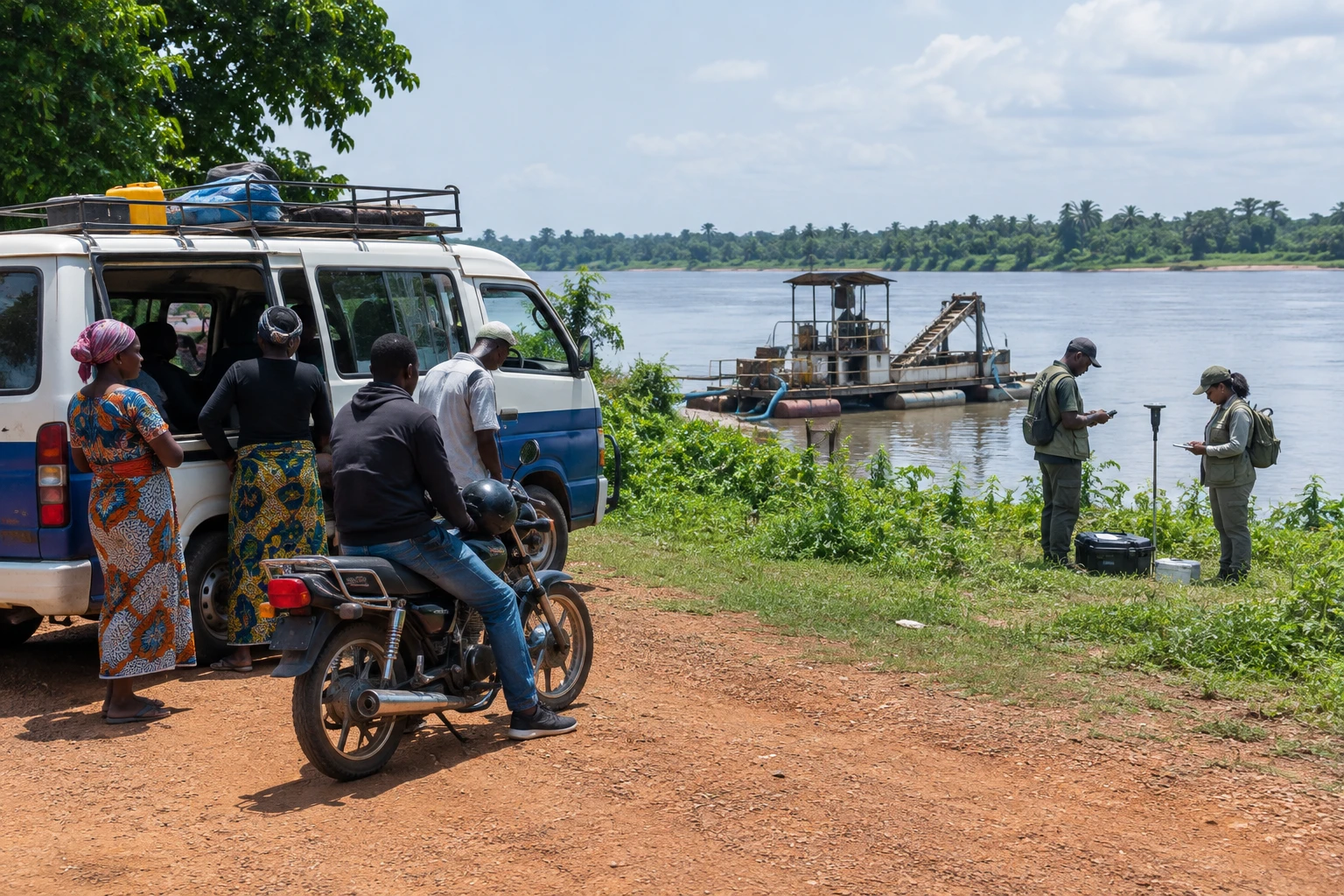
On a riverbank where the border runs through the water, destroying a dredger is not enough to protect a waterway in the long term. In Sud-Comoé, the fight against illegal gold mining depends as much on repeated patrols as on cooperation between Côte d’Ivoire and Ghana.
An operation beside a shared waterway
Near Mouyassué, in Sud-Comoé, a unit from the Special Surveillance and Intervention Brigade (BSSI), which reports to Côte d’Ivoire’s Ministry of Water and Forests, found equipment linked to illegal extraction. Men fled as officers approached, leaving behind gas cylinders, among other items. The operation’s officials explained that this type of equipment powers the engines used for digging or running boats.
Dredgers suck up sediment from riverbeds. The extraction clouds the water and disturbs the banks. Officers at the scene also reported finding mercury, which is used to separate gold from other materials. The risks do not stop at the mining site: when pollutants enter the water, riverside communities and activities that depend on it may be exposed.
The reported incident also highlights another dimension: a young man detained by officers said he had left gold mining to work in cocoa. Officers found mercury in his bag. He was later identified as 17 years old. His individual experience does not represent that of everyone at these sites, but it is a reminder that operations can involve migrant workers and minors, sometimes drawn by the prospect of income or displaced by difficult circumstances.
Many operations, but sites can still be reopened
Côte d’Ivoire has strengthened its efforts to combat illegal gold mining in recent years. In 2021, the National Security Council established a specialised unit to support the agencies responsible for enforcing mining regulations. The BSSI operates on the ground, monitoring forest areas and waterways in particular.
Official figures indicate the scale of the problem, but also show the limits of a strategy based on clearing sites. In 2023, the government reported that operations had been carried out at 1,098 sites in 302 localities across 25 regions and the Yamoussoukro district. It also reported that 501 people had been detained between January and October of that year. These are administrative figures: on their own, they do not show how many sites were subsequently reoccupied or how many operations moved elsewhere. The government’s 2023 report on operations nevertheless provides a national benchmark.
BSSI officials note that abandoned sites can become active again when patrols become less frequent. Destroying crushers and dredgers reduces immediate extraction capacity, but does not address access to equipment or the economic incentives that draw some workers into the activity. Regular monitoring, investigations into supply chains and legal income opportunities are therefore complementary priorities, although implementing them requires time and resources.
The border calls for a coordinated response
Ghana’s proximity complicates operations in Sud-Comoé. Ivorian officers say some gold miners may retreat across the border. This is an account given by officers in the field, not proof that Ghanaian authorities tolerate these activities. It does, however, point to a practical difficulty: action by just one state risks displacing operations rather than stopping them.
The rivers and streams in this area do not stop at the administrative boundary. The Bia and Tanoé are among the transboundary waterways being monitored. An Ivorian forward base was established in Noé in 2024 to strengthen the presence in these areas. Cooperation between Abidjan and Accra — including information-sharing and the coordination of inspections — can therefore have a direct bearing on the effectiveness of operations. The official outline of Côte d’Ivoire’s programme describes the role of specialised units in this policy.
The issue is also regional. Both countries are members of ECOWAS, the Economic Community of West African States, which provides a framework for regional cooperation. But operations against illegal gold mining are primarily the responsibility of national authorities: ECOWAS does not replace field inspections or the bilateral agreements needed to operate on both sides of a border.
Protecting water without overlooking livelihoods
The consequences of illegal gold mining are not felt equally. Riverside communities may suffer from the degradation of water and riverbanks. Farmers, fishers and other users of waterways can be affected when local resources deteriorate. Workers at the sites, meanwhile, sometimes lose their income following an operation, without any guarantee that alternative work will be immediately available.
The use of mercury adds an environmental and health risk that extends beyond the boundaries of a worksite. A study of gold mining in the Tengréla department describes the use of the metal in gold amalgamation and its potential effects on the environment. This field study of gold mining in Tengréla concerns another part of the country; it sheds light on possible mechanisms but is not a direct measure of contamination in Mouyassué.
A sustainable policy must therefore distinguish illegal extraction from artisanal activities that could be regulated by law. Côte d’Ivoire’s Mining Code provides a regulatory framework, but formalisation requires credible inspections, enforceable rules and economic opportunities. Without these, closures may push workers and equipment towards new sites, while environmental damage persists.
The next test: preventing sites from reopening
At the national level, operations in Sud-Comoé are testing the state’s ability to maintain its presence beyond one-off interventions. Across West Africa, they are a reminder that managing shared natural resources requires sustained exchanges between neighbouring countries. Success will not be measured only by the number of dredgers destroyed or sites cleared, but also by fewer returns, better monitoring of waterways and effective protection for riverside communities.
National figures published in 2023 and officers’ observations in Mouyassué do not make it possible to conclude that the problem has been eradicated. Rather, they show why the authorities emphasise regular patrols. In this border area, what happens next will depend as much on the continuity of Ivorian inspections as on practical cooperation with Ghana.