Algeria
 Egypt
 Libya
 Morocco
 Sudan
 Tunisia
 Benin
 Burkina Faso
 Cabo Verde
 Côte d'Ivoire
 Ghana
 Guinea
 Guinea-Bissau
 Liberia
 Mali
 Mauritania
 Niger
 Nigeria
 Senegal
 Sierra Leone
 The Gambia
 Togo
 Cameroon
 Central African Republic
 Chad
 DR Congo
 Equatorial Guinea
 Gabon
 Republic of the Congo
 São Tomé and Príncipe
 Burundi
 Comoros
 Djibouti
 Eritrea
 Ethiopia
 Kenya
 Madagascar
 Malawi
 Mauritius
 Mozambique
 Rwanda
 Seychelles
 Somalia
 South Sudan
 Tanzania
 Uganda
 Angola
 Eswatini
 Lesotho
 Namibia
 South Africa
 Zambia
 Zimbabwe
When the price of a mineral falls, public revenues can decline with it. That is the risk highlighted by Botswana’s experience as Ivory Coast accelerates the development of its gold mines. The challenge is not simply to extract more: it is to turn sometimes unstable revenues into useful, sustainable investment.
Botswana: a genuine success, but an exposed one
Botswana will be the guest of honour at the International Exhibition of Extractive and Energy Resources (SIREXE), taking place in Abidjan from 18 to 22 November 2026. The exhibition’s second edition is also expected to host a mining and energy co-operation agreement between the two countries. For Ivorian officials, Botswana’s experience offers lessons in resource management. It also serves as a reminder that sound management alone cannot protect an economy concentrated on a single commodity.
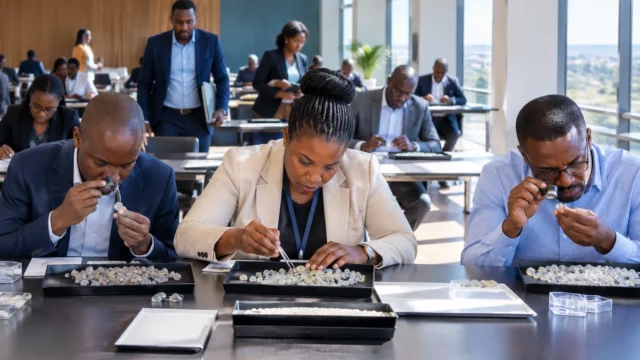
For several decades, diamonds have played a central role in Botswana’s economy. The state is directly involved in their exploitation through Debswana, a company jointly owned with De Beers on an equal basis. This public stake, combined with prudent financial management and investment in services, has contributed to the country’s development. But dependence remains high: the International Monetary Fund (IMF) estimates that diamonds accounted for about 80% of Botswana’s exports between 2012 and 2023, and nearly two-thirds in 2024.
A fall in global demand has since weakened the sector. Synthetic stones, high inventories and weak sales have weighed on exports. The IMF describes a sharp economic contraction in 2024. The situation illustrates the difference between managing resource revenues well and reducing dependence on them: mining income can fund services and infrastructure, but it does not automatically create other drivers of growth.
This assessment does not diminish Botswana’s achievements. Rather, it highlights a structural constraint: when exports and public revenues depend on a dominant resource, a market shock is quickly transmitted across the economy. For Ivory Coast, Botswana’s experience is therefore both an institutional model and a warning about concentration.
Gold gains ground in Ivory Coast
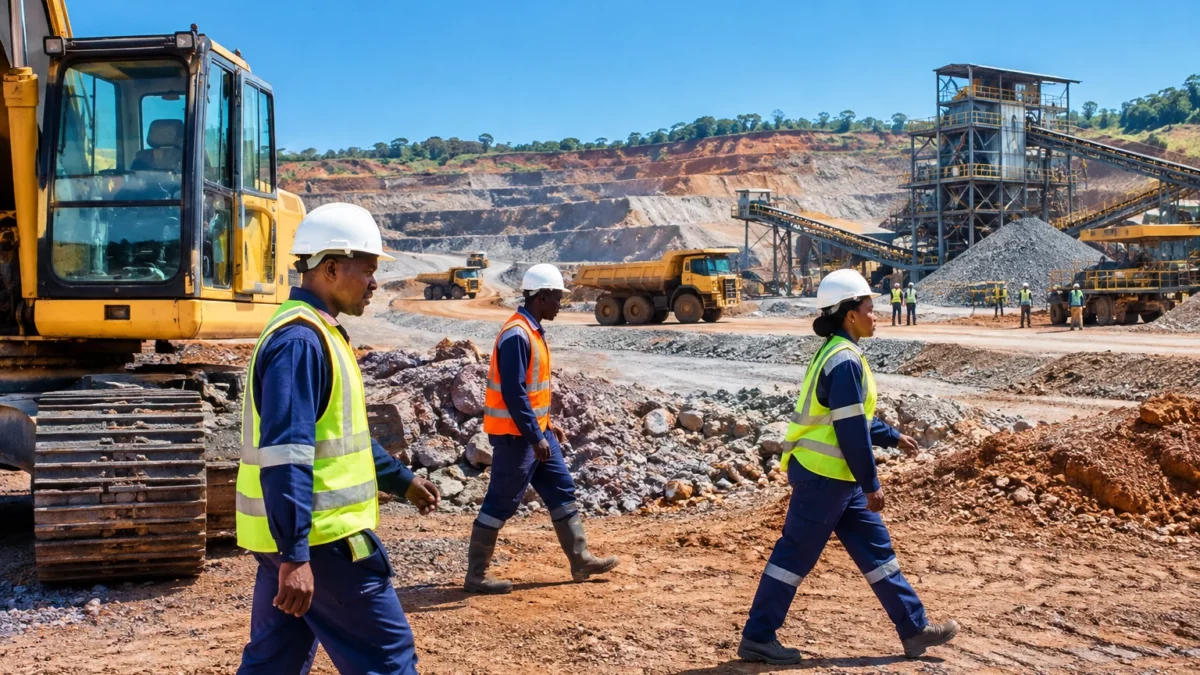
Ivory Coast’s mining sector is expanding rapidly, driven in particular by gold. Customs statistics show that the total value of mineral product exports rose from CFA francs 1,193bn in 2020 to CFA francs 2,479bn in 2024. These figures cover all mineral products and should not be confused with public revenues alone: they measure export value, not the sums actually paid into the state budget.
Available customs data confirm that gold’s share of exports is growing. However, the figure that the metal represents 96% of non-oil mining export revenues is a calculation based on these statistics, not an indicator published directly by Customs. This concentration warrants close attention, while bearing in mind that Ivory Coast’s economy is also supported by agriculture and other activities.
Gold production is expected to rise further as new projects come on stream. This prospect could increase revenues, employment and infrastructure needs. But the effects vary between stakeholders and regions. Tax revenues go to the state; jobs and subcontracting opportunities depend on companies’ choices and the level of local participation. Communities in mining areas also expect tangible benefits, while agricultural activity and water resources must coexist with extraction operations.
Ivory Coast is also seeking to broaden its mining output. Manganese, nickel and bauxite are already being mined. Projects involving lithium and coltan are also under discussion. But a range of deposits does not guarantee diversified revenues: prices fluctuate, investment takes time, and transport or operating constraints can disrupt activity. Each project must therefore be assessed for its viability, local benefits and environmental requirements.
From underground resources to long-term investment
The central question is how revenues are used. In April 2026, the Ivorian government approved the creation of the Strategic Sovereign Fund for the Development of Ivory Coast (FSD-CI). According to official announcements, the fund is intended, among other things, to support infrastructure, build a stabilisation reserve and promote long-term saving. Its impact will depend on the resources actually allocated to it, its governance rules and the regular publication of its results.
A sovereign wealth fund is no substitute for a diversified economy. It can, however, help smooth public spending when revenues fluctuate, provided its rules are clear and investment decisions can be tracked. To assess its effects, it will be necessary to distinguish announced sums from amounts actually transferred, and then examine the projects funded and their benefits for the population.
Ivory Coast has economic strengths beyond mining: a substantial agricultural base, processing industries and two ports of access, Abidjan and San Pedro. These assets can facilitate the transport and processing of resources. However, they will produce lasting benefits only if mining investment also strengthens skills, local businesses and infrastructure that serves several sectors.
An issue that extends beyond the two countries
The comparison between Ivory Coast and Botswana is part of a broader debate in West Africa and across the continent: how can countries negotiate a greater share of the value generated by resources without depending solely on global prices? The Economic Community of West African States (ECOWAS), which brings countries in the region together around economic co-operation, provides a framework in which transport, energy and market integration also matter to the extractive industries.
SIREXE can thus serve as a forum for discussing governance choices and infrastructure, but the outcome will be judged after the speeches. The indicators to watch are concrete: the share of revenues actually invested, the transparency of the sovereign wealth fund, export diversification and benefits in mining regions. Only under these conditions can the wealth underground support Ivory Coast’s economy without becoming its sole pillar.
Ivorian customs statistics are available on the Ivory Coast Customs portal. The IMF details Botswana’s exposure to diamonds in its report on the Botswana economy. The exhibition dates and objectives are set out by the Ivorian government, while the fund’s creation was announced by the Ivorian News Agency.