Algeria
 Egypt
 Libya
 Morocco
 Sudan
 Tunisia
 Benin
 Burkina Faso
 Cabo Verde
 Côte d'Ivoire
 Ghana
 Guinea-Bissau
 Liberia
 Mali
 Mauritania
 Niger
 Nigeria
 Senegal
 Sierra Leone
 The Gambia
 Togo
 Cameroon
 Central African Republic
 Chad
 DR Congo
 Equatorial Guinea
 Gabon
 Republic of the Congo
 São Tomé and Príncipe
 Burundi
 Comoros
 Djibouti
 Eritrea
 Ethiopia
 Kenya
 Madagascar
 Malawi
 Mauritius
 Mozambique
 Rwanda
 Seychelles
 Somalia
 South Sudan
 Tanzania
 Uganda
 Angola
 Botswana
 Eswatini
 Lesotho
 Namibia
 South Africa
 Zambia
 Zimbabwe
Where easy money meets digital vulnerabilities
In Guinea, the appeal of quick investments has found fertile ground on social media. Promises of high returns, a few clicks, then waiting for a withdrawal that never arrives: this is how several savers say they lost sums ranging from a few hundred to several thousand euros. The trap is nothing new. It resembles a classic Ponzi scheme, in which the returns of early investors are paid with money from new entrants, until the system collapses.
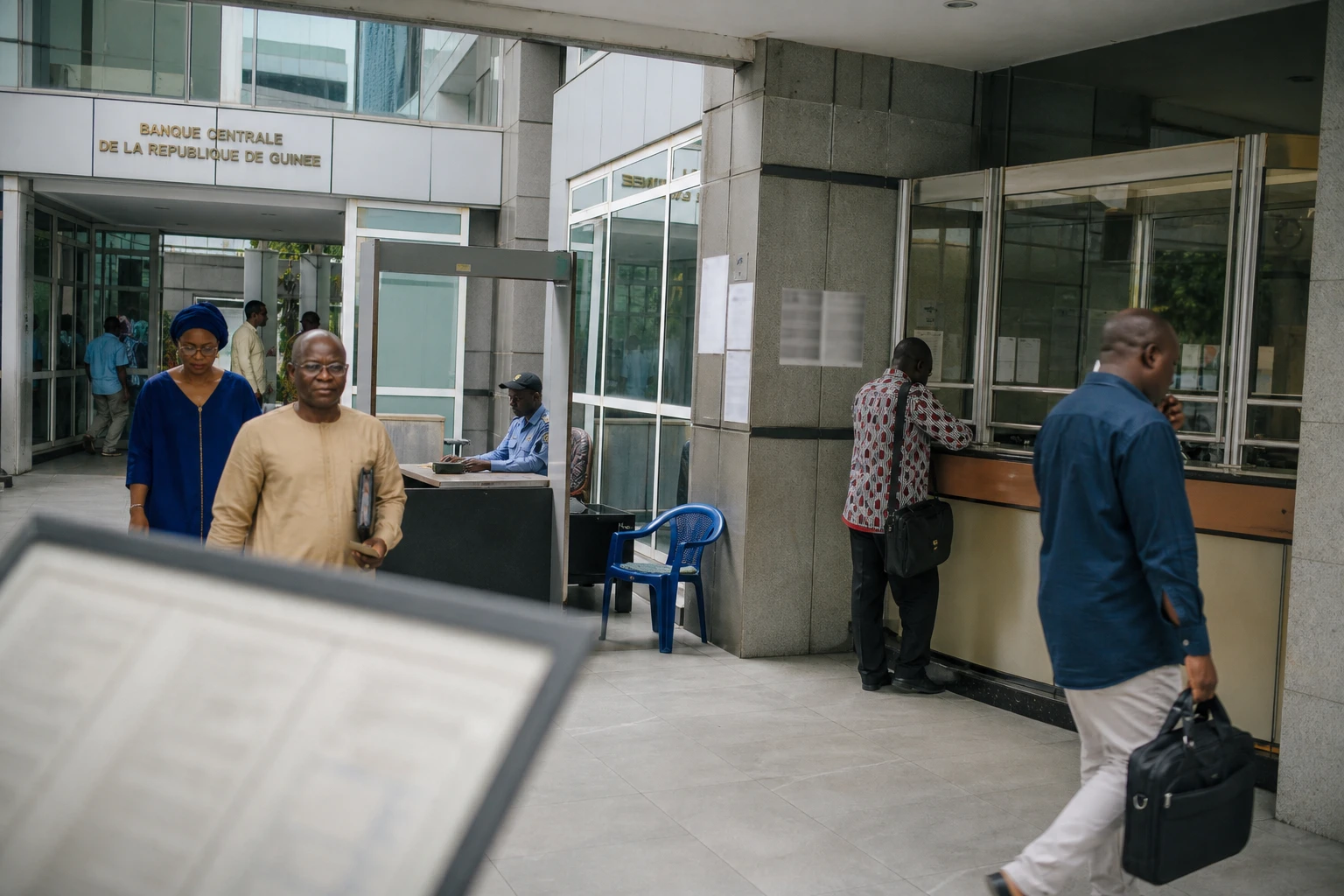
Yet the issue goes beyond individual fraud. It says something about an increasingly digital financial market, where mobile payments, WhatsApp groups and influencer videos can become vehicles for trust or abuse. In Guinea, this tension is particularly visible, as the country moves to modernise its payments while needing to protect users who are still poorly equipped to deal with dubious platforms. The Central Bank of the Republic of Guinea, based at 6 Boulevard du Commerce in Conakry, already oversees electronic money and the country’s financial supervision.
Conakry’s response to increasingly commonplace fraud
The warning came from the Central Bank of the Republic of Guinea, which says virtual currencies are not legal tender in Guinea and are not guaranteed by the issuing institution. This reminder is significant. It is aimed at an environment where many people confuse financial innovation, electronic money and crypto-assets, even though these tools have neither the same legal status nor the same level of protection.
The message comes amid a broader regional context. In West Africa, crypto-assets are no longer a marginal issue. In May 2026, the BCEAO organised an international conference on crypto-assets and digital innovations, showing that the region’s central banks are closely monitoring the effects of these tools on monetary and financial stability. ECOWAS, for its part, has strengthened its digital strategy and its focus on cybersecurity, signalling that the digitalisation of trade and payments is advancing rapidly across West Africa.
In Conakry, the authorities have not limited themselves to a general warning. The central bank has also asked digital payment systems, including Orange Money, to block and report accounts used in these transactions, according to information released by Guinean authorities. At the same time, the justice system has been called in to identify the alleged perpetrators and assess possible avenues for prosecution. This response shows that the case has already moved from prevention to enforcement.
What crypto platforms reveal: trust, speed and vulnerability
Scams of this kind often exploit the same factors. First, speed. Then, a reputation manufactured on social media. Finally, time pressure: people have to invest quickly, before the opportunity disappears. In practice, the money paid in mainly fuels a recruitment mechanism. As long as new deposits keep coming in, withdrawals seem possible. Then everything freezes. The system shuts down, leaving victims with virtual balances that are worthless.
In Guinea, this vulnerability has a particular social dimension. In an economy where cash remains central but mobile money is growing, the line between useful payments and risky investments remains blurred for many users. The victims are not only seasoned investors duped by greed. They also include employees, small traders, members of the diaspora and savers seeking a faster return than traditional banking channels offer. In each case, the promise is the same: turn modest savings into an immediate gain.
The risk does not affect everyone in the same way. For households, losing a few hundred euros can mean several months’ savings. For traders, it weakens cash flow. For payment platforms, it raises questions about traceability and responsibility. For the state, it poses another challenge: preserving trust in the digital infrastructure it is itself seeking to develop. This is why the BCRG stresses the distinction between regulated financial innovation and unauthorised pseudo-investments.
A test for Guinean regulation and West Africa
The case comes at a sensitive time. Guinea, which chose monetary independence by issuing the Guinean franc, is accelerating financial modernisation without being able to afford a loss of confidence in its payment channels. In January 2025, the BCRG launched a national payments and digital switch, presented as a tool to transform Guinea’s financial system. This kind of infrastructure needs a healthy environment. If scams proliferate, mistrust could also spread to legitimate digital services.
Regionally, the case is a reminder of an often-underestimated truth: digital fraud moves faster than regulation. Fraudulent platforms change their name, website or distribution channel in a matter of days. Authorities, meanwhile, have to cross-check information, coordinate payment monitoring and work with telecommunications, banking and judicial actors. ECOWAS is working on digital trust, cybercrime and e-government. But on the ground, public protection also depends on the quality of local warnings and how quickly transactions can be blocked.
The continent-wide significance is clear. From Dakar to Abidjan, from Conakry to Lagos, crypto-assets, fake investments and promises of quick returns now form a single landscape of risk. African central banks are no longer discussing innovation alone. They are also seeking to prevent digital tools from undermining trust in money and payments. In Guinea, this case will therefore be a test. It will show whether regulation can move faster than fraud, and whether financial modernisation can protect, rather than leave more vulnerable, Guinean savers.