
 Algeria
 Egypt
 Libya
 Morocco
 Sudan
 Tunisia
 Benin
 Burkina Faso
 Cabo Verde
 Côte d'Ivoire
 Guinea
 Guinea-Bissau
 Liberia
 Mali
 Mauritania
 Niger
 Nigeria
 Senegal
 Sierra Leone
 The Gambia
 Togo
 Cameroon
 Central African Republic
 Chad
 DR Congo
 Equatorial Guinea
 Gabon
 Republic of the Congo
 São Tomé and Príncipe
 Burundi
 Comoros
 Djibouti
 Eritrea
 Ethiopia
 Kenya
 Madagascar
 Malawi
 Mauritius
 Mozambique
 Rwanda
 Seychelles
 Somalia
 South Sudan
 Tanzania
 Uganda
 Angola
 Botswana
 Eswatini
 Lesotho
 Namibia
 South Africa
 Zambia
 Zimbabwe
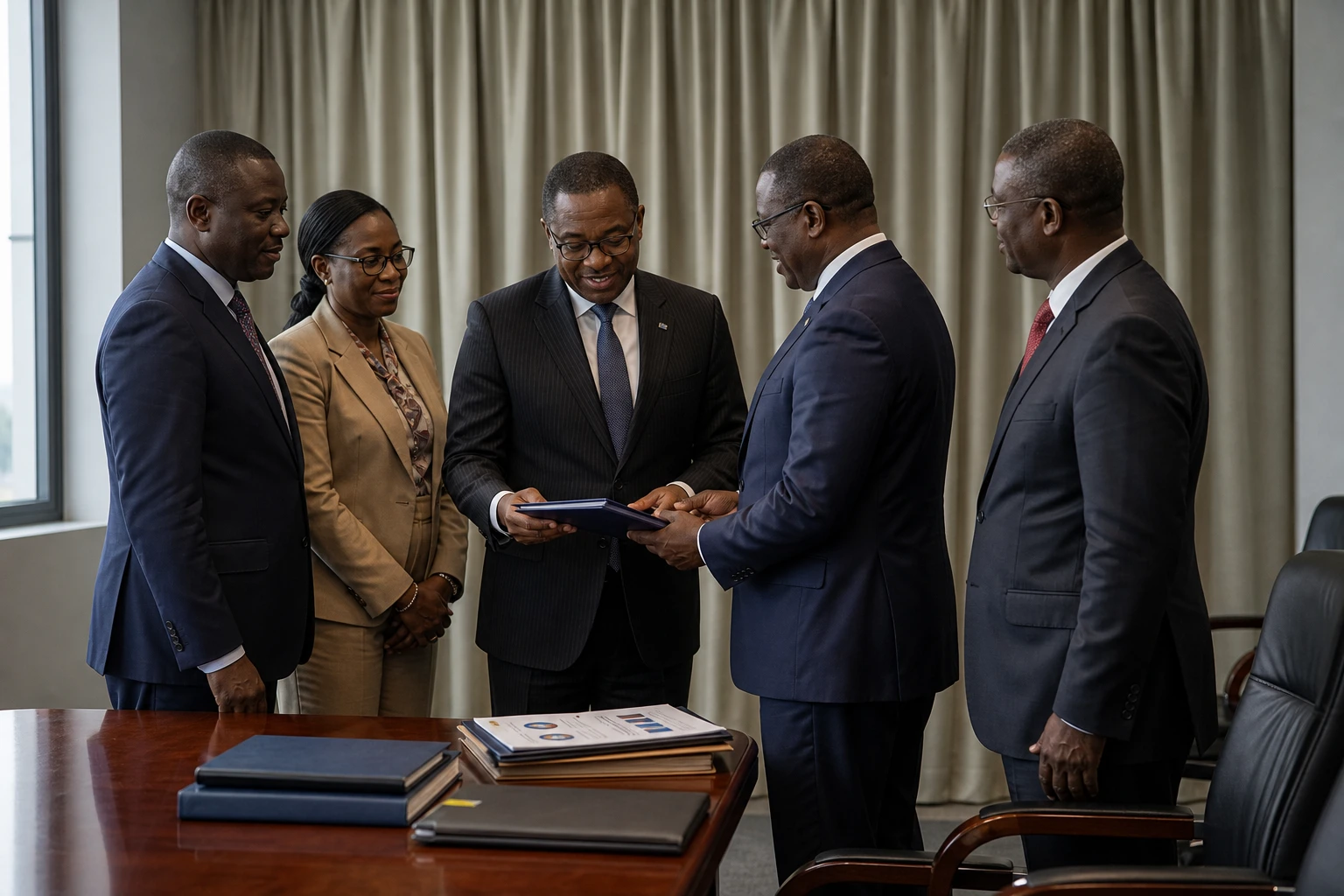
Ghana seeks to finance its gold without burdening the central bank
In Ghana, artisanal gold is no longer just a matter of extraction. It has become an instrument of cash management, reserves and economic sovereignty. In Accra, the state is now seeking to have its gold purchases financed by the banking market rather than the Bank of Ghana, in a bid to keep the arrangement lighter on the public balance sheet.
The change is significant for a country where gold carries considerable weight in exports and in management of the cedi. The reform comes as the Bank of Ghana itself acknowledged in its 2025 financial statements that the gold-for-reserves programme had involved substantial flows of purchases and sales of doré, with stocks turned over quickly to generate foreign currency.
From public pre-financing to a more commercial arrangement
The process accelerated in 2025 and 2026. The Ghana Gold Board, or GoldBod, was established by a law passed in March 2025 to regulate the purchase, assaying, refining and export of gold, particularly gold from artisanal and small-scale mining. Agence France-Presse reported at the time that the body was becoming the sole buyer and exporter in this segment, while the measure also sought to remove foreign operators from the local market.
On 21 July 2026, the Ghana News Agency reported that the Bank of Ghana was ending its pre-financing mechanism for GoldBod’s domestic purchases, with effect from 1 July 2026. A few days later, the central bank published guidelines on foreign-exchange intermediation linked to the domestic gold-purchasing programme, signalling that the arrangement was entering a more closely regulated phase. GoldBod, for its part, issued new procedures in July 2026 for accessing finance for gold purchases through aggregators.
On 11 August, chief executive Sammy Gyamfi described the shift as a quest for “operational independence”. Under the new model, GoldBod raises funds directly from commercial banks and buyers to finance its acquisitions, without going through the Bank of Ghana. An initial pilot financing of $75 million had already been announced as proof of concept.
Record volumes, but debate continues over the real cost
The issue can also be understood through the figures. GoldBod says it exceeded its initial export target of 100 tonnes in 2025, exporting about 103 tonnes of artisanal and small-scale gold worth an estimated $10.8 billion. The body also says these volumes helped capture foreign currency that had previously eluded the formal system.
At the same time, the cost of the mechanism has prompted questions. In its 2025 country report on Ghana, the IMF cited losses of $214 million linked to doré transactions under the Gold-for-Reserves programme, partly because of trading losses and intermediation fees. The Bank of Ghana later disputed any definitive interpretation before an audit, while GoldBod argued that this sum did not encapsulate either its performance or the programme’s economic outcome.
The Bank of Ghana’s 2025 financial statements confirm that the programme did operate as a mechanism for acquiring and rapidly reselling doré to generate foreign currency. They also show the scale of the flows: 2.91 million fine ounces purchased in 2025 and 2.89 million resold that year, with very small closing balances. In other words, the issue is not only the volume, but how price risk, fees and the payment chain are shared between the state, the central bank and intermediaries.
What the new structure means for producers, banks and the state
For artisanal miners, the main issue remains liquidity. A more bank-led financing system could smooth purchases, provided aggregators can access credit in time and at a sustainable cost. GoldBod published detailed rules in July 2026 on the guarantees required of Tier 2 buyers, signalling the state’s intention to secure funds while avoiding settlement delays.
For commercial banks, the reform opens up a financing market backed by an exportable asset, but also transfers some execution risk to them. The government is seeking to stop placing the same burden on the Bank of Ghana, whose role should remain monetary and prudential. This separation is consistent with explanations given by the central bank in its 2026 documents, which distinguish reserve management from the operational function of purchasing, now assumed by GoldBod under the new legal framework.
For Ghana’s government, the stakes are broader. The gold programme is intended to strengthen reserves, support the cedi and reduce reliance on more costly external financing. An economic report commissioned by GoldBod from the University of Ghana estimates that the formalisation of the gold trade brought an additional $3.8 billion in foreign-exchange gains in 2025, far exceeding the accounting losses cited elsewhere. Even if this is an institutional assessment, it shows that the debate concerns the model’s net value, not just the amount of gold purchased.
A Ghanaian issue, but a signal for West Africa
Ghana is not alone in this trajectory. Across West Africa, several states are seeking to capture more of the value of gold, curb smuggling and bring a highly informal activity into the banking system. Across ECOWAS, the issue touches on the circulation of foreign currency, the fight against illicit flows and states’ ability to turn mineral wealth into a macroeconomic instrument.
What happens next will depend on two tests. First, GoldBod’s ability to finance its purchases without cash-flow pressures or a return of arrears. Second, the Bank of Ghana’s ability to maintain robust reserves while leaving operational matters to the new body. The coming months will show whether the bank-led model genuinely reduces the public cost or merely shifts the risk to other players in Ghana’s financial system.



