Algeria
 Egypt
 Libya
 Morocco
 Sudan
 Tunisia
 Benin
 Burkina Faso
 Cabo Verde
 Côte d'Ivoire
 Guinea
 Guinea-Bissau
 Liberia
 Mali
 Mauritania
 Niger
 Nigeria
 Senegal
 Sierra Leone
 The Gambia
 Togo
 Cameroon
 Central African Republic
 Chad
 DR Congo
 Equatorial Guinea
 Gabon
 Republic of the Congo
 São Tomé and Príncipe
 Burundi
 Comoros
 Djibouti
 Eritrea
 Ethiopia
 Kenya
 Madagascar
 Malawi
 Mauritius
 Mozambique
 Rwanda
 Seychelles
 Somalia
 South Sudan
 Tanzania
 Uganda
 Angola
 Botswana
 Eswatini
 Lesotho
 Namibia
 South Africa
 Zambia
 Zimbabwe
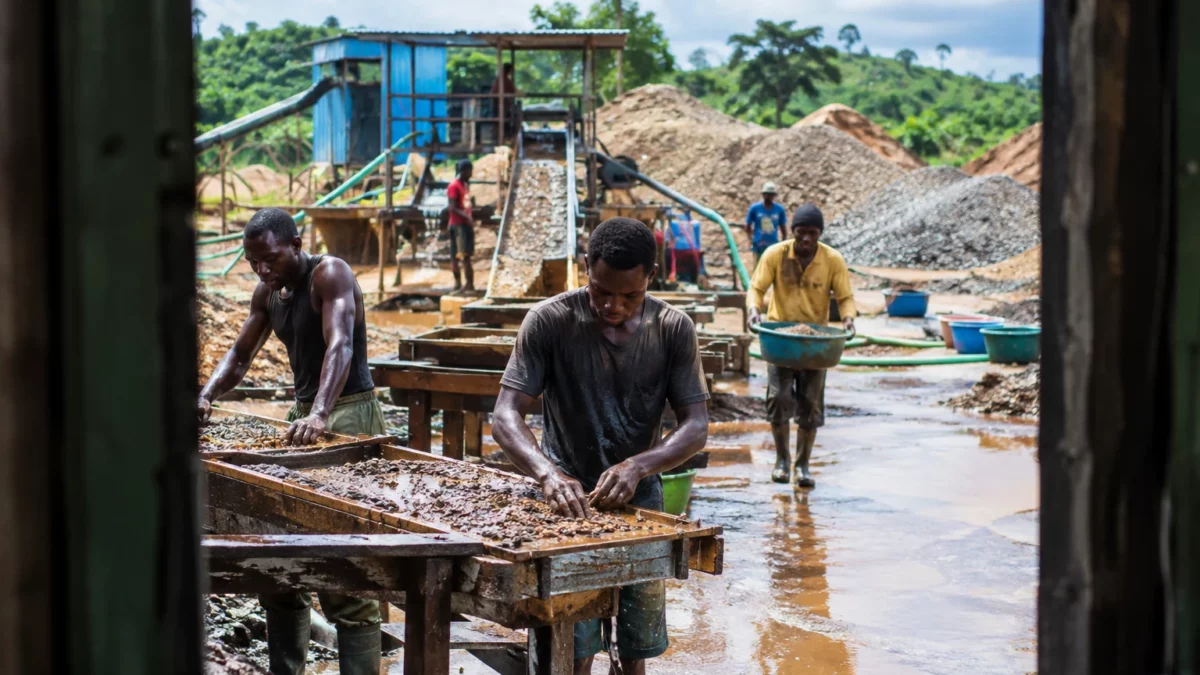
An application for a permit marks a new stage for the Enchi gold project in south-western Ghana. But it is neither permission to build nor a guarantee of production: regulatory review, technical studies and environmental approval remain outstanding.
A project facing an approvals test
Ghana plays a central role in West Africa’s gold sector. Accra is seeking to attract new investment while increasing the national benefits of extraction and tightening regulation of artisanal activities. This ambition is being pursued in a member country of ECOWAS, the Economic Community of West African States, where flows of minerals, capital and workers cross national borders.
Ghanaian production reached 5.94 million ounces in 2025, up 23.41% year on year, according to figures published by the Ghana Chamber of Mines and reported by the Ghana News Agency. This increase was driven mainly by small-scale mining, which accounted for 52.4% of the total, while production from large mines fell by 2.98%. The sector’s momentum is therefore not limited to future industrial projects. It also depends on how the country organises and controls artisanal activities.
It is against this backdrop that Newcore Gold, a Canadian mining company, filed an application for an Enchi mining permit on 19 November 2026. The application covers an area of 53.37 sq km within a 248 sq km project area. Ghana’s Ministry of Lands and Natural Resources is targeting a review that would result in the permit being granted in the first half of 2027. Newcore also says it expects a decision by mid-2027.
Forecasts still to be confirmed
The mining permit is a regulatory step, not a full green light for construction. After obtaining it, the company plans to apply for environmental approval from Ghana’s Environmental Protection Authority. Construction work and the start of production will then depend on decisions by the authorities and the continuation of project studies.
The figures currently being cited come from the pre-feasibility study published by Newcore. It envisages average production of 104,162 ounces of gold a year over 9.3 years, with about 130,000 ounces a year during the first three years. Initial investment is estimated at $351 million. These projections are not established results: a definitive feasibility study must still set out costs, technical plans and the economic conditions for development.
The distinction matters for public finances as well as neighbouring communities. Production forecasts alone do not show what share of revenues will stay in the country, how many jobs will be lasting or which Ghanaian companies will be able to take part in contracts. These effects will depend in particular on agreements reached, tax rules and local-content requirements. The figures announced by the company should therefore be read as project estimates, not as a promise of benefits that can already be measured.
Minister Emmanuel Armah-Kofi Buah has described Enchi as one of the most advanced large-scale gold projects under development in Ghana. He cited jobs, support for communities and national revenues among the potential benefits. This statement reflects the government’s position; it does not replace an independent assessment of economic and environmental impacts.
The question of local benefits
In Ghana, the expansion of gold mining is accompanied by debate over the formalisation of artisanal mining and the capture of revenues. The 2025 data underscore the growing weight of this segment, which surpassed large mines in its share of production. For the authorities, the challenge is to capture more of the metal’s value and ensure that rules are followed. For communities, it also concerns access to jobs, protection of land and water, and the distribution of benefits.
An industrial mine such as the one envisaged at Enchi does not automatically answer these questions. It is governed by a project-specific permitting and study framework, while artisanal activity involves other operators and control mechanisms. Comparing the two segments nevertheless shows why volumes alone are not enough to measure the sector’s success: traceability, the legality of extraction and local benefits also matter.
The next concrete milestone will therefore be the outcome of the permit review, expected in the first half of 2027 according to the ministry. The environmental process and completion of feasibility studies will follow. Until these steps are completed, the timetable for any potential construction remains conditional.
A signal being watched beyond Ghana
Enchi illustrates a question shared by several West African producer countries: how to attract capital to develop mines while retaining a greater share of the value and limiting environmental and social costs. The project is therefore of interest to investors and regional authorities, as well as to people living near extraction sites.
Ghana has a significant gold sector, but the change in its production shows that large mines are only part of the picture. The Enchi permit will indicate Accra’s ability to advance an industrial project within an announced regulatory framework, while the 2025 results are a reminder that artisanal activity now accounts for a substantial share of national volumes. The decision expected in 2027 will show where the project stands administratively; on its own, it will not settle the question of how benefits are shared.