Algeria
 Egypt
 Libya
 Morocco
 Sudan
 Tunisia
 Benin
 Burkina Faso
 Cabo Verde
 Côte d'Ivoire
 Guinea
 Guinea-Bissau
 Liberia
 Mali
 Mauritania
 Niger
 Nigeria
 Senegal
 Sierra Leone
 The Gambia
 Togo
 Cameroon
 Central African Republic
 Chad
 DR Congo
 Equatorial Guinea
 Gabon
 Republic of the Congo
 São Tomé and Príncipe
 Burundi
 Comoros
 Djibouti
 Eritrea
 Ethiopia
 Kenya
 Madagascar
 Malawi
 Mauritius
 Mozambique
 Rwanda
 Seychelles
 Somalia
 South Sudan
 Tanzania
 Uganda
 Angola
 Botswana
 Eswatini
 Lesotho
 Namibia
 South Africa
 Zambia
 Zimbabwe
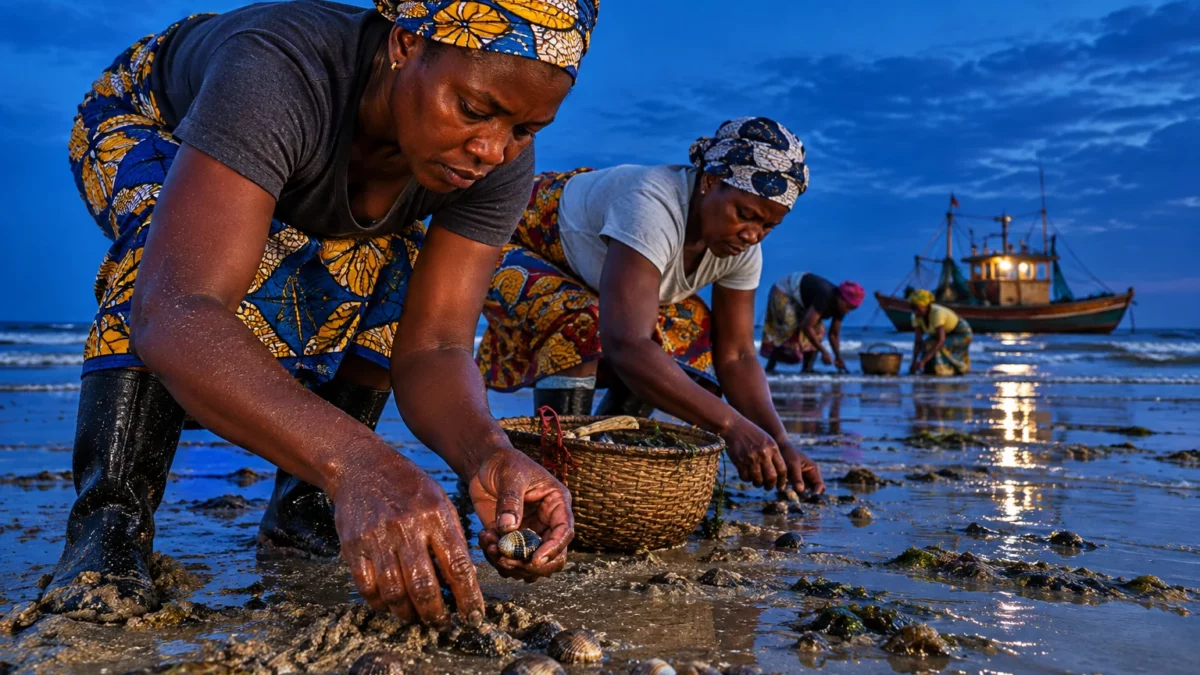
At Cap Estérias, north of Libreville, the low tide reveals more than shellfish. It brings to light coastal knowledge passed down by Benga women: recognising traces in the sand, harvesting razor clams and preparing dishes whose names vary from one language to another. The challenge is to document these practices without detaching them from the communities that keep them alive.
On Gabon’s coast, women are the custodians of knowledge
In October 2026, chef and content creator Kwame Asié accompanied women fishers from the Lambi La Mbocka cooperative near Libreville, Gabon’s capital. Of Nigerian and Ghanaian descent, aged 32 and followed by around 50,000 people, he films and photographs local practices. He is interested in razor clams, oysters and sea snails eaten by the Benga, a coastal people of the country.
The women are not mere supporting figures in this documentation work. They hold practical knowledge: how to spot shellfish, harvest and prepare it, and pass on its uses. Stella Ehebo Eyavo, a member of the cooperative, describes razor clams as a Benga inheritance, linked to the roots and everyday life of her community.
After the catch, the shellfish are shucked and washed before being used to prepare “mehènènès” in the Benga language, also called “issènènès” in more common Gabonese usage. The name, technique and marine environment together form a single heritage. Reducing the recipe to a list of ingredients would lose part of its story.
Documenting without erasing languages
Asié describes himself as a “culinary archivist”. His ambition goes beyond publishing recipes: he wants to connect cuisine, geography and anthropology, and preserve knowledge often passed on orally. He also notes that translation, particularly into English, can erase nuances. Keeping the original terms helps preserve ways of naming and understanding food.
This work is part of a movement already driven by local actors in Gabon. In 2021, the Gabonese outlet Gabonreview featured a collection of 38 recipes from Gabon’s nine provinces, published in French, English and vernacular languages. This initiative is a reminder that culinary archiving did not begin with social media: creators, families and communities are already building their own ways of passing on knowledge.
The question is also who controls the narrative. Filming a practice can make it visible to a wider audience, but visibility does not guarantee that those who hold the knowledge retain control over it. Who chooses which images are shared? How are names and uses credited? These issues matter particularly when community knowledge circulates on global platforms.
From West Africa to the Gulf of Guinea
Asié’s journey spans different culinary traditions. He says he has travelled across West Africa, from Senegal to Sierra Leone and Liberia, before continuing his route in Central Africa. His stated plan is to visit all 54 countries on the continent in three years. This timetable and the scale of the mission are the targets he has set himself; they do not mean that every heritage can be documented exhaustively.
Bringing cuisines together should not blur their differences. Ingredients or techniques may be found from one country to another, but their meaning depends on local languages, environments, histories and practices. Gabon, on Central Africa’s Atlantic coast, offers a distinctive coastal perspective: the ocean feeds communities along the shore and shapes knowledge of tides, species and their preparation.
In a report broadcast by TV5MONDE on 19 November 2026, Asié explains that understanding a food also means understanding its environment. This shifts the focus: cuisine is not confined to the table. It depends on ecosystems, harvesting practices and relationships between communities and their land.
Cultural exchange brings responsibilities
Asié uses the term “gastrodiplomacy” to describe how food can bring people and regions closer together. The term refers to the use of cuisine as a space for cultural encounters. In exchanges between West and Central Africa, this approach can introduce products and techniques that are less well known outside their region of origin. It does not, however, by itself change the living or working conditions of women fishers.
For the women of Lambi La Mbocka, fishing and preparing shellfish are first and foremost skills rooted in their community. For online audiences, the images offer a window on these practices. For chefs and researchers, they can provide a starting point, provided the knowledge holders are credited and their words respected. The circulation of images therefore makes attribution as important as the recipe itself.
Asié’s project gives continent-wide visibility to cuisines often discussed at family or local level. But its value will also be measured by the space it gives to the voices encountered along the way: Gabonese women fishers, like cooks and producers in other countries, must remain at the centre of the documentation. Only then can culinary bridges between regions bring stories together without making cultures uniform.