Algeria
 Egypt
 Libya
 Morocco
 Sudan
 Tunisia
 Benin
 Burkina Faso
 Cabo Verde
 Côte d'Ivoire
 Guinea
 Guinea-Bissau
 Liberia
 Mali
 Mauritania
 Niger
 Nigeria
 Senegal
 Sierra Leone
 The Gambia
 Togo
 Cameroon
 Central African Republic
 Chad
 DR Congo
 Equatorial Guinea
 Gabon
 Republic of the Congo
 São Tomé and Príncipe
 Burundi
 Comoros
 Djibouti
 Eritrea
 Ethiopia
 Kenya
 Madagascar
 Malawi
 Mauritius
 Mozambique
 Rwanda
 Seychelles
 Somalia
 South Sudan
 Tanzania
 Uganda
 Angola
 Botswana
 Eswatini
 Lesotho
 Namibia
 South Africa
 Zambia
 Zimbabwe
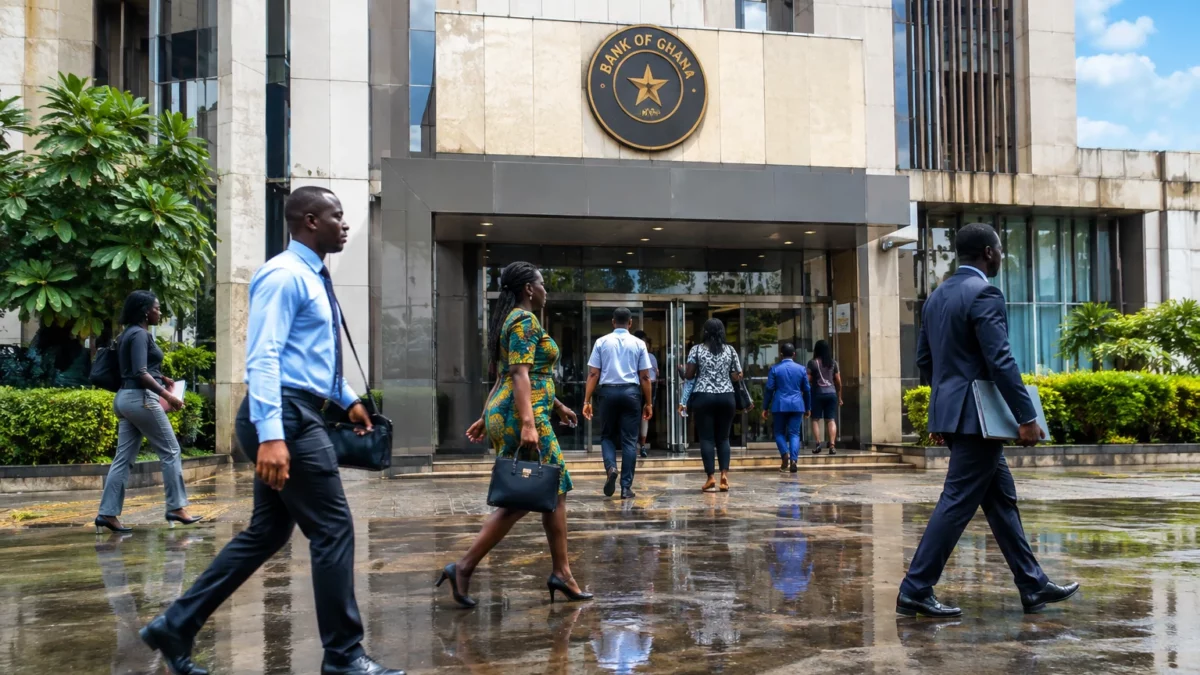
In Ghana, price rises are slowing, but households are not necessarily seeing their expenses fall. It is against this gap between macroeconomic indicators and the real cost of living that the Bank of Ghana has made its latest decision: to bring its benchmark rate closer to the lending conditions already prevailing in the market.
A monetary signal brought closer to prevailing rates
The Monetary Policy Committee lowered the policy rate from 14% to 11% at the end of its meeting held in Accra from 16 to 18 November 2026. It also replaced its 14-day market operations with 7-day operations and tightened the corridor around the policy rate, from plus or minus 400 to plus or minus 100 basis points. This corridor defines the range within which the central bank seeks to keep short-term rates.
The decision is therefore not simply a reduction in the official cost of money. The Bank of Ghana says money-market rates were already below the former policy rate. The published benchmark no longer fully reflected the cost at which banks were borrowing in the short term. By intervening more often and narrowing the corridor, the institution aims to manage liquidity more effectively and bring interbank rates closer to its new benchmark.
The committee is due to meet again from 18 to 20 January 2027. This next meeting will provide an opportunity to see whether the adjustment is passed through to lending rates and investment decisions, beyond the financial markets.
Disinflation, but pressures remain uneven
Annual inflation stood at 5.5% in October 2026, according to the Ghana Statistical Service, the national statistics office. The figure remains well below the levels recorded the previous year, but marks a third consecutive monthly increase: inflation was 5.2% in September. The overall fall in inflation does not mean that prices are declining; it mainly indicates that they are rising more slowly than before.
The average also masks differing trends. Food inflation slowed to 2.8% in October, while non-food inflation reached 7.9%, driven in particular by utility tariffs and fuel costs. The impact on households will vary according to spending, income and place of residence. Businesses, meanwhile, remain exposed to energy prices, transport costs and the financing of their working capital.
The central bank also reports an increase in credit to the private sector: 37.2% year on year in nominal terms and 30% in real terms. Its Composite Index of Economic Activity rose by 17.7% year on year in September, driven in particular by credit, exports, tourism and construction. These indicators point to robust activity, but on their own do not show how the gains are distributed among sectors, businesses and workers.
Fiscal headroom, with external conditions under scrutiny
The Bank of Ghana believes the fiscal position also made easing possible. In the first ten months of 2026, the fiscal deficit was 1% of gross domestic product, against a target of 3% for the period. The primary balance — which excludes interest payments on debt — showed a surplus of 1.4% of GDP. These provisional figures reflect more restrained budget execution than expected, without erasing the burden of debt service.
At the end of October, public debt stood at 759.3 billion cedis, or 47.5% of GDP. The central bank put it at 641.1 billion cedis, or 44.7% of GDP, at the end of December 2025. Lower rates may gradually reduce financing costs for some borrowers, but the effect will depend on the terms imposed by banks and confidence in economic stability.
The clearest cause for concern is foreign exchange reserves. On 17 November, they stood at $12.1 billion, equivalent to 4.4 months of imports, compared with $13.8 billion and 5.7 months at the end of 2025. At the same time, Ghana recorded a trade surplus of $13 billion between January and October, according to the central bank, supported in particular by gold exports. Outflows related to external payments and demand for foreign currency have nevertheless weighed on reserves.
The challenge: turning the adjustment into productive lending
For Ghanaian businesses, effective transmission could make financing more accessible and support investment. But a cut in the policy rate does not guarantee an equivalent reduction in the rates charged on loans. Banks also assess their clients’ risk, their own funding costs and the quality of loan applications. Small businesses, which are often less equipped to provide collateral, may therefore benefit more slowly from easing than larger companies.
The central bank must also prevent more plentiful credit from driving up demand for foreign currency at a time when reserves are falling. If imports rise faster than external earnings, the cedi could come under pressure and make imported goods more expensive. Conversely, keeping conditions too tight could curb investment and economic activity. The challenge is to strike a balance between supporting credit, price stability and external resilience.
The decision comes amid a West African economy in which monetary paths and external constraints differ from country to country. Ghana, a member of ECOWAS — the regional economic community of West Africa — retains its own currency and conducts monetary policy through its central bank. Its experience is a reminder that the policy rate does not act alone: fiscal management, exports, imports and confidence in the currency also influence financing conditions.
The next monetary policy meeting, in January 2027, will therefore be assessed against several indicators: inflation trends, the rates actually offered to borrowers, private-sector activity and the level of reserves. The impact of the cut will depend less on its announcement than on whether it reaches businesses and households without creating renewed pressure on prices or the foreign exchange market.